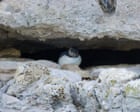
For three long decades, birdwatchers and conservationists standing atop the breezy cliffs of Purbeck had almost given up. They peered through binoculars at Dancing Ledge near Langton Matravers, watching six lonely Atlantic puffins flutter against the limestone face. The adults kept coming back every spring, mating, and even carrying fish deep into the rock fissures. But season after season ended in silence. No chicks ever emerged. Most experts quietly assumed the last breeding colony on mainland England's southern shoreline was dead in the water.
That assumption changed on a quiet July evening.
Just after 7:00 PM on July 7, 2026, a tiny grey-beaked chick—known as a puffling—poked its head out from a dark crevice roughly two meters deep in the cliffface. A team of researchers who had anchored a chartered boat beneath the cliffs caught the moment on camera. It was the first verified puffling sighting on the Dorset coast in 30 years.
Purbeck Puffin Population Timeline

1930s-1950s : ~80 breeding birds along the cliffs
1975        : Dropped to 23 birds
2026        : Just 3 breeding pairs (6 adults total) remaining
July 2026   : 1 puffling successfully fledges (First in 30 years)
Why This Single Chick Matters So Much
One chick doesn't magically fix a collapsing population. Nobody is claiming the Purbeck colony is suddenly safe. But this single fledged bird proves three critical things that scientists weren't sure about anymore.
First, it proves these remaining Purbeck puffins can still produce fertile eggs. Second, it shows the adults can find enough sprats, sand eels, and small fish in the English Channel to feed a growing mouth. Third, it confirms that a chick can actually avoid predators long enough to reach fledging age.
Dr Richard Caldow, a marine ornithologist with nearly 40 years of coastal bird experience leading the monitoring project alongside the Purbeck Natural History Forum, summed it up perfectly while out on the water. Every chick matters when you only have three pairs left. One puffling alone won't save the site, but one is light-years better than zero.
Fifteen Weeks of Precarious Cliff Watching
Finding this chick wasn't a stroke of dumb luck. It took 15 weeks of painstaking, sweat-drenched effort from 13 dedicated volunteers who logged roughly 150 hours of monitoring time along the precarious coastal paths near Spyway.
Back in April 2026, the team counted exactly six adult puffins returning to Dancing Ledge. By late May, volunteers noticed adults carrying tiny fish in their beaks into two separate cliff crevices. That was the classic sign that eggs had hatched and parents were feeding hungry young.
The drama escalated in mid-June.
Deliveries to one of the crevices suddenly stopped after June 12, signaling that the chick inside likely died or fell victim to a predator. But fish drops to the second crevice kept happening daily right up until July 5.
Knowing that puffin chicks usually fledge between 38 and 44 days after hatching, Dr Caldow calculated that the surviving chick was roughly 38 days old by early July. Pufflings usually venture toward the edge of their dark burrows in the evening, often right next to a parent.
On July 7, the monitoring team chartered a boat to anchor beneath the sheer cliffs from 4:00 PM to 8:00 PM. They waited three agonizing hours in the swells. Then, at 7:07 PM, the puffling stepped into the light behind its parent.
By the following morning, the chick was gone. It almost certainly fledged under the cover of night, taking its leap of faith into the ocean.
What Happens to the Puffling Now
Unlike many seabirds, puffin parents don't guide their young once they leave the nest. They don't teach them how to hunt or navigate.
The Dorset puffling is now out in the Atlantic Ocean entirely on its own. It will spend the next two to three years living at sea without touching land. If it survives the winter storms and marine predators, it might return to the Purbeck cliffs around 2028. However, puffins don't reach breeding maturity until they're about four or five years old, meaning this bird won't raise its own young until at least 2030.
There's also no guarantee it will come back to Dorset. While puffins generally display high site fidelity—meaning they like to nest where they hatched—young birds sometimes colonize other sites across Skomer Island in Wales or the Farne Islands up north.
Solved Puzzles and High-Tech Trail Cameras
Why did the Dorset colony collapse from 80 birds in the 1950s down to three pairs today?
For a long time, people blamed food scarcity due to warming ocean currents pushing sand eels northward. Others pointed to human disturbance from coasteering and climbing. But recent evidence paints a different picture. Food around Purbeck seems fairly healthy, with plenty of small fish observed in adult beaks. Furthermore, climbing restrictions during nesting season have kept human intrusion low.
The prime suspect for the 30-year breeding slump is egg and chick predation inside the deep, dark rock fissures. Invasive rats, crows, and peregrine falcons can easily wipe out a nest before the parents can defend it.
To figure out what is happening inside the rock, high-rope experts working with Ben Cooke, the National Trust's rivers and coast project officer in Purbeck, installed solar-powered, motion-sensor cameras deep inside the nesting fissures earlier this spring.
These cameras operate silently two meters inside the rock. Once the breeding season wraps up, conservationists will retrieve the gear and analyze thousands of recorded frames. Those photos will show precisely what happens inside the darkness when human eyes aren't watching.
How to Help Dorset Coastal Wildlife Today
If you want to support the fragile seabird population along the South West Coast Path, here is how you can take action right now.
- Watch from the sea, not the ledge. Avoid scrambling down the cliffs near Dancing Ledge or Spyway during breeding season (April through July). Take commercial boat tours operated out of Durlston Country Park or Birds of Poole Harbour to spot seabirds safely without causing stress.
- Support local monitoring groups. Donate or volunteer with organizations like the National Trust Purbeck team or local Wildlife Trusts that maintain cliff safety zones and monitor nesting sites.
- Report ringed bird sightings. If you are a coastal hiker or mariner who spots ringed puffins or other auks along the English Channel, log your sightings with the British Trust for Ornithology (BTO) to help track survival rates.