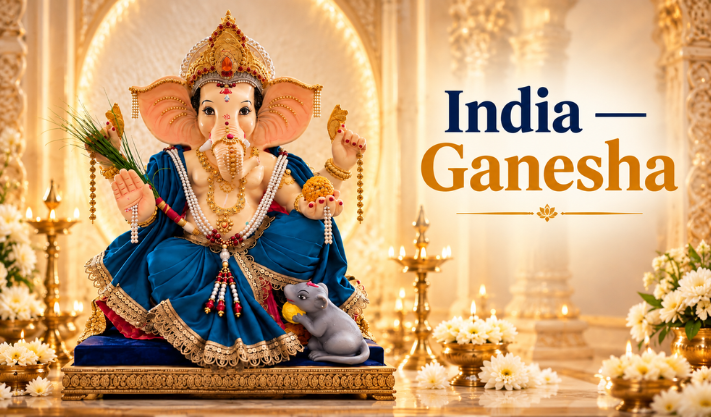
Most travelers assume Ganesha belongs exclusively to the bustling streets of Mumbai during Ganesh Chaturthi. They picture clay idols dissolving in the Arabian Sea, massive public processions, and mountains of sweet modaks stacked high on silver trays. That view is far too narrow. Honestly, the elephant-headed deity has traveled further and morphed into more fascinating cultural forms than almost any other figure from South Asian history. You aren't just looking at a local Hindu icon when you examine Ganesha across international borders. You are tracking centuries of migration, merchant trade, and religious syncretism that reshaped spiritual practice across half of Asia.
If you want to understand why Ganesha resonates from Tokyo temples to Balinese stone carvings, you have to throw out the modern textbook idea of strict religious borders. Ancient people didn't care about rigid boxes. Traders, monks, and rulers carried stories across oceans and mountains. They adapted what worked. They took a deity known for clearing obstacles and rewired him to fit local kings, local arts, and local fears. Let's look at how this actually played out across ten distinct regions.
The Mechanics of Ancient Cultural Export
How did an elephant-headed god leave the Indian subcontinent without an army? Simple: commerce and diplomacy. Between the first and tenth centuries, maritime trade routes buzzed across the Bay of Bengal. Indian merchants sailed to Southeast Asia, bringing sacred texts, architectural blueprints, and stone-carving traditions with them. Local rulers in places like Java, Cambodia, and Champa welcomed these ideas because they legitimized royal authority.
But locals didn't just copy-paste Indian religion. They localized it immediately. They gave the deity new names, adjusted his iconography to match local aesthetics, and folded him into existing indigenous belief systems. That flexibility is why Ganesha survived the rise of Buddhism, the spread of Islam, and modern secularization.
When you study Sanskrit inscriptions found in ancient Southeast Asian ports, you realize that religious exchange was a two-way street. Local scholars traveled to Indian universities like Nalanda, returning home with new philosophical frameworks that blended fluidly with local animist practices. Ganesha sat at the center of this cultural melting pot because his domains of wisdom, new beginnings, and obstacle removal appealed universally to traders facing dangerous sea voyages and kings trying to stabilize shaky dynasties.
Thailand and the Artistic Identity of Phra Phikanet
Step into Thailand and you will meet Phra Phikanet. He isn't tucked away in a dusty corner. He is everywhere. You see his statues outside major television networks, art academies, and government buildings. Thai culture treats him as the ultimate patron of the creative arts, fine arts, and academic success. Silpakorn University, Thailand's premier fine arts institution, famously features Ganesha on its official emblem.
Thai artists approach Phra Phikanet with immense reverence. Actors, dancers, and musicians pray to him before major performances or product launches. The visual representation here often features a sleeker, more ornate silhouette than the stout, heavy-bellied idols common in parts of India. Crowns are taller, body lines are sharper, and the overall aesthetic reflects classical Thai court art. It proves that religious imagery adapts to local artistic standards over time, shedding heavy regional stereotypes to become truly indigenous.
Buddhist Transformations in Japan and Myanmar
Things get wilder when you travel further north and east. In Japan, Ganesha morphed into an esoteric Buddhist deity called Kangiten, or Shoten. You won't find him in ordinary Zen temples. Instead, he belongs to esoteric traditions like Shingon and Tendai Buddhism, introduced via China and Korea centuries ago. Japanese depictions often show dual figures locked in a tight embrace, symbolizing the union of opposing cosmic forces, spiritual awakening, and mundane desires. That is a massive conceptual leap from the traditional remover of obstacles sitting quietly in a South Asian bazaar.
Meanwhile, down in Myanmar, the deity is known as Maha Peinne. Burmese culture absorbed him through centuries of contact with neighboring traditions. Rather than remaining a purely orthodox Hindu figure, Maha Peinne became woven into the local spiritual fabric, sitting comfortably alongside traditional local spirit worship known as nat veneration. People in Myanmar didn't see a theological contradiction. They saw a powerful protector who belonged in their spiritual ecosystem, offering stability in a volatile political climate.
Stone Monuments Across Cambodia Indonesia and Vietnam
If you love archaeology, Southeast Asia offers physical proof of Ganesha's ancient reach. Cambodia's ancient Khmer empire left behind stunning stone sculptures of Ganesha at temple sites like Angkor Thom and Banteay Srei. Khmer artists carved him with distinct facial features, different crown designs, and unique body proportions that separate them cleanly from Indian prototypes. Some early Khmer representations show Ganesha wearing simple monastic garments or standing in dynamic martial poses, reflecting royal ambitions.
Down in Indonesia, Bali remains a living museum of this shared heritage. Balinese Hinduism places Ganesha at temple gates, crossroads, and sacred caves like Goa Gajah, the Elephant Cave. He guards thresholds against negative spiritual energy. Further north, the ancient Champa civilization in Vietnam left behind weathered sandstone carvings of Ganesha at sanctuaries like Mỹ Sơn. These artifacts prove that Indian iconography found a permanent home in coastal Vietnam long before modern national borders existed, surviving centuries of tropical decay and wartime destruction.
The Living Devotion of Sri Lanka and Malaysia
Move toward South and Southeast Asian diaspora communities, and the worship takes on a deeply personal, devotional rhythm. In Sri Lanka, Tamil communities know him as Pillaiyar. Shrines to Pillaiyar dot the island, serving as community anchors where families seek blessings before weddings, exams, or long journeys. Historical temples like the Nallur Kandaswamy temple complex incorporate vibrant shrines to Pillaiyar, ensuring his role as the primary opener of ways remains central to daily Tamil life.
Malaysia tells a similar story. Driven by historical migration patterns from Tamil Nadu during the colonial era and earlier trade periods, Malaysian Hindus built thousands of temples where Vinayagar and Pillaiyar hold pride of place. You can walk into a bustling urban temple in Kuala Lumpur and watch devotees perform specific rituals, breaking coconuts on the pavement to shatter ego and clear the path ahead. The practice is ancient, but it survives because people keep it alive in their daily routines, adapting old traditions to modern urban realities.
Shared Sacred Space in the Kathmandu Valley
Nepal offers perhaps the most fluid blending of Hindu and Buddhist traditions regarding Ganesha. In the Kathmandu Valley, you can find shrines where both Hindu priests and Buddhist practitioners offer worship to the same elephant-headed deity. He is known locally in various forms, including Surya Vinayak and the fierce dancing form known as Heramba.
Nepalese artisans developed distinct craftsmanship styles, casting dynamic, multi-armed forms of Ganesha with intricate metalwork and stone carving. The local legends here tie Ganesha directly into the geography of the valley, making him a local guardian rather than a foreign import. When you visit Kathmandu, you realize that dividing traditions into neat categories is entirely useless. The people living there never bothered with those artificial lines.
Moving Past Misconceptions About Global Traditions
People often make the mistake of viewing global religious traditions through a single, static lens. They think if a deity originates in one place, every foreign practice must be an imitation or a dilution. That view misses the human element entirely. Culture is a living conversation. When communities adopt a symbol, they infuse it with their own struggles, hopes, and artistic genius.
Ganesha didn't conquer Asia through military might. He conquered it through adaptation. By offering comfort, creative inspiration, and a psychological anchor during times of change, he became whatever people needed him to be. That is why an office worker in Bangkok, a Shingon monk in Kyoto, and a temple dancer in Bali all connect with the exact same elephant-headed silhouette while experiencing entirely different cultural realities.
Actionable Steps to Deepen Your Knowledge
If you want to move beyond surface-level travel articles and genuinely understand this cultural legacy, stop scrolling through generic photo galleries. Take concrete steps to study the history properly.
- Visit major Asian art wings in international museums, paying close attention to Khmer, Champa, and Javanese stone sculptures to spot regional stylistic differences.
- Read primary academic texts on maritime trade routes across the Bay of Bengal to understand how iconography traveled through commercial networks.
- Speak with cultural anthropologists or historians specializing in Southeast Asian religious syncretism to grasp how local populations reinterpreted imported deities.
- Plan field visits to actual historical sites like Goa Gajah in Bali or ancient temple complexes in Cambodia to see how architecture integrates these deities into the surrounding environment.