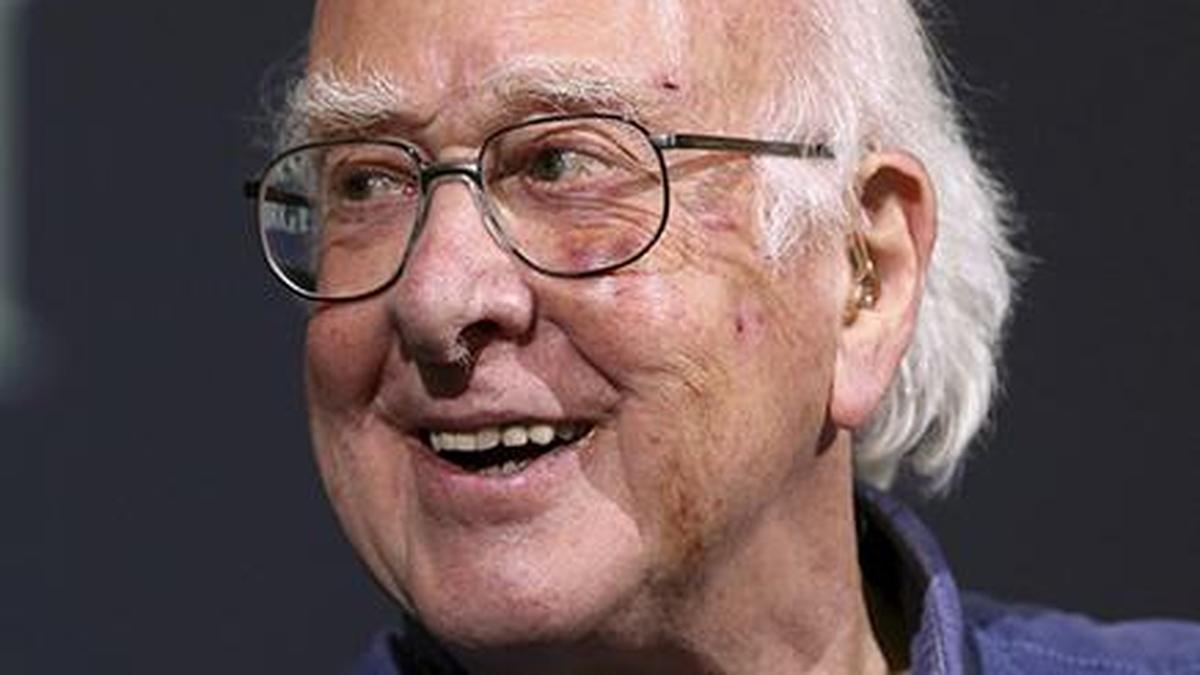
We spent nine billion dollars to find a particle because an unassuming man had a hunch in 1964.
When Peter Higgs passed away peacefully at his home in Edinburgh at the age of 94, the world paused to remember the scientist who gave his name to the most famous subatomic particle in human history. Most news alerts focused on the typical talking points. They called it the "God Particle" and talked about the massive machines at CERN. If you found value in this post, you should look at: this related article.
But the real story of Peter Higgs is much weirder, quieter, and more vital than the standard headlines suggest.
Many people think Higgs was an aggressive, career-driven physicist who spent his life chasing glory. He wasn't. He was a deeply modest man who didn't own a mobile phone, despised the internet, and actually shed tears when scientists finally proved he was right after five decades of waiting. For another angle on this story, see the latest update from The New York Times.
Understanding what he did changes how you view everything around you. Without his theory, nothing would exist. Literally.
The Day Physics Changed on a Walk in the Scottish Highlands
In the early 1960s, particle physics hit a massive wall.
Scientists had a beautiful set of equations to describe the universe, but there was a glaring flaw. The math only worked if every single fundamental particle had absolutely zero mass.
That clearly wasn't true. You have mass. The computer or phone you are holding has mass. If electrons and quarks were weightless, they would zip across the cosmos at the speed of light, never forming atoms, molecules, planets, or people. The universe would be a featureless, chaotic blur of radiation.
The big question was simple. Where does mass actually come from?
In 1964, Peter Higgs went for a walk in the Cairngorms National Park in Scotland. He came back to his office at the University of Edinburgh with a radical idea. He suggested that the universe is filled with an invisible, all-pervading background medium. We now call this the Higgs field.
Think of it like a cosmic molasses. Some particles, like electrons, have to push hard through this invisible field, slowing down and gaining what we perceive as mass. Other particles, like photons of light, glide through it without noticing a thing, remaining completely weightless.
When Higgs wrote his short paper about this mechanism, his first draft was actually rejected by a journal. They thought it was just a mathematical quirk with no real real-world application. He added a few paragraphs to the end, pointing out that this invisible field should leave behind a telltale signature: a single, heavy subatomic particle.
That particle became known as the Higgs boson.
Why the God Particle Label Rubbed Higgs the Wrong Way
You cannot talk about Peter Higgs without addressing that famous nickname.
Leon Lederman, a Nobel laureate physicist, wrote a popular science book about the search for the missing piece of the universe. He wanted to call it the "Damned Particle" because it was so impossibly difficult to find. His publisher thought that was too controversial and changed it to the "God Particle."
Higgs hated it.
He was an atheist and felt the name was an unnecessary distraction that offended religious people while misrepresenting the actual science. It wasn't a divine entity. It was an essential gear in the clockwork of the cosmos.
The name stuck anyway, much to his enduring annoyance. For decades, Higgs preferred to slip into the background. He didn't want the fame. He didn't seek the spotlight.
While other physicists built massive careers on self-promotion, Higgs stayed in Edinburgh, teaching students and living a remarkably low-tech life. He famously skipped the announcement of his own Nobel Prize win in 2013, opting instead to go out for a quiet lunch of soup and sea bass, followed by a stroll through an art exhibition. The Nobel committee couldn't even reach him because he didn't carry a phone. He found out he won when a former neighbor stopped him on the street to congratulate him.
The Fifty Year Hunt Under the French Swiss Border
Proving a theory from 1964 required building the largest machine ever constructed by human beings.
The European Organization for Nuclear Research, or CERN, spent decades designing and constructing the Large Hadron Collider. It is a giant 27-kilometer ring of superconducting magnets buried deep underground beneath the border of France and Switzerland.
To find the Higgs boson, scientists had to smash protons together at nearly the speed of light. The goal was to recreate the extreme, high-energy conditions that existed just a trillionth of a second after the Big Bang.
It was an administrative and engineering nightmare. It required the cooperation of thousands of scientists from dozens of nations, all hunting for a particle that decays into other things almost instantly. It took trillions of proton collisions to collect enough data to be absolutely sure.
On July 4, 2012, CERN held a historic press conference. Peter Higgs was invited to sit in the auditorium. When the data screens showed a clear, undeniable bump at 125 gigaelectronvolts, the room erupted.
The theory was real. The missing piece of the Standard Model had been found.
Higgs sat in the crowd, took off his glasses, and wiped away tears. He told the audience that he never expected to see this discovery happen during his lifetime. It remains one of the most emotional moments in modern science.
The Problem With Modern Science According to Higgs
Before his passing, Higgs voiced a major concern about the state of modern research. He openly doubted whether an idea like the Higgs boson could be discovered in today's academic environment.
He believed the intense pressure on modern academics to constantly collaborate, publish papers, and secure immediate funding leaves no room for quiet reflection. He felt the system had become too corporate.
Higgs was a man who valued peace and quiet to think through complex mathematical problems over years, not weeks. He published fewer than ten papers during his entire career after his breakthrough. By today's metrics, a university might consider that unproductive.
That is a sobering thought for the future of discovery. If our current system discourages the deep, solitary thinking that led to the discovery of how matter gets its mass, what else are we missing?
What Happens Next in Particle Physics
The story doesn't end with the death of Peter Higgs or the discovery in 2012.
Physicists are currently using the Large Hadron Collider to measure the properties of the Higgs boson with extreme precision. They want to know exactly how it interacts with other particles. There are still massive mysteries left unsolved.
We still don't know what dark matter is made of, and the current Standard Model doesn't explain gravity. Some theorists believe the Higgs boson might act as a portal to undiscovered physics, interacting with dark matter in ways we can't yet see.
European physicists are already planning the next generation of particle smashers, like the Future Circular Collider, which would be four times larger than the current ring.
If you want to understand the legacy of Peter Higgs, don't look at the awards or the old news clips. Look at the fact that human beings are still willing to dig giant tunnels and spend billions of dollars just to understand the invisible rules of our reality. He showed us that a quiet walk in the woods can sometimes unlock the deepest secrets of creation.
If you are fascinated by how the universe works, read up on the ongoing experiments at CERN or look into the current debates surrounding the Future Circular Collider. The hunt for what lies beyond the Standard Model is wide open.