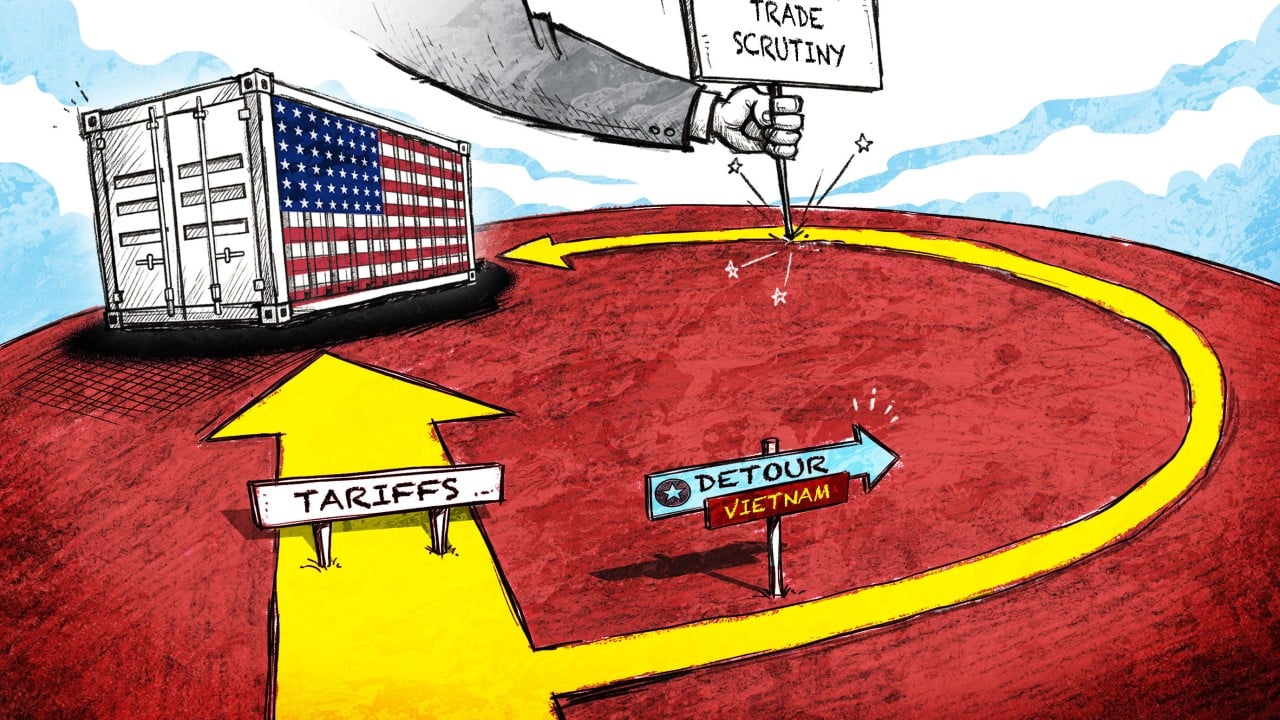
For years, the playbook for dodging Washington's trade restrictions seemed simple. If you were a factory owner in Shenzhen facing 25% duties, you didn't panic. You packed your machinery, moved it a few hours south across the border, and slapped a "Made in Vietnam" sticker on your boxes.
It felt like a flawless workaround. Ship your goods through the Vietnam detour, watch the US-bound Chinese goods slip past customs, and keep the profits rolling.
But that detour just hit a massive, multi-nation concrete wall.
The fantasy of Vietnam as a friction-free backdoor for Chinese manufacturing is officially dead. Between aggressive US enforcement and a crushing geopolitical squeeze, the cost of masking Chinese origins has skyrocketed. If you are still relying on this backdoor, you are playing economic roulette with a fully loaded chamber.
The 40% Trump Penalty That Broken the Backdoor
The biggest blow came straight from Washington. Under the recent trade deal negotiated between the US and Hanoi, the rules completely changed. While standard Vietnamese goods face a steep 20% tariff—a painful jump from historical single digits—the real hammer drops on anything labeled as a transshipment.
The US now slaps a flat 40% tariff on transshipped goods that pass through or are lightly assembled in Vietnam using Chinese inputs.
This isn't a minor regulatory hurdle. It completely obliterates the cost advantage of rerouting. When you factor in the logistics of shipping components from southern China to Vietnamese hubs like Haiphong, paying local processing fees, and then facing a 40% tax at an American port, the math fails completely. It is cheaper to just manufacture somewhere else entirely—or pay the direct China duty.
Why Simple Relabeling is an Enforcement Nightmare
A lot of trade analysts assume the Vietnam detour failed because of simple customs paperwork. It is much deeper than that. The US customs apparatus, backed by data analytics and boots-on-the-ground intelligence, caught on to the scale of the operation.
Let's look at how the scam actually operated. A Chinese trading company would ship fully finished machinery, electronics, or solar panel components across the border to places like Mong Cai or Bac Luan. Once inside Vietnam, workers did little more than repackage the goods, swap out the crates, and apply for a fraudulent certificate of origin.
That doesn't work anymore. Vietnamese authorities, terrified of losing access to the lucrative US market, launched an aggressive internal crackdown. They've exposed thousands of fraudulent trade practices and origin-falsification schemes in a matter of months.
Hanoi is in a horrible position here. They run a massive trade surplus with the US, but they rely entirely on China for raw materials and intermediate inputs. They can't afford to anger Washington, but they also can't completely sever ties with Beijing. To survive, they have to prove to US inspectors that "Made in Vietnam" actually means what it says.
The Myth of the Clean Vietnamese Supply Chain
Many companies thought they were being clever by upgrading from "pure transshipment" to "partial assembly." They figured if they imported Chinese parts and put them together in a factory outside Hanoi, they would be safe.
They were wrong.
Vietnam’s domestic supply chain lacks depth. The country doesn't have the heavy basic industries, raw material processing, or advanced component manufacturing required to build complex goods from scratch. Take the electronics or textile sectors. Nearly half of the specialized components, synthetic fabrics, and machinery parts used in Vietnamese factories still come directly from China.
[Chinese Components] ──> [Vietnam Assembly] ── (40% Tariff Trigger) ──> [US Market]
When the US threshold for Chinese content is tight, even legitimate assembly factories get dragged into the tariff net. If your product relies heavily on Chinese sub-assemblies, US customs treats it as a Chinese product in disguise. The illusion of a clean, non-Chinese supply chain dissolves under scrutiny.
The Real Numbers Behind the Rerouting Illusion
The scale of this shift shows up clearly in the data, though it often gets misinterpreted. Critics point to Vietnam's ballooning trade deficit with China—which jumped significantly over the last couple of years—alongside its massive trade surplus with the US.
At first glance, it looks like massive, systemic cheating. But studies tracking individual firms reveal a more nuanced reality.
Pure illegal rerouting—literally swapping labels on a container—only accounts for a small single-digit percentage of the actual trade flow. The real volume is driven by genuine, albeit shallow, supply chain integration. Chinese companies aren't just smuggling boxes; they are setting up real operations in Vietnam.
But because those operations are completely dependent on Chinese supply networks, they trigger the exact same regulatory penalties. The distinction between a smuggler and a lazy manufacturer no longer matters to a US customs agent. Both get hit with the same punitive duties.
What You Need to Do Right Now
If you manage a supply chain or source products from Southeast Asia, the era of turning a blind eye to your suppliers' component origins is over. Expecting Vietnam to protect your margins against US-China trade friction is a losing strategy.
- Audit Your Tier 2 and Tier 3 Suppliers: You need to know exactly where your Vietnamese manufacturing partner gets their raw materials. If their sub-components are coming from a Chinese parent company, you are sitting on a tariff time bomb.
- Demand Verifiable Certificates of Origin: Do not just accept a stamped piece of paper. Require your suppliers to provide clear documentation of value-add manufacturing steps performed inside Vietnam.
- Diversify Beyond the Direct Neighbors: Look at manufacturing hubs that aren't physically contiguous or economically tethered to China's immediate orbit. Geographies with more mature, independent ecosystems are becoming the only viable way to mitigate geopolitical risk.