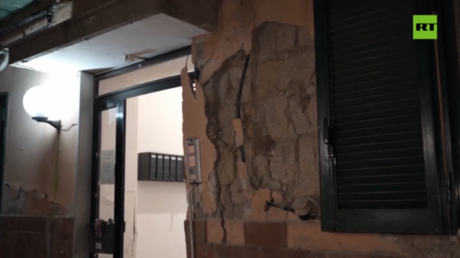
When a 2,000-pound Mark-84 bomb flattens a residential house on Qeshm Island, you don't need a military background to understand the devastation. You just need eyes. Yet, the official response from US Central Command remains a rigid script: "The US military never targets civilians."
That phrase gets repeated every time civilian infrastructure turns to dust. But official declarations don't erase thirty-foot craters in densely populated neighborhoods. Let's look at what actually happens when heavy ordnance meets urban geography, and why the gap between Pentagon policy and ground reality keeps growing.
The Anatomy of a High-Yield Strike
In the early hours of a Thursday morning, the Chah-Tangu neighborhood on Qeshm Island changed forever. A strike obliterated the home of Qeysar Jafari, a local taxi driver, his wife Zahra, and their young son Sina. Two other children survived, pulled from the wreckage with injuries, while roughly twenty neighboring households lost their homes to the blast wave and flying debris.
Visual investigations and munitions experts examining footage from the scene pointed straight to a massive weapon: a 2,000-pound Mark-84 conventional bomb, likely equipped with a JDAM precision guidance kit.
Why does the weapon choice matter? Because a bomb of that size is built to shatter reinforced concrete, underground bunkers, and heavy military installations. Dropping it into a tightly packed civilian area where independent analyses find zero military facilities raises glaring tactical questions. Even if the guidance system hits its exact coordinate, the sheer physics of a 2,000-pound explosive payload guarantees wide-area destruction. Sandy terrain might direct some blast force downward, but it doesn't contain the shockwave enough to spare neighboring structures.
The Pentagon Response Loop
When reporters press CENTCOM on these incidents, the answers follow a predictable pattern. They acknowledge awareness of reports. They mention ongoing investigations. They offer boilerplate assurances that protocols are followed, precautions are taken, and non-combatants are never the intended target.
Military transparency advocates point out a glaring flaw in this loop. Investigations rarely yield public accountability, and high-level commanders frequently downplay systemic collateral damage. When oversight committees ask about damaged schools, hospitals, or residential blocks, the baseline defense is often that adversary forces use human shields or operate out of populated sectors.
However, independent tracking groups and visual media investigations show a persistent pattern of heavy munitions landing far outside legitimate military perimeters. When a clock on a shattered living room wall stops ticking at 3:40 AM, right as CENTCOM logs its regional strike windows, the connection is difficult to dismiss with administrative denials.
Why Precision Can Still Mean Destruction
We live in an era where defense contractors market weapons as surgical tools. Laser guidance, GPS coordinates, and smart kits imply clinical accuracy.
The public assumes smart bombs only kill combatants. That assumption ignores the realities of modern ordnance. A precision guidance kit ensures a bomb hits the exact latitude and longitude it's programmed to strike. If that coordinate is placed near a civilian dwelling—or if intelligence misidentifies a target—the smart bomb becomes just as destructive as an unguided weapon.
Weighing strategic objectives against civilian safety is the core burden of modern warfare, but when multi-ton explosives hit family homes, the abstract strategy matters very little to the survivors staring at the rubble. The official stance protects the institution, but it leaves an unbridgeable gulf between military press releases and the ground-level cost of conflict.
Iran-Israel War: CENTCOM Chief Says US Struck nearly 2000 Iranian Targeted
This video provides additional context regarding CENTCOM's military operations and target assessments during the ongoing conflict involving US and Iranian forces.
http://googleusercontent.com/youtube_content/1