For years, marine conservationists treated seagrass restoration like a standard gardening project. You collect tiny seeds, scatter them across the muddy seabed, and cross your fingers. Most of the time, nothing happens. The seeds wash away, get eaten, or fail to germinate in the harsh marine environment. Britain's underwater meadows kept shrinking, leaving coastlines vulnerable and marine life without nurseries.
Then a community-led charity on the west coast of Scotland threw out the rulebook.
Instead of messing around with fragile seeds, the team at Seawilding started transplanting mature, living seagrass meadows directly. The results changed everything. In a recent trial at Loch Craignish in Argyll, they hit a staggering 97% shoot survival rate.
Why Seed-Based Restoration Keeps Failing
If you want to understand why this Scottish breakthrough matters, you need to look at why old methods flopped. Seagrass (Zostera marina) is a marine flowering plant that anchors entire coastal ecosystems. It absorbs carbon up to 35 times faster than tropical rainforests, stabilizes sediments, and provides safe breeding grounds for commercial fish stocks.
Despite these massive benefits, the UK has lost a staggering percentage of its historic seagrass beds since the early 20th century due to pollution, anchoring, and physical disturbance.
For a decade, restoration efforts relied heavily on seed collection. Volunteers would dive down, harvest seed capsules, process them in labs, and scatter them underwater. It sounds proactive. In practice, it has a miserable success rate. Germination rates are low, and tiny seedlings struggle against strong currents and shifting sands. You spend months of labor for very little return.
The Pivot to Mature Shoots
Seawilding didn't stumble into success overnight. According to Will Goudy, the organization's seagrass lead, the team spent years dealing with failed trials before changing tactics.
They stopped treating seagrass like annual flowers and started treating them like established plants.
The process involves carefully harvesting tens of thousands of adult shoots from healthy "donor" meadows and anchoring them directly into barren or degraded patches of the seabed. By skipping the fragile germination phase entirely, the plants get an immediate head start.
The numbers speak for themselves. In a trial plot planted at Loch Craignish, seabed coverage skyrocketed from 10% to over 70% in just 15 months. A subsequent trial recorded that 97% of the transplanted adult shoots survived, multiplying seabed coverage fourfold in a mere six months. Together, these efforts successfully established about 0.3 hectares of new, dense habitat.
What Happens to the Donor Meadows?
A natural worry comes up immediately. If you rip up adult plants to fix one area, aren't you just destroying another?
The charity tested this exact scenario. They monitored donor beds where up to 25% of the shoots had been harvested. The ecosystem impact turned out to be remarkably low. Within roughly five months, shoot density in the donor areas naturally bounced back to pre-harvest levels. The donor meadows absorbed the temporary loss without long-term damage.
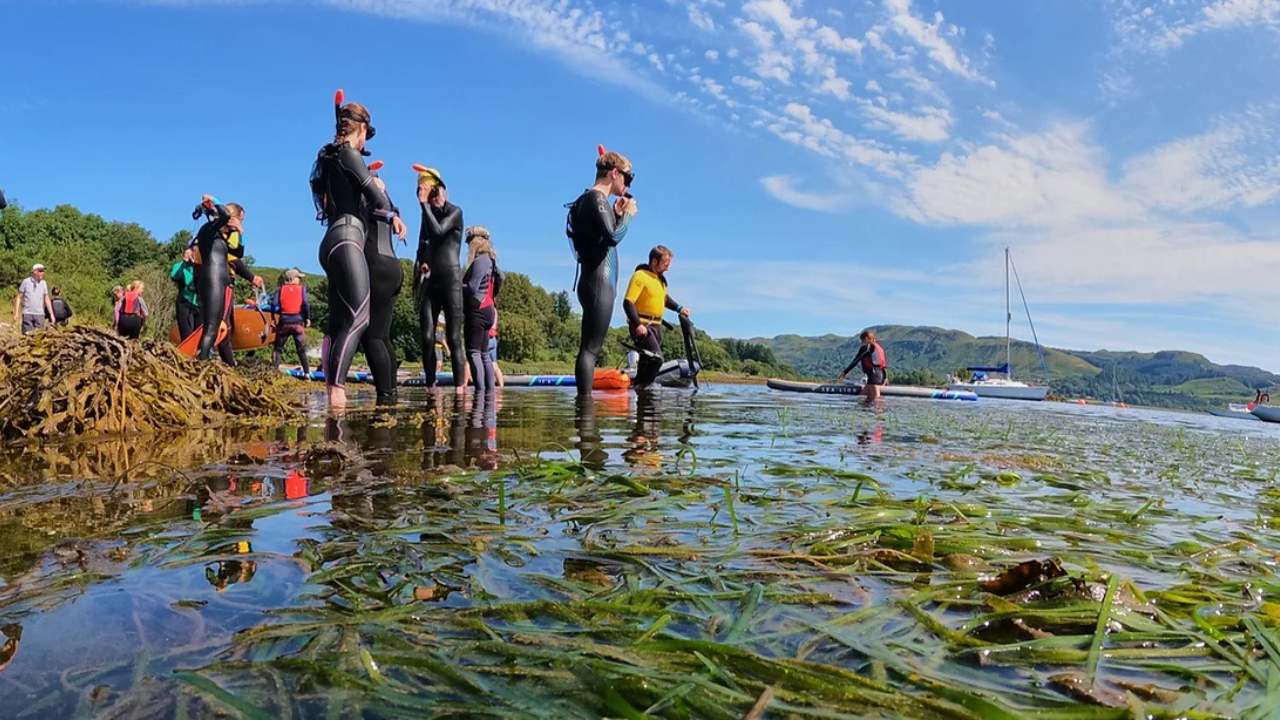
Local involvement played a massive role too. Partnering with NatureScot, local residents, paddleboarders, and snorkellers jumped into the water to help monitor transects, map growth, and handle field observations. Conservation works best when the people living next to the water actually participate in saving it.
Scaling Up the Blueprint
With proof of concept locked down in Argyll, the strategy is moving outward. Backed by organizations like the Blue Carbon Trust, upcoming trials are expanding to new marine environments around Scotland, including Ganavan Bay near Oban, Loch na Cille, and Port na Carraigh on the Isle of Gigha.
These new sites will test how adult-shoot transplants perform under different wave actions, water temperatures, and sediment types through 2027.
Stop waiting for nature to fix human-caused destruction passively. If you want to restore marine habitats, ditch the seeds, copy the adult-shoot method, and get local communities in the water doing the heavy lifting.