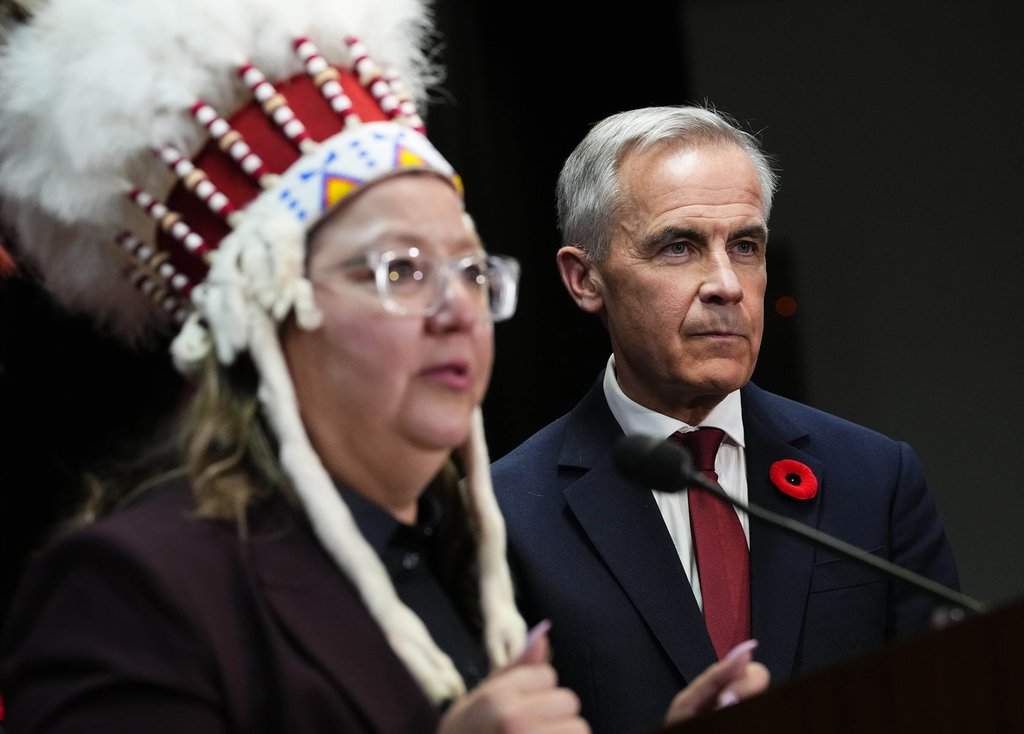
Conversations about rewriting the foundations of Indigenous governance in Canada usually start in closed rooms and end in public friction. That exact dynamic played out recently when Assembly of First Nations National Chief Cindy Woodhouse Nepinak pushed back hard against claims made following a high-profile Ottawa summit.
Prime Minister Mark Carney and Manitoba Premier Wab Kinew insisted that the idea of abolishing the 1876 Indian Act gained traction among leaders inside the room. Woodhouse Nepinak called out that narrative directly, stating that no one besides Carney and Kinew actually drove that specific conversation. Instead, she pointed out that chiefs were laser-focused on major projects legislation that they argue threatens treaty rights, pushing the talk of outright abolition to the wayside. Read more on a related topic: this related article.
It is a familiar collision of priorities. Ottawa wants modernization and streamlined resource development. First Nations leadership wants fundamental protection of rights and sovereignty before anyone starts tearing up 150-year-old legislation.
The Heavy Shadow of 1969
You cannot talk about scrapping the Indian Act without acknowledging why so many communities react with immediate suspicion. History leaves deep scars. Back in 1969, Pierre Trudeau's government introduced the infamous White Paper, championed then by Jean Chrétien as Minister of Indian Affairs. Further journalism by USA.gov highlights comparable views on the subject.
That proposal aimed to eliminate Indian status, dissolve treaties, privatize reserve lands, and absorb First Nations people directly into the general Canadian population as ordinary citizens. It was billed as a step toward equality. Indigenous leaders saw it for what it truly was: an aggressive attempt at forced assimilation designed to wipe out distinct cultural identities.
Legendary leaders like Harold Cardinal and the Indian Association of Alberta mobilized fierce pushback that ultimately forced the government to back down. That historical trauma explains why any modern talk of "abolishing" or "replacing" the Indian Act without absolute, ground-up Indigenous consensus triggers immediate alarm bells. Communities remember what happened the last time Ottawa tried to unilaterally fix a law it created.
What Leaders Actually Disagree On
The Indian Act is undeniably paternalistic, racist, and restrictive. It gives the federal government sweeping powers over status determination and reserve governance. Everyone agrees it needs to go.
The dangerous part is the question of what replaces it.
First Nations communities are far from unified on a single path forward. While there is broad support for fixing the archaic rules surrounding who qualifies for status—rules that have historically divided families and discriminated against Indigenous women—agreeing on a replacement framework is a massive hurdle. Some nations are actively working toward self-government agreements, pointing to models like the 1975 James Bay and Northern Quebec Agreement. Others fear that untangling themselves from federal oversight without ironclad guarantees will leave them financially vulnerable or strip away existing treaty rights.
When federal officials claim widespread consensus behind closed doors, they gloss over these deep internal complexities. Governance reform cannot be rushed to fit an economic timeline or a legislative agenda for resource extraction.
The Economic Pressure Driving the Debate
The timing of this renewed debate is no accident. Carney’s administration is under intense pressure to accelerate major infrastructure and resource projects across provinces and territories. The original iteration of the federal Building Canada Act even contained provisions that would have allowed Ottawa to sidestep certain regulatory hurdles tied to Indigenous lands, though those clauses were later stripped out following fierce pushback from opposition parties.
When political leaders frame the Indian Act as a barrier to economic growth, they frame the entire relationship transactionally. First Nations are not roadblocks on a permitting checklist. They are sovereign nations with constitutional rights that predate Canada itself.
Until Ottawa understands that substantive reform requires ceding actual control and respecting self-determination from the ground up, debates over abolishing the Indian Act will remain political theater rather than meaningful reconciliation. Real change doesn't happen by declaration in a room full of federal and provincial elites. It happens when the nations governed by the law write the terms of its demise.