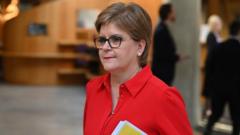
Imagine a world where the United Kingdom faces a sudden, catastrophic military assault from Russia. Power grids blink out. Communications collapse. Panic hits the streets. Now, imagine the people sitting in the emergency COBR bunker trying to save the country are not the current elected government, but an alternate-universe cabinet led by Michael Gove as Prime Minister and Nicola Sturgeon as his second-in-command.
It sounds like a late-night internet meme. It is actually Sky's latest unscripted television project, The Wargame. For a different look, check out: this related article.
The four-part series gathers a heavy-hitting cast of former political rivals, retired military bosses, and espionage veterans. They are locked inside a simulated crisis room, forced to make split-second decisions against real-time simulated threats. While the initial reaction online has been a mix of amusement and sheer bewilderment, this production signals a massive shift in how the public digests geopolitical risk and how retired politicians manage their public images.
http://googleusercontent.com/lmdx_content/gybKgKEOssmwQzKgjblMXAuBWxPFwlKTDTWxFNQvGGTqscSelgAqTcJhrlOblPWiIsHIiGmwcIqQsyjEIPZLcCQNwvAlhDEDgKjPpPXimrKsgtnuzqoy1034 Similar analysis on the subject has been published by Vanity Fair.
The Fictional Cabinet and the Setup
Sky built this format off its successful news podcast. The television version ups the ante by dropping these figures into a highly realistic environment managed by defense experts and academics. They do not follow a script. Instead, they react to simulated rolling news bulletins, intelligence briefs, and social media chaos.
The line-up reads like a political drama cast list. Michael Gove takes the top job as Prime Minister. Nicola Sturgeon serves as Deputy Prime Minister. Joining them are former Conservative MP Penny Mordaunt as Defence Secretary, Labour veteran Harriet Harman as Home Secretary, and former Labour MP Jim Murphy as Foreign Secretary.
To keep the simulation grounded, actual experts fill out the advisory roles. Baroness Sayeeda Warsi acts as Attorney General. General Sir Richard Barrons steps in as Chief of the Defence Staff, alongside former MI6 intelligence professionals and diplomat Lord Kim Darroch. They even brought in international players, with former White House communications director Anthony Scaramucci playing the US Secretary of State. They face an opposing team of Russia experts who manage the adversarial moves.
Moving From Public Service to Prime Time
For decades, retired British politicians followed a predictable path. They wrote an expensive memoir, joined the international speaking circuit, or took a seat in the House of Lords. Some did all three.
Television was usually reserved for lighthearted entertainment. Think of Ed Balls dancing on Strictly or Matt Hancock eating bugs in the jungle. Those appearances were about proving a politician was human, approachable, or simply seeking attention.
The Wargame is completely different. It asks the audience to take these individuals seriously as crisis managers, even though they no longer hold power. For Sturgeon and Gove, this format serves a dual purpose. It allows them to demonstrate their deep procedural knowledge without the actual accountability of public office.
Sturgeon spent years fighting the Westminster establishment. Gove spent years at the very center of it. Seeing them sit side-by-side to defend the British state offers a bizarre look at what happens when the constant bickering of party politics hits a hard wall of simulated existential threat.
Entertainment or Public Education
Sky executives argue that the series is highly relevant. With global tensions at their highest point since the Cold War, understanding how decisions are made in the shadows is genuinely valuable. The show strips away the polished press releases and reveals the agonizing trade-offs leaders face. Do you retaliate immediately and risk total escalation? How do you protect critical infrastructure when the public is panicking on social media?
Critics argue the opposite. Some view the series as a cynical way to make entertainment out of nuclear anxieties and international conflict. There is a fine line between educating the public on national defense and turning a potential global disaster into reality television drama.
The format works because of the tension between the participants. Gove and Sturgeon have vastly different political philosophies. In a real crisis, a national unity government requires total cooperation. Watching how these dominant personalities clash or cooperate when the simulation turns up the heat will likely be the main draw for viewers.
What to Expect This September
The series drops on Sky and NOW this September. It spans four episodes, focusing on a timeline set slightly in the future.
Do not expect the usual talking-head commentary or predictable documentary beats. The pacing mimics a real-time crisis. If the podcast version proved anything, it is that these simulations quickly expose the gaps in national readiness and the fragile nature of high-level decision making.
Whether this project rehabilitates reputations or simply draws hate-watching crowds remains to be seen. It highlights a reality where the lines between governance, defense strategy, and home entertainment are completely gone.
Keep an eye on the scheduling details as the launch date approaches. Check your subscription status on Sky or NOW to ensure access ahead of the premiere.