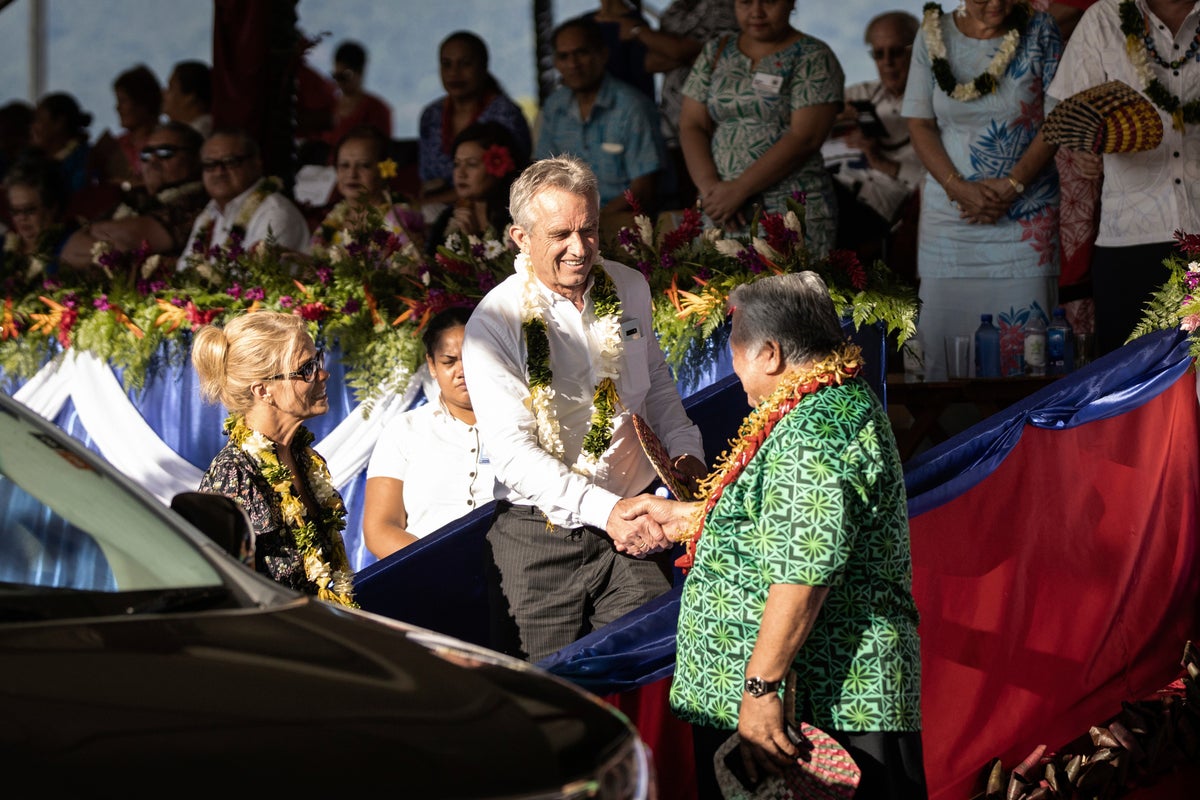
Political confirmation hearings rarely hinge on tropical islands, but Robert F. Kennedy Jr. turned a Pacific journey into a massive flashpoint. When lawmakers questioned him about his controversial 2019 trip to Samoa, his answer was absolute. He claimed it had nothing to do with vaccines. Newly unearthed documents tell a completely different story.
Before taking office as Health Secretary, Kennedy needed to soothe skeptical senators who held the keys to his confirmation. During intense questioning by senators like Ron Wyden and Edward Markey, Kennedy batted away concerns about his past anti-vaccine advocacy. He insisted under congressional scrutiny that his voyage to Samoa was strictly meant to introduce a digital medical informatics system to streamline healthcare records.
"I went there, nothing to do with vaccines," Kennedy told the Senate.
Documents obtained by reporters via public records lawsuits completely shatter that narrative. A letter dated January 20, 2019, written on Children’s Health Defense letterhead and addressed to then-Prime Minister Tuilaepa Sailele Malielegaoi, shows Kennedy explicitly offering to study Samoa's measles, mumps, and rubella (MMR) vaccines. In that single document, the word vaccine or vaccination appears eight times.
The Backstory of the 2019 Trip
To understand why this letter matters, you have to look at what happened in Samoa just months prior. In July 2018, two infants tragically died shortly after receiving an MMR vaccine. Local health authorities quickly discovered the cause was human error; nurses had improperly mixed the vaccines with muscle relaxant instead of water. Samoa briefly suspended its immunization program while investigating.
Enter Kennedy and his anti-vaccine organization. Seizing on the tragedy, Kennedy wrote to the prime minister, speculating that manufacturing defects might be to blame rather than local clinical mistakes. He proposed sending his own team to conduct a detailed assessment of the nation's vaccine supply.
By the time Kennedy, his wife Cheryl Hines, and a colleague actually arrived in Samoa in mid-2019, the government had already resumed routine immunizations after clearing the batch. Yet, local records and reporting indicate that Kennedy met with prominent anti-vaccine figures during his stay.
Months later, vaccination rates plummeted to dangerous lows. A devastating measles outbreak struck the island nation in late 2019, sickening thousands and killing 83 people—mostly young children under the age of five. Public health officials on the ground repeatedly noted that local skepticism, fueled by foreign activists, severely hampered containment efforts.
Defending the Testimony
When the newly discovered letters surfaced, the Department of Health and Human Services rushed to defend its leader. Representatives argued that any suggestion Kennedy lied to Congress was false and defamatory. They pointed out a technicality: Kennedy was not formally under oath during those specific moments of his confirmation hearings.
Legal experts point out that giving material false statements to Congress remains a crime punishable by prison time, regardless of whether a swearing-in ceremony occurred. Even so, political realities make formal perjury charges unlikely under a friendly legislative majority.
Senators bought the explanation at the time. Crucial swing votes, including Republican physician Senator Bill Cassidy, ultimately advanced his nomination. Kennedy secured his seat, but the paper trail left behind proves that his version of history does not survive contact with his own correspondence.