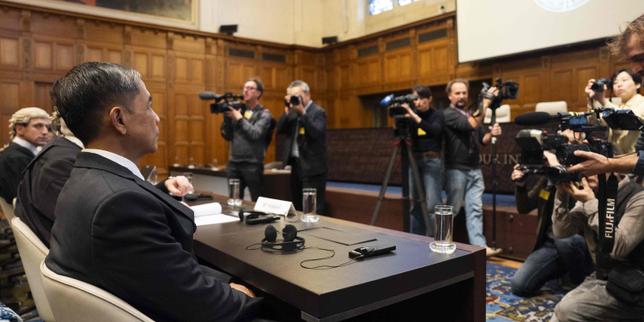
On November 19, 2026, the International Court of Justice finally said the quiet part out loud. Myanmar committed genocide against the Rohingya.
For years, diplomats hedged. Politicians talked about "ethnic cleansing," "grave human rights violations," or "crimes against humanity," dancing around the G-word like it might burn their fingers. Today, in The Gambia v. Myanmar, the world's top court ruled that Myanmar acted with intent to destroy a substantial part of its Rohingya population during the 2016 and 2017 military clearance operations in Rakhine State.
This isn't a preliminary order or a polite warning. It's a final, binding judgment from the principal judicial organ of the United Nations, with no appeal. According to UN News, the ruling marks the first time the ICJ has found a state directly responsible for genocide under the Genocide Convention.
People searching for this news usually want two things right away. First, did the court actually call it genocide, and what does it mean for Myanmar? Second, will anything real happen to the people who ordered the killings, burned villages, and drove hundreds of thousands of families across the border into Bangladesh?
Let's be honest about where things stand. A judgment on paper doesn't automatically empty a refugee camp in Cox's Bazar or hand a military general a cell in The Hague. Still, pretending this verdict doesn't shift the ground beneath international law would be a mistake.
What the Rohingya Genocide Verdict Actually Decides
Reading through the court's findings, one thing jumps out immediately. Judges didn't stop at saying Myanmar's military went too far or failed to keep order. They concluded that the state itself breached its core obligations under the 1948 Genocide Convention.
Led by ICJ President Yuji Iwasawa, the bench detailed extreme violence against largely Muslim Rohingya communities in Rakhine State and cited evidence that roughly 10,000 Rohingya were killed during those clearance operations. The court also pointed to what happened after the smoke cleared. Bulldozing. Large-scale terrain erasure. Rapid construction of security installations, new villages, and civilian infrastructure right over destroyed sites.
That detail matters legally and practically. You don't casually bulldoze entire neighborhoods and erect security outposts over them by accident. Combined with mass killings, displacement, and severe harm, it points to deliberate state policy rather than rogue soldiers acting in isolation.
The court also ruled that Myanmar failed in its duty to prevent and punish genocide, and failed to pass domestic legislation that actually gives effect to the protections of the Genocide Convention. As Human Rights Watch noted right after the ruling, this is a milestone for victims who waited nearly seven years since The Gambia filed the case back in November 2019.
The Orders Myanmar Now Faces
A court finding is one thing. Concrete orders are another. According to legal analysis from Matrix Chambers and reporting by PBS NewsHour, the ICJ didn't just hand down a moral lecture. It issued specific directives:
- Investigate everyone reasonably suspected of committing acts contrary to the Genocide Convention, and prosecute and punish those responsible.
- Provide guarantees of non-repetition and take active steps to prevent further violations.
- Deliver reparations to Rohingya victims and the wider community, including restitution—such as safe, voluntary, and dignified return to their homes, family reunification, searching for the disappeared, and identifying victims—plus compensation where restitution isn't possible, and physical and psychological rehabilitation.
- File a report with the court within two years detailing the steps taken toward restitution and compensation.
Notice that two-year clock. That gives judges and intervening states a clear benchmark to measure whether Myanmar's authorities do anything at all or simply stonewall again.
Why Small States and Interveners Matter So Much
Here is a detail a lot of quick headlines gloss over. The Gambia is a small West African nation thousands of miles away from Rakhine State. Yet it stepped up in 2019 to bring this case before the ICJ, backed by legal counsel including Foley Hoag and international lawyers such as Philippe Sands and Paul Reichler.
Why did The Gambia do it? Under the Genocide Convention, every state party has an interest in preventing and punishing genocide—even when no Gambian citizen is harmed. In legal terms, that obligation is erga omnes partes, owed to the international community as a whole under the treaty.
Over the years, eleven states were admitted to intervene in the proceedings, including Canada, Denmark, France, Germany, the Netherlands, the United Kingdom, the Maldives, Belgium, Ireland, Slovenia, and the Democratic Republic of the Congo. In January 2026, the court held public hearings on the merits where Gambia and Myanmar laid out their competing cases before deliberations began.
Having eleven intervening states matters because it turns a bilateral dispute into a collective legal project. When major European powers, North American allies, and other states weigh in on how the Genocide Convention should be interpreted, they build a broader coalition around the court's reasoning.
The Gap Between Legal Victory and Reality on the Ground
If you've followed international justice long enough, you know the hardest part starts the moment the gavel comes down.
The ICJ settles disputes between states. It doesn't have its own police force, and it doesn't try individual generals for personal criminal liability—that's the domain of bodies like the International Criminal Court or domestic courts exercising universal jurisdiction.
Meanwhile, Myanmar remains riven by deep internal conflict and military rule, and hundreds of thousands of Rohingya refugees remain stuck in precarious conditions, largely in Bangladesh, where humanitarian funding and food rations have faced severe strain over the past couple of years. Asking a military establishment that spent years denying atrocities and fighting armed resistance groups at home to voluntarily prosecute its own officers and hand back bulldozed land is a tall order.
Some observers argue that ICJ rulings can feel hollow when a government ignores them. Fair point. If a state refuses to comply, enforcement often depends on the UN Security Council—where geopolitical vetoes and rivalries frequently stall binding action—or on unilateral diplomatic, economic, and legal pressure from other countries.
Right after the judgment, UK Foreign Secretary Ed Miliband announced Britain was expelling Myanmar's defense attaché and pushing for an urgent UN Security Council session. That's an immediate diplomatic reaction. Whether it snowballs into real leverage—or fizzles out after a week of news cycles—is the real test.
Common Myths About This Ruling
Whenever a major international court hands down a landmark decision, confusion spreads fast. Let's clear up a few misconceptions right away.
First, this does not automatically put individual commanders behind bars tomorrow. The ICJ rules on state responsibility under international law. Individual criminal trials require separate proceedings and custody of suspects.
Second, a ruling doesn't magically open the border for safe return. Reparations and safe, voluntary return are legally ordered, yes, but safe return on the ground requires security guarantees, citizenship and legal status, housing, and basic services that don't exist overnight.
Third, the case isn't purely symbolic. A binding ICJ judgment becomes a permanent legal record. Future courts, sanctions regimes, diplomatic negotiations, and aid agencies can all point to it as an established judicial finding of genocide, not merely an allegation by advocacy groups.
How This Shapes Future Genocide Cases
Watch how legal scholars and governments talk about the Genocide Convention from this point forward. For decades, proving dolus specialis—the specific intent to destroy a protected group in whole or in part—was treated as an almost impossibly high bar in international courts.
By finding state responsibility for genocide against the Rohingya and laying out detailed reasoning around mass killings, displacement, and destruction of communities, the ICJ reinforces that genocidal intent can be inferred from patterns of conduct and state actions rather than waiting for a hypothetical smoking-gun memo signed by a general.
Even outside Myanmar, other states watching proceedings in The Hague—including cases involving other conflicts and allegations—will study how the court evaluates evidence, treats interventions by third countries, and crafts reparations like rehabilitation and restitution. International law moves slowly, often painfully so, until one precedent shifts what lawyers and governments consider possible.
For Rohingya survivors and advocates, vindication has been a long, exhausting climb. As one survivor who traveled to The Hague put it, hearing the court recognize their suffering brings relief and hope for the next generation, even though the struggle isn't over.
Practical Next Steps to Follow and Support Accountability
If you're tracking this ruling—whether as a researcher, journalist, policy reader, or someone looking for credible ways to stay informed or support humanitarian relief—skip the rumor mills and focus on concrete steps.
- Read the primary court record. Check the official case docket for The Gambia v. Myanmar on the International Court of Justice website to see the exact operative paragraphs, voting tallies on each count, and the two-year reporting timeline on reparations.
- Track UN and state compliance over the next 24 months. Pay attention to UN Security Council debates, diplomatic measures announced by intervening states, and Myanmar's required reporting on restitution and compensation.
- Support vetted humanitarian and documentation groups. If you want to help Rohingya communities directly or support evidence preservation, look into established organizations working on refugee aid, healthcare, and international justice—such as Human Rights Watch and Physicians for Human Rights—and verify any fundraising appeal before donating.
- Separate legal findings from political spin. When commentators claim this ruling either "solves everything" or "means nothing," check what the court actually ordered versus what enforcement mechanisms exist in the real world.
The verdict is in. Now comes the harder, slower work of holding power to account.