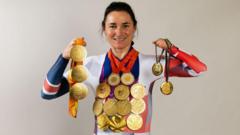
Dame Sarah Storey is not chasing a tenth Paralympic Games.
The most decorated British Paralympian of all time has announced her immediate retirement from international competition. At 48, after accumulating 30 Paralympic medals across a staggering 35-year career, she is stepping off the bike. You might also find this connected coverage insightful: Why Morocco Can Actually Beat France This Time Around.
The decision is a shockwave for British sport, but it is not because she cannot win anymore. Physically, she is confident she could line up in Los Angeles in 2028 and defend the two gold medals she won in Paris. She is walking away because she believes the Paralympic movement has stalled, and she can do more to fix it off the bike than on it.
The Decision to Prioritize Progress Over Medals
Most athletes have to be dragged away from their sport by injury or a decline in performance. Storey is doing the opposite. Leaving on top, unbeaten at the Paralympic Games, is a luxury few elite competitors ever get. As discussed in detailed reports by Yahoo Sports, the effects are widespread.
Her reasoning exposes a quiet frustration with the current state of Para-sport. Storey pointed out that momentum has waned since the highs of the London 2012 Games. The intervals between each Paralympic cycle have not been used properly to maintain public interest or build structural depth in the sport. Basically, she is tired of seeing Para-sport treated as an afterthought between four-year cycles.
This is not a sudden whim. Storey has been planning for her post-athlete life since she first put on a Great Britain tracksuit as a teenager. Her parents drilled into her that an athletic career can end in an instant, meaning you always need another option. She has worked as the Active Travel Commissioner for Greater Manchester, proving her capabilities extend far beyond a velodrome or a swimming pool.
A Tale of Two Legendary Careers
To appreciate why Storey's voice carries so much weight, you have to look at the sheer longevity of her career. She did not just dominate one sport. She dominated two entirely separate disciplines.
Born without a functioning left hand, she qualified for her first Paralympics in Barcelona in 1992 as a 14-year-old swimmer. She won two golds, three silvers, and a bronze in Spain. She spent the next decade commanding the pool, collecting 16 Paralympic swimming medals across four Games.
Then her body forced a change. Severe ear infections in 2005 kept her out of the water for months. To maintain her aerobic fitness, she hopped on a bike for cross-training. She turned up at a taster session at the Manchester Velodrome and rode a 3,000-meter individual pursuit time that was just one second off the world record. She never looked back.
By the time she competed in Beijing in 2008, she was a cyclist. She went on to win 14 Paralympic gold medals on the track and the road. She even crossed over into able-bodied competition, finishing sixth in the individual pursuit for England at the 2010 Commonwealth Games.
What Para-Sport Needs Next
Storey has been incredibly clear about what needs to change. In the UK, she has consistently pushed for combined national championships where Para-cyclists and able-bodied cyclists race at the same events on the road, just as they occasionally do on the track.
Media coverage remains another major battleground. The drop-off in visibility for Para-athletes outside of the Paralympic years is massive. By stepping into administrative, advisory, and advocacy roles full-time, Storey wants to force broadcasting and governance to treat Para-sport with permanent respect, not seasonal curiosity.
Her departure leaves a massive void in the Great Britain squad, but it opens the door for a new generation. It also sets a template for how elite athletes can leverage their status to create structural change rather than just adding silverware to a personal trophy cabinet.
If you want to support the growth of the sport in the spirit of Storey's mission, stop tuning in only when the Paralympic flame is lit. Seek out domestic para-cycling events, watch the UCI Para-cycling World Championship broadcasts, and demand equal billing for these athletes from sports media outlets. True equality in sport requires a fanbase that shows up all the time, not just once every four years.