Traditional naval power cannot win a war in the Taiwan Strait anymore. If Beijing decides to launch an invasion, the sheer volume of their shipbuilding industry means they can throw more hulls into the water than the United States, Japan, and Taiwan combined. Trying to match them ship-for-ship is a losing strategy. Recent military simulations and tabletop war games have made one thing brutally clear. The only way to stop an invasion fleet is to make the water itself completely unnavigable using cheap, autonomous technology.
Naval planners call this concept the Hellscape. The goal isn't to fight a glorious, old-school fleet battle. The goal is to turn the hundred-mile stretch of water separating Taiwan from the Chinese mainland into a completely chaotic, automated nightmare. By flooding the strait with thousands of unmanned surface vessels and underwater drones, allied forces can blind, distract, and systematically dismantle an invading force before it ever reaches the beaches.
This isn't speculative science fiction. It's the immediate direction of Pacific military strategy in 2026.
The Brutal Math of a Taiwan Strait Conflict
To understand why unmanned systems matter, you have to look at the raw numbers. The People's Liberation Army Navy has grown at a dizzying pace, turning into the largest naval force on the planet by ship count. If a conflict breaks out, a massive portion of that fleet will be concentrated in a tight, predictable geographical chokepoint.
Conventional warships are slow to build. They cost billions of dollars. If an American aircraft carrier or a Japanese destroyer gets hit by a hypersonic anti-ship missile, hundreds of lives are lost, and a massive chunk of allied naval capability vanishes instantly. The financial and human costs of relying solely on crewed fleets are unsustainable in a high-intensity conflict.
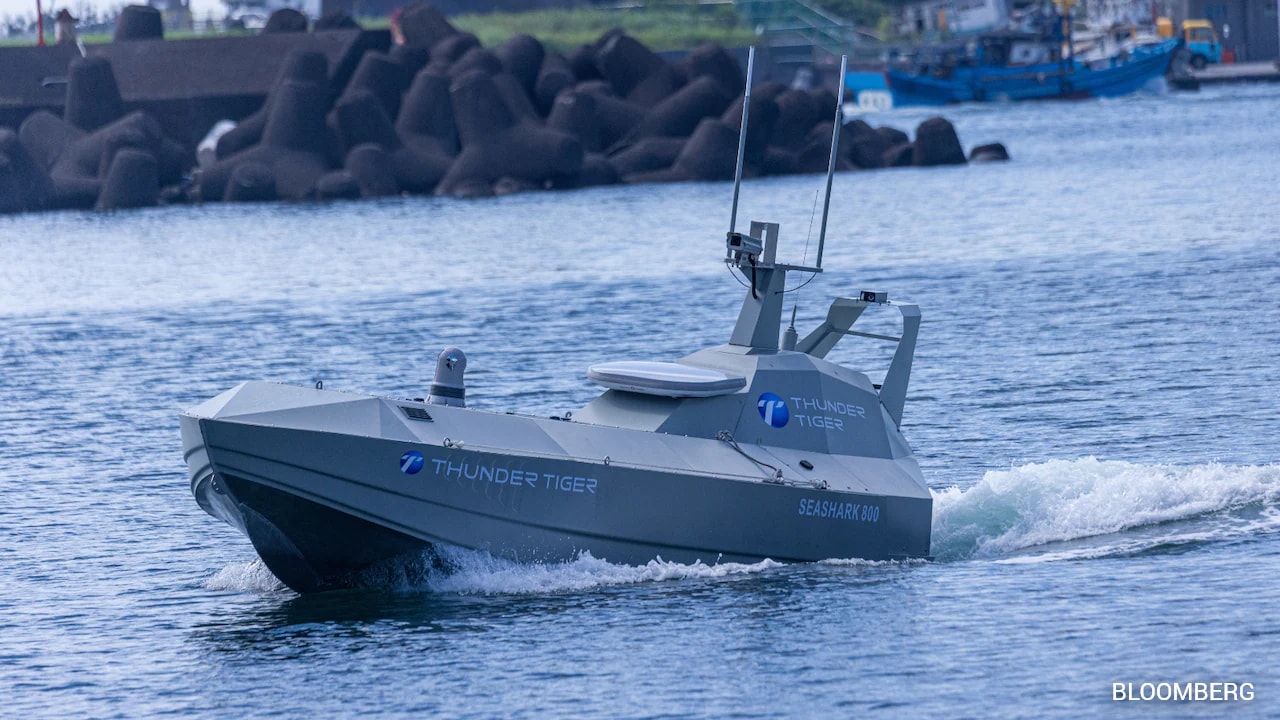
Sea drones rewrite this equation. An unmanned surface vessel packed with explosives costs a fraction of a percent of a traditional warship. You can build hundreds of them for the price of a single naval hull. When an autonomous boat gets destroyed, nobody dies. You just launch another one from a hidden coastal garage.
Recent war games conducted by organizations like the Hudson Institute have exposed the exact mechanism of how this works. In these simulations, when Chinese forces initiated an attack, smaller navies didn't try to go toe-to-toe with major surface combatants. Instead, they deployed a mix of surface and subsurface drones to clog up the sea lanes. The results were telling. Unmanned systems successfully absorbed the initial shock of the assault, drew enemy fire, and forced the opposing fleet to waste expensive munitions on cheap targets.
How the Hellscape Plan Buys Crucial Time
The top American commander in the region, Admiral Samuel Paparo, has been unusually blunt about this strategy. The objective is to make the enemy's life utterly miserable for a month. That single month is everything. It provides the window needed for global reinforcements to assemble, for political decisions to solidify, and for heavy naval assets to position themselves safely outside the immediate strike zone.
The core of the strategy relies on closing the kill chain faster than the enemy can react. In naval warfare, the kill chain involves finding a target, tracking it, assigning a weapon, and destroying it. Traditional methods require heavy surveillance aircraft or vulnerable radar ships. Drones split this responsibility into tiny, disposable pieces.
Small, low-profile surface vessels can linger on the water for days, using passive sensors to track enemy movements without transmitting signals that give away their own positions. They feed this data back to automated command systems. When an invasion fleet moves, dozens of kamikaze sea drones can strike simultaneously from multiple angles.
This creates an environment where an attacker can never rest. Every floating piece of debris, every small wave, and every radar blip could be an incoming explosive charge. The psychological toll on a crewed fleet navigating a drone-infested strait is massive, forcing ships to slow down, perform constant evasive maneuvers, and burn through their ammunition supplies before they even get close to their primary objectives.
Inside the Tech Shift in Japan and Taiwan
This strategic pivot has triggered massive budget reallocations across East Asia. Tokyo and Taipei are no longer treating autonomous systems as experimental projects. They are treating them as core defensive requirements.
Taiwan has actively pushed forward with its own domestic programs, including the development of the Kuai-Chi unmanned surface vessel. Taipei has laid out plans to procure more than 1,300 of these attack units, backed by a multi-billion dollar domestic drone defense initiative. For an island with a limited budget and a smaller traditional navy, these expendable systems offer a realistic way to create asymmetric complications for a larger invading force.
Japan faces a different geographical headache. The country has more than 14,000 islands scattered across vast distances, making traditional garrisoning impossible. Tokyo has dedicated significant funding to autonomous systems, aiming to ramp up domestic drone production toward 80,000 units by the end of the decade.
During recent tabletop exercises, Japanese forces deployed unmanned underwater vehicles to handle the quiet, dangerous work of submarine detection. These underwater drones patrolled vital maritime chokepoints, tracking sub-surface threats while surface drones acted as a screen to distract and harass enemy fleets. This division of labor allowed Japan's high-end crewed warships to stay out of the immediate danger zone, preserving their combat power for the long fight.
Why Black Sea Success Cannot Be Copied Blindly
A lot of the enthusiasm for sea drones comes from the war in Ukraine, where small, explosive-laden boats managed to cripple portions of Russia's Black Sea Fleet. It was a stunning demonstration of how a country without a major navy could dominate a localized maritime theater. Ukrainian defense contractors are even actively pitching their software and hardware to Asian markets, seeing the obvious parallels in the strategic dilemma.
But military planners are starting to realize that the Pacific presents a totally different set of challenges. The Black Sea is a small, enclosed body of water. The Indo-Pacific is vast.
Distance changes everything. A drone that works perfectly well when launched ten miles from its target will struggle when it needs to travel hundreds of miles through rough, open ocean waters. Long-range autonomous underwater vessels have shown great promise for surveillance and laying naval mines, but they are slow. They lack the speed and immediate payload capacity of a nuclear attack submarine.
The geography of the Taiwan Strait itself is also a double-edged sword. The waters are shallow and heavily constricted. While this makes it easier to bottleneck an invading fleet, it also makes drones highly vulnerable to localized electronic jamming. If an adversary successfully cuts off satellite links or localized communication networks, a drone swarm can quickly become useless if it lacks advanced, onboard decision-making capabilities.
That is why the focus is shifting away from simple remote-controlled boats toward true autonomy. Companies are testing AI-driven software designed to let groups of drones communicate with each other without relying on a central command signal. If one drone loses its connection or gets destroyed, the rest of the swarm adjusts its behavior automatically to finish the mission.
Actionable Steps for the Next Phase of Maritime Defense
The transition from theory to actual deterrence requires immediate, practical shifts in how defense networks operate in the Pacific.
First, the United States and its allies must focus on building mass rather than perfection. The Pentagon has a historical habit of over-engineering weapons, turning simple tools into multi-million dollar projects that take a decade to field. For a Hellscape strategy to work, the drones must be cheap, simple, and expendable. They need to be good enough to hit a target, not advanced enough to last for twenty years in a warehouse.
Second, supply chains must be totally insulated from adversarial control. It does no good to design a brilliant sea drone if the electric motors, battery cells, or circuit boards are manufactured in factories that could be cut off at the start of a conflict. Establishing localized production lines in Taiwan, Japan, and the United States is the only way to guarantee a continuous supply of replacement hardware during a prolonged war of attrition.
Finally, allied navies need to integrate these autonomous systems into regular, live-fire exercises. Running software simulations is useful, but the real ocean introduces unpredictable variables like saltwater degradation, extreme weather, and unpredictable wave patterns. Testing swarming software in the actual environment of the Western Pacific is the only way to ensure these systems will perform when the shooting starts.
The era of relying solely on massive, expensive surface fleets to secure the Pacific is over. The side that successfully masterfully integrates cheap, automated mass into its naval doctrine will control the terms of the next major maritime conflict. Saving Taiwan and protecting Japan's maritime borders won't happen by matching an adversary ship-for-ship. It will happen by making the sea too dangerous for any fleet to cross.
To prepare for this shifting reality, defense analysts and procurement officers must focus immediately on standardizing data links between different allied drone platforms, ensuring American, Taiwanese, and Japanese autonomous systems can operate as a single, cohesive swarm under combat conditions.