The English Channel isn't just a shipping lane anymore. It's an active front line. Over the weekend, heavily armed Royal Marine commandos fast-roped from Chinook helicopters onto the deck of the MV Smyrtos, a rust-bucket tanker carrying 98,000 tonnes of Russian crude oil. It was a slick, midnight operation that felt more like a Hollywood thriller than a regulatory inspection. But the real shockwave didn't hit until Tuesday morning in a quiet courtroom in Southampton.
Ajay Pant, the 38-year-old Indian captain of the vessel, found himself remanded in custody, facing up to 10 years in a British prison for breaching Western oil sanctions.
This isn't just about one captain or one ship. It marks a dramatic shift in how Western nations enforce economic blockades. For years, Russia used its "shadow fleet"—an armada of over 700 unregistered, uninsured, and decrepit tankers—to bypass G7 price caps and pump billions into its military complex. By arresting a captain and launching 70 fresh sanctions at the G7 summit, British Prime Minister Keir Starmer sent a cold message to the global shipping industry. You can no longer hide behind corporate orders.
The Midnight Raid off the Isle of Wight
The MV Smyrtos was sailing south of the Isle of Wight, ostensibly bound for India, when the military swooped in. The ship flew a Cameroon flag, but it had already been secretly expelled from the African nation's registry. It was legally stateless.
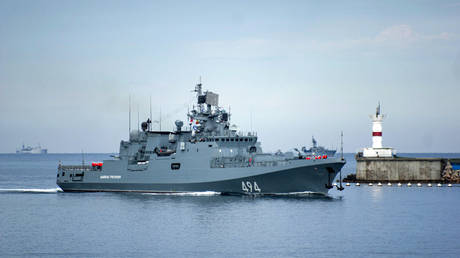
The six-hour operation used a small armada of its own: Chinooks, Merlin Mk4, and Wildcat helicopters, an RAF P-8 maritime patrol aircraft, and two British warships, HMS Sutherland and HMS Ledbury. Royal Marines stormed the decks in the dark, and National Crime Agency (NCA) investigators quickly tore through the bridge to seize paperwork.
The legal fallout was immediate. Defending the captain at Southampton Magistrates' Court, solicitor James Diamond offered a defense that every commercial sailor understands: Pant was "simply following orders" from his corporate employers.
But British prosecutors aren't playing that game anymore. Under Regulation 46Z9B of the Russia Sanctions Regulations, anyone directly or indirectly delivering prohibited Russian oil faces massive criminal liability. The 24 remaining crew members—a mix of Indian and Georgian nationals—are currently stuck aboard the tanker, anchored under guard off Weymouth, Dorset, assisting the NCA with a sprawling criminal investigation.
Inside the 2026 G7 Sanctions Crackdown
While Pant sat in a Bournemouth police cell, Starmer arrived at the G7 summit in Évian-les-Bains, France, to drop the hammer. The UK announced a massive package of 70 new sanctions explicitly targeting the logistical and financial architecture that keeps these ghost ships moving.
The fresh restrictions target:
- More than 20 specific shadow fleet oil tankers, stripping them of access to international maritime services.
- Ship insurers and maritime service providers who turn a blind eye to fake shipping manifests.
- Several Liquefied Natural Gas (LNG) vessels newly bought by Moscow to revive its crippled Arctic LNG 2 project.
- LLC Neptune Co Ltd, a front company run by Russian military intelligence (GRU) to covertly buy Western military technology.
Western allies previously relied on polite bureaucracy, hoping banks and insurers would police themselves. That failed. Russia simply built a parallel maritime economy. This new offensive targets the plumbing of that economy. If you insure a rogue ship, you're cut off from the global financial system. If you captain one, you go to jail.
The Reality of Russia's Shadow Fleet
Why is the UK suddenly using elite commandos to stop merchant tankers? Because the shadow fleet is the only thing keeping the Kremlin's war machine alive.
The Ministry of Defence estimates that these ghost ships transport roughly 75 percent of Russia's sanctioned oil. They operate completely outside international maritime safety regulations, frequently turning off their AIS transponders to vanish from tracking maps, and performing dangerous ship-to-ship oil transfers in international waters.
The environmental risk is terrifying. These are ageing, poorly maintained vessels that wouldn't pass a basic European port safety inspection. A major spill in the English Channel would devastate British and French coastlines. By aggressively policing its territorial waters, the UK is trying to force these ships to take longer, far more expensive routes around the Atlantic, eating into the Kremlin's profit margins.
The pressure is showing results. UK officials note that Russia’s oil and gas revenues dropped by 24 percent year-on-year heading into 2026. The Arctic LNG 2 terminal, designed to export 13.5 million tons of gas annually, managed just 1.3 million tons because it couldn't find enough cleared vessels to transport the product.
What This Means for Global Shipping
If you work in global maritime logistics, the rules of the game just changed permanently. The "just following corporate orders" defense is dead in Western courts. Captains, engineers, and ship brokers can no longer claim ignorance when dealing with complex, multi-layered ownership structures designed to hide Russian origins.
The immediate next steps for maritime operators are clear.
First, implement hyper-rigorous due diligence on vessel registries. If a ship changes flags frequently or uses registries known for lax enforcement—like Cameroon, Gabon, or Eswatini—it requires immediate red-flagging.
Second, scrutinize the ultimate beneficial ownership (UBO) of every counterparty. The NCA and its G7 partners are aggressively tracking shell companies across the UAE, Türkiye, and China that act as fronts for Russian buyers.
The era of looking the other way is over. The British government proved it's willing to deploy military force, seize multi-million-dollar cargoes, and put commercial crews in handcuffs to choke off the flow of illicit oil. If you operate in the murky corners of global shipping, you are officially on notice.