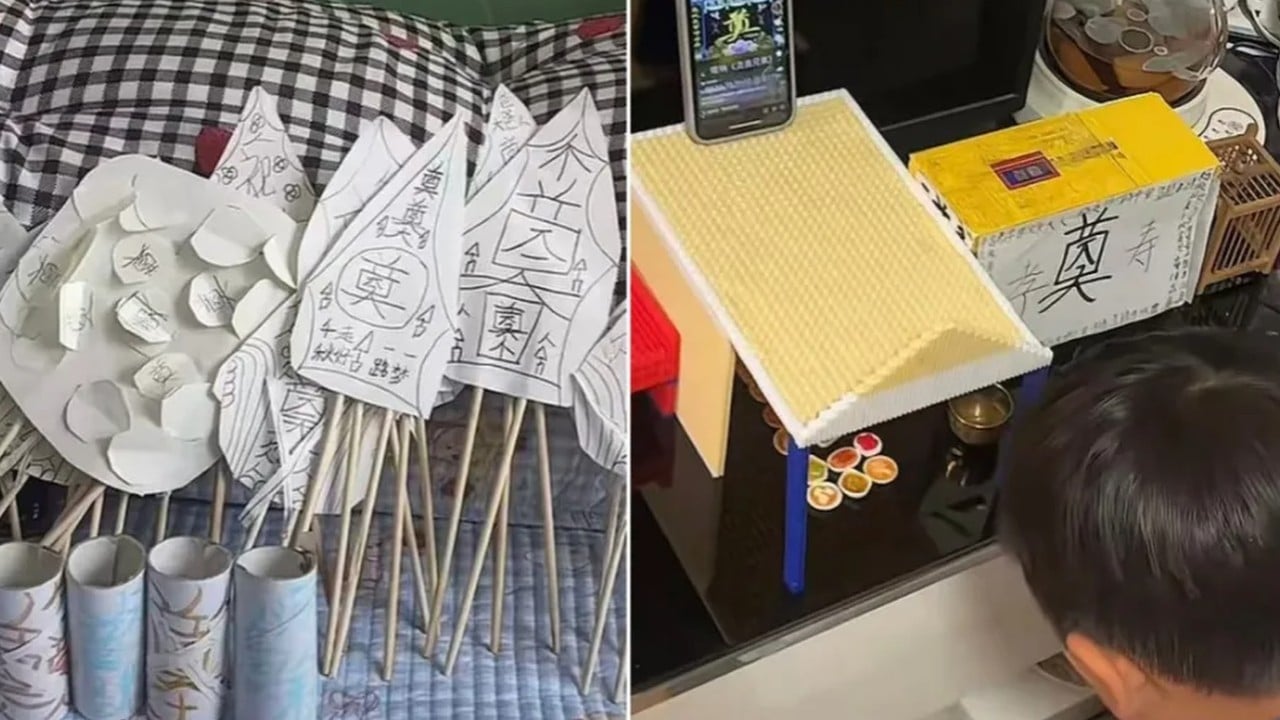
Most kids want to build race tracks or castle forts out of cardboard boxes. A seven-year-old primary school student surnamed Wang in China had a different vision entirely. He spends his free time crafting miniature coffins, building paper funeral tents with Lego blocks, and staging mock memorial services for his dad.
When his mother posted videos of these morbid play sessions online, the clips naturally went viral. Internet commentators chuckled, scratched their heads, and wondered if they were witnessing the early career of an eccentric architect or a horror writer in the making. But beneath the dark comedy of a kid turning the living room into a mortuary lies something far more interesting: a child pursuing a genuine fascination without the heavy baggage of adult superstition.
Let us look past the shock value. Why is the internet so amused, and what does this story actually tell us about how we handle childhood curiosity?
Where Kids Curiosity Actually Comes From
Wang's obsession didn't sprout from a vacuum or a dark psychological thriller. It started when he was just four years old and attended a real funeral. While most parents try to shield children from the realities of death, masking it with vague euphemisms about sleeping or going away, this boy looked at the ceremony and saw a puzzle to figure out.
Kids are hyper-observant data sponges. When they see a structured ritual, they want to reverse-engineer it. They build blocks, they play kitchen, and sometimes, if they are wired that way, they construct paper caskets. Wang found DIY instructions online entirely on his own. His parents never coached him, bought him specialized funeral kits, or nudged him toward the theme for social media clout.
Adults panic when children gravitate toward topics like mortality because we associate death with grief, fear, and taboo. Kids don't have those filters yet. To a seven-year-old, a funeral is just a very elaborate, highly structured event with specific props, colors, and rules. Reenacting it is no different than playing doctor or firefighter.
Breaking Cultural Taboos Around Death
In many cultures, particularly across East Asia, talking about death openly is heavily discouraged. Mentioning coffins or graves in casual conversation can invite scolding or accusations of bad luck. Generations have treated mortality like a linguistic trapdoor.
That is why Wang's family reaction stands out so sharply. His mother, who works as a street-food vendor, and his grandparents didn't view his hobby as an ominous sign or a bad omen. They let him build his paper tombs and even sat through his mock memorial services.
When reporters asked the mother about her son playing funeral games near her food stall—which sometimes frustrated her when customers looked confused—she remained remarkably pragmatic. Her son has already announced that he wants to work in the funeral industry when he grows up. Her response was simple and grounding: someone has to do that job anyway.
That level of emotional maturity from a parent is rare. Instead of pathologizing an unusual interest, they gave it room to breathe. They recognized that supporting a child weird phase is often better than trying to suppress it out of superstitious panic.
Why We Panic Over Kids Having Dark Interests
We live in a culture that loves sanitizing childhood. We hand kids brightly colored plastic toys and expect them to occupy themselves with safe, predictable concepts. When a child swerves into macabre territory, society reaches for the nearest diagnostic handbook or assumes the household is dysfunctional.
Yet history is full of kids who developed intense, hyper-specific fixations on niche industries. Some kids obsess over trash trucks; others memorize every dinosaur bone ever unearthed. Wang happened to fixate on the death care industry.
The internet reaction exposes our collective discomfort with the inevitable. We laugh because it feels wrong to laugh at a funeral service, even a fake one made of construction paper and Lego bricks. But the joke is really on us. We spend decades hiding from the concept of mortality, while a seven-year-old is calmly crafting scale-model caskets in his bedroom just to see how the pieces fit together.
What Parents Can Learn From This
If your kid develops a strange, hyper-focused hobby that makes your neighbors raise an eyebrow, take a deep breath.
First, check the source. Did they stumble into it naturally through genuine curiosity, or are they mimicking online shock content? In Wang's case, the self-directed nature of his DIY project proved it was genuine inquisitiveness.
Second, stop projecting adult dread onto children activities. A child playing mortician is usually not exhibiting dark psychological traits; they are exploring spatial design, mechanics, and solemn human rituals through play.
Wang is going to keep building his miniature models, and chances are high he will actually end up in the death care sector or engineering field down the line. He has the focus, the dedication, and most importantly, a support system that does not make him feel broken for being curious about how the world works.
Let kids explore the mechanics of reality, even the parts that adults prefer to keep behind closed doors.