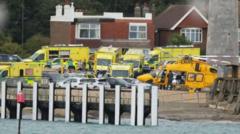
The death of a six-year-old girl, Saja El-Khawas, following a drowning incident off Shoreham-by-Sea is a nightmare scenario for any family. Coming just three days after her parents and teenage sister lost their lives in the same stretch of water, this news marks a total tragedy. It’s hard to wrap your head around such a sudden, absolute loss.
The family, visiting from London, entered the water near Shoreham Fort around 2 p.m. on Tuesday, August 18. Within moments, what was meant to be a simple day trip turned into an emergency operation. Sussex Police and coastguard teams arrived quickly, but the current reality is a stark reminder of how deceptive coastal waters can be.
The hidden risks of shoreline swimming
Most people assume that if they can stand in the water, they are safe. That’s a dangerous assumption. At Shoreham, where the River Adur meets the sea, the environment is particularly volatile. You’re dealing with more than just waves. You’re dealing with shifting sandbanks, river outflows, and tidal pulls that can move with shocking speed.
I’ve spent enough time around the coast to know that "calm" water is often the most deceptive. When the tide turns, it creates channels—rips—that pull you out, even if you’re a strong swimmer. The tragedy here wasn't a failure of character; it was likely a failure of environment awareness. We need to be honest about the fact that the ocean doesn't care about your swimming ability. It doesn't care about your plans.
Why safety education remains a gap
Politicians and local leaders have already started talking about "more education" for water safety. We hear this every time a tragedy happens, yet the same patterns emerge. The truth? Most visitors to the coast don't check the tide tables. They don't look for flags, and they rarely consider the specific geography of the beach they’re standing on.
If you are planning to head to the coast, don't just rely on your eyes. Here is the reality of what you should be doing before you even touch the water:
- Check the local tide charts: Not just for the beach, but for the specific area. Incoming tides can trap you against cliffs or sea defenses faster than you can walk back to safety.
- Identify the lifeguards: If there aren't any, ask yourself why. Many smaller beaches don't have constant patrols. If you can't see a lifeguard, assume you are on your own.
- Look for the signs: Local councils post warnings for a reason. Rip current warnings aren't suggestions; they’re survival indicators.
- Understand the "float to live" rule: If you get into trouble, do not fight the current. Fighting the water exhausts you in minutes. You have to float and signal.
Moving past the heartbreak
The Sussex community is reeling. Tributes have been left at Shoreham Fort, and the loss of the El-Khawas family—Hassan, 55, Zeina, 37, Sara, 14, and now young Saja—has touched people far beyond the coast. Sussex Police have stated that, based on CCTV and witness accounts, this was a tragic accident with no third-party involvement. A file is being prepared for the coroner, which is standard procedure, but the loss remains final.
We often look for someone to blame in these situations. We want a villain or a broken piece of infrastructure. Sometimes, however, the answer is just that nature is indifferent to our presence.
If you want to honor the memory of those lost in events like this, the best thing you can do is take water safety seriously. Don't be the person who assumes it won't happen to you. Check the conditions, know your limits, and keep a constant eye on those around you. Ocean safety isn't a theory; it's a practice. Start by checking the Royal National Lifeboat Institution (RNLI) advice before your next trip to the shore. Your life, and the lives of those you bring with you, depend on it.