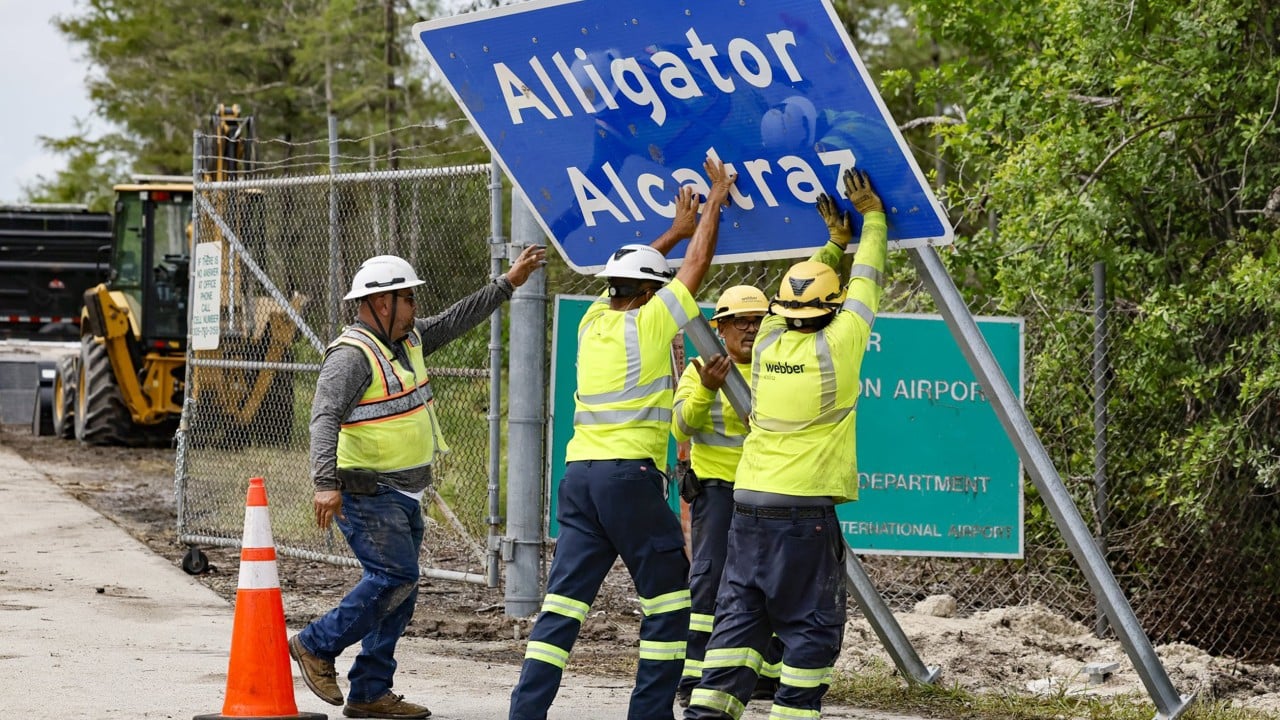
The most notorious experiment in modern American immigration enforcement is officially over. Florida Governor Ron DeSantis stood in the sweltering heat of Ochopee on Thursday to announce that the South Florida Detention Facility, widely known as Alligator Alcatraz, has finished its mission and closed its doors.
He spun it as an unmitigated triumph. Standing next to Donald Trump's border czar, Tom Homan, DeSantis bragged that the facility helped deport 21,000 people over its year of operation. He told reporters that the state stepped up when the federal government lacked space. Now that federal capacity has expanded, he says Florida is packing up its tents. Don't miss our previous article on this related article.
Don't buy the spin.
The closure of this isolated outpost in the Florida Everglades isn't just a routine operational shift. It's the quiet end to a massive, $1.2 billion political experiment that became a legal liability, an environmental disaster, and a humanitarian nightmare. The facility didn't just close because it "served its purpose." It collapsed under the weight of systemic failures, compounding lawsuits, and skyrocketing costs that Florida taxpayers are still on the hook for. If you want to understand where the national immigration battle is actually heading, you need to look at what really happened inside those tents. If you want more about the history of this, TIME provides an excellent breakdown.
The Real Story Behind the Shut Down of Alligator Alcatraz
When Alligator Alcatraz opened in July 2025, it was built to be the crown jewel of a aggressive new deportation strategy. The DeSantis administration used emergency powers to seize control of the Dade-Collier Training and Transition Airport, a remote airstrip surrounded by the Big Cypress National Preserve. Within days, contractors poured massive concrete slabs directly onto the fragile wetland ecosystem and erected rows of massive white tents.
The goal was clear. The state wanted a staging ground right next to an airstrip so they could process and deport undocumented immigrants at unprecedented speeds.
For a year, it worked exactly how the administration wanted the public to see it. It was a high-visibility, high-volume deportation machine. At his press conference, DeSantis held up a list of names, claiming the facility kept dangerous criminals off Florida streets. He argued that without this space, thousands of people with severe criminal records would have been released back into local communities.
But public safety wasn't the whole story. Media investigations and legal filings revealed that hundreds of people held in the swamp facility had no criminal records or charges whatsoever. Their only infraction was being in the country without legal documents, which is a civil violation, not a criminal one. The administration marketed the camp as a holding pen for the most dangerous individuals on earth, but the reality inside the cages was vastly different.
The official excuse for clearing the camp started weeks ago. In mid-June, immigration officials quietly began moving more than 1,000 remaining detainees out of the Everglades. The Department of Homeland Security stated that the upcoming 2026 Atlantic hurricane season made the tent city unsafe. Officials initially hinted that the camp would remain staged and ready to reopen after storm season passed.
Instead, the vendors running the camp received orders for full demobilization. The lights are turning off for good. DeSantis claims federal authorities finally have the permanent brick-and-mortar space to take over, but the timeline suggests the state was desperate for an exit strategy.
Inside the High Cost of South Florida Political Theatre
Running a makeshift city in the middle of a swamp is an incredibly inefficient way to manage a budget. Alligator Alcatraz cost an estimated $1.2 million every single day to operate. Over its year of existence, the total bill surpassed $1.2 billion.
DeSantis insists that the federal government will foot the bill. He told reporters that President Trump explicitly promised to reimburse Florida for the massive expenditure. The Department of Homeland Security even earmarked $608 million for that exact purpose.
Look at the actual receipts, though. So far, only $58 million of that federal money has actually been dispersed to Florida. The state has burned through hundreds of millions of dollars of its own funds, operating on a promise that the rest of the cash will eventually arrive.
Critics point out that this financial burden was completely manufactured. The state spent unprecedented sums to build a temporary camp that duplicated federal responsibilities, all to secure political headlines. The private contractors and corporations hired to build the tents, manage the perimeter, and supply the food made millions of dollars in profit. Meanwhile, local taxpayers are left wondering when, or if, the state treasury will ever be made whole.
Horrific Conditions and Why the Everglades Experiment Failed
The financial bleeding was only part of the problem. The logistical reality of keeping thousands of human beings in a swamp created an immediate humanitarian crisis.
Immigrant rights groups, lawyers, and even former guards described a horrifying environment inside the camp. The facility consisted of giant white tents packed with endless rows of bunk beds, all cordoned off by chain-link cages. Because it was built on an active airfield in the Everglades, the elements took over almost immediately.
Detainees faced brutal physical conditions.
- Heavy South Florida rains regularly caused the floors of the tents to flood.
- Portable toilets routinely backed up, leaving common areas flooded with raw fecal waste.
- The sweltering Florida heat became unbearable when the makeshift air conditioning units abruptly failed.
- Swarms of mosquitoes, flies, and ticks infested the living quarters and showers.
- Multiple reports emerged of detainees finding worms in their food.
The isolation of the Dade-Collier airstrip made things worse. Because the site sits miles away from major cities, detainees were effectively cut off from the outside world. Immigration attorneys reported that they were systematically denied access to their clients. Detainees frequently went days without access to basic medical care, necessary prescription medications, or working showers. Some individuals disappeared into the camp for weeks before their families could locate them.
This lack of due process turned Alligator Alcatraz into a massive legal liability. Activists held weekly protests outside the remote site for 47 consecutive weeks. Organizations like the Workers Circle and the Florida Immigrant Coalition kept a constant spotlight on the abuses. Amnesty International published a damning report detailing the systemic civil rights violations occurring inside the cages. The constant stream of bad press and impending civil rights lawsuits made the facility politically toxic. The hurricane season offered a convenient, face-saving excuse to shut it down before a federal judge could force their hand.
Where the Migrants and the Money Go From Here
The closing of the Everglades camp doesn't mean Florida is backing away from its aggressive anti-immigration stance. The battle is simply shifting to new locations.
Lawyers reported that the final groups of detainees were scattered across the country. Over the course of a single week, buses and planes moved hundreds of people to other detention facilities in California, Arizona, Louisiana, Texas, and other parts of South Florida. Many families only found out where their loved ones were sent after the transfers were already complete.
DeSantis has made it clear that Florida intends to keep playing a leading role in immigration enforcement. He continues to push local police and sheriff departments to partner with Immigration and Customs Enforcement through programs that allow local cops to act as federal immigration agents. The state is also shifting focus to other facilities, including a heavily criticized "deportation depot" located at a former state prison in Baker County. The infrastructure of mass detention isn't going away; it's just being decentralized.
The immediate question left behind is what happens to the land in Ochopee.
Miami-Dade County Mayor Daniella Levine Cava announced a bold plan on Thursday to reclaim the site. She wants the county to sell the airstrip land directly to the National Park Service and other conservation groups. The goal is to tear down the concrete slabs and restore the acreage so it can be integrated back into the Everglades restoration project. Levine Cava argued that holding people in inhumane conditions on top of a fragile, irreplaceable ecosystem was a mistake from day one. She wants the permanent preservation of these lands to be the actual legacy of this site.
Predictably, DeSantis slapped down that idea. At his press conference, he dismissed the conservation plan, claiming that removing the runway wouldn't make a meaningful impact on the Everglades anyway. He stated that the airstrip was fine before the camp arrived, and the state intends to keep utilizing it for aviation purposes. The concrete might remain, but the tents are coming down.
Next Steps for Florida Environmental and Border Policy
The physical structure of Alligator Alcatraz is being dismantled, but the legal and environmental fallout will take years to resolve. If you're tracking the impact of these hardline border policies, watch these specific developments over the next few months.
- Track the ongoing environmental lawsuits. The Miccosukee Tribe of Indians and groups like the Center for Biological Diversity are still moving forward with legal actions over the pollution caused by the camp. They want a full independent assessment of how the runoff and concrete construction impacted local wildlife and water quality.
- Monitor the state budget battle. Keep an eye on how much of the remaining $550 million in promised federal reimbursements actually makes it back into Florida's accounts. If the federal government stalls on the cash, it will create a massive deficit in state law enforcement budgets.
- Watch the shift to permanent facilities. Watch how the state expands capacity at brick-and-mortar locations like the Baker County facility. The closing of the tent city means the state will likely rely more heavily on county jails to hold immigration detainees moving forward.
The closure of Alligator Alcatraz proves that temporary, high-concept political fixes rarely survive contact with reality. You can build a tent city in a swamp in a matter of days, but you can't outrun the financial, environmental, and humanitarian costs forever. The tents in Ochopee are empty, but the fight over how Florida polices its borders is far from finished.