Geopolitics usually plays out in massive capitals or sprawling border zones. Right now, it's happening on a tiny North Atlantic archipelago with fewer than six thousand residents.
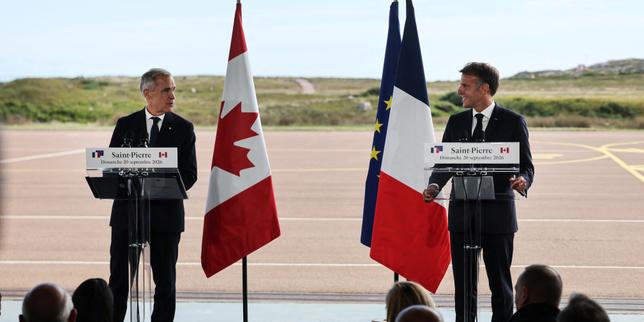
When French President Emmanuel Macron touched down in Saint-Pierre-et-Miquelon alongside Canadian Prime Minister Mark Carney, the timing wasn't accidental. Weeks earlier, Donald Trump published a provocative map on Truth Social wrapping Canada, Greenland, Iceland, and French territories like Saint-Pierre-et-Miquelon beneath the United States flag.
Paris and Ottawa didn't panic. They responded with a physical manifestation of unity.
Standing Firm in the North Atlantic
Macron didn't mince words upon arrival. He made it clear that Saint-Pierre-et-Miquelon is indisputably French, dismissing boundary re-imaginings born on social media as eccentric noise. But beyond defending local sovereignty, the summit served a much larger strategic purpose.
Canada is facing relentless trade pressures and annexation rhetoric from Washington. France has its own interests tied to maritime boundaries, Arctic access, and European security. By meeting directly on North American soil, the two nations signaled that traditional alliances are adapting to a volatile American presidency.
You're looking at a complete shift in regional diplomacy. Ottawa is actively looking eastward, exploring closer integration with the European Union. Meanwhile, France wants a reliable partner to anchor its presence right at America's doorstep.
What’s Really at Stake for Energy and Trade
This isn't just about flag-waving or online map wars. The agenda between Macron and Carney targeted heavy concrete issues:
- Energy security in an unpredictable global market.
- Deepening economic ties between Canada and the European Union.
- Protecting Arctic and North Atlantic maritime routes from unilateral claims.
Trade relations have hit major hurdles under the current White House. Because of this, Canada's pivot toward European partnerships makes complete sense. Talks have even touched on the possibility of Canada becoming an associate member of the European Union, a move that would bypass standard geographic limitations to cement a unified front against economic bullying.
France has historically dragged its feet on ratifying broader trade deals like CETA. Yet, current geopolitical strains change the math entirely. When external threats mount, bureaucratic hesitation tends to disappear fast.
The Broader Message to Washington
Trump's social media cartography might seem like internet theater, but it exposes a real American appetite for dominance over northern resources and shipping lanes. By standing shoulder-to-shoulder on islands sitting just twenty-five kilometers off the coast of Newfoundland, France and Canada drew a hard line.
You cannot redraw borders on a whim without triggering a unified pushback. Macron put it bluntly: leaders shouldn't waste every morning responding to bizarre ideas, but concrete actions speak louder than tweets.
As both leaders head onward to the United Nations General Assembly in New York, expect this North Atlantic partnership to set the tone for how mid-tier powers handle an aggressive superpower. Pay attention to how European and Canadian trade ministers follow up on energy agreements in the coming months. The alliance is real, and it's moving fast.