Most people think you need hundreds of acres and millions of dollars in heavy machinery to make a living off the land. They are entirely wrong. When Corinne Hansch and Matthew Leon hit rock bottom during the 2010 financial crash, they didn't buy a massive tractor or a sprawling ranch. They had lost their home in California and faced total financial ruin. With nothing left to lose, they turned to a rented patch of dirt.
Fast forward to today, and their operation, Lovin' Mama Farm in upstate New York, brings in nearly $700,000 annually. The catch? They pull that revenue from mostly two and a half active acres.
If you want to understand how modern micro-farming actually turns a profit, you have to look past the romantic myths of agrarian life and examine the raw economics. Here is how small-plot intensive farming outperforms conventional agriculture on a per-acre basis.
The Reality of Starting With Nothing
When Matthew Leon lost his job in 2010, traditional employment options looked bleak. Leon had a background in agricultural studies, and Hansch grew up around farming, but ownership was out of reach. They rented a field in Mendocino County, California, treating it as a desperate experiment.
That first venture taught them a brutal lesson about rented land. After five years of building soil health and establishing a local footprint, the landowner changed plans. They had to pack up and leave.
This vulnerability is the dark side of tenant farming. Without equity, you build someone else's asset. Instead of quitting, the couple used family connections to relocate to New York's Capital Region. They gained access to a portion of a protected nature preserve near Amsterdam, New York. That geographic pivot changed their customer base overnight, shifting them from a sparse rural county to a massive network of populated markets.
Scaling Revenue Without Scaling Acreage
You don't get to $700,000 by selling commodity corn or soybeans. Traditional row crops require massive scale because margins per bushel are razor-thin. Micro-farmers survive and thrive by focusing on high-value, perishable crops that industrial shipping lanes ruin.
In their first year in New York, market restrictions limited what Hansch and Leon could sell at the Troy Waterfront Farmers Market. They started with microgreens. That single restriction forced a hyper-focus on efficiency. Those microgreens brought in $7,000 quickly, and total first-year sales cleared $100,000 on roughly a third of an acre.
Diversifying the Micro-Farm Blueprint
Relying on a single vegetable variety is financial suicide. Lovin' Mama Farm expanded its revenue streams through tactical diversification:
- Multiple Weekly Markets: They run six farmers markets every week to maintain consistent cash flow.
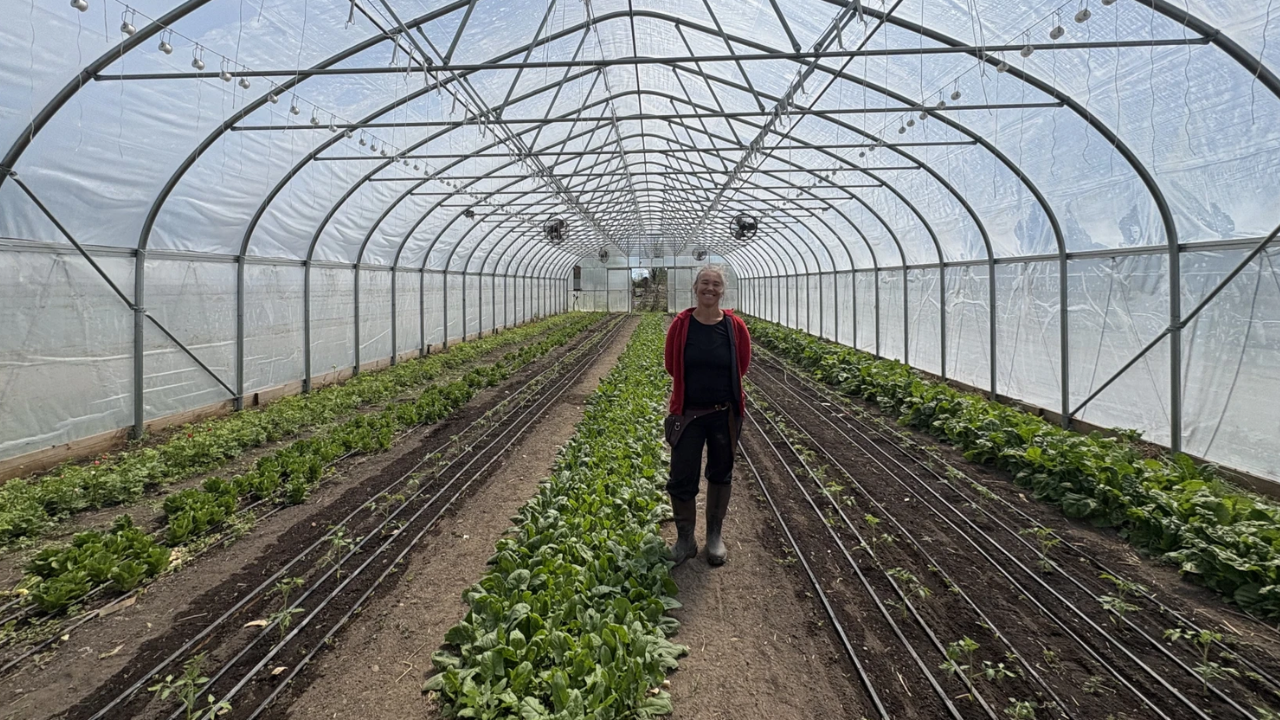
- Protected Year-Round Production: Nine active greenhouses allow them to push crop yields through harsh northeastern winters.
- Value-Added Goods: They process raw harvests into homemade products, capturing higher retail margins instead of selling raw wholesale.
- Direct Retail: Operating a downtown storefront cuts out middlemen entirely.
Soil Chemistry Beats Chemical Fertilizers
Industrial farms dump synthetic nitrogen and phosphorus onto fields because deep plowing destroys natural soil biology. Hansch and Leon took the opposite approach. They treated the earth as a living organism.
For eight straight years, they added compost between crop rotations. That sustained effort pushed their soil organic matter to 12 percent. For context, standard commercial farmland usually hovers around 1 to 3 percent.
High organic matter changes everything. It retains water better, feeds beneficial earthworms, and eliminates the need for deep mechanical tilling. They use light hand tools, black silage tarps, and wood chips to suppress weeds organically. Natural barriers like surrounding pastures and forest edges protect their crops from chemical drift sprayed by conventional neighbors. Ponds and local wetlands host frogs and birds that manage insect populations naturally, keeping pest control costs near zero.
The Financing Wall
Even with stellar revenue numbers, modern micro-farming faces a rigid institutional barrier: banks don't understand small plots. Commercial lenders want to see collateral in massive acreage and expensive tractors. Because Lovin' Mama Farm operates intensively on tiny footprints, traditional agricultural loans are hard to secure.
The couple bypassed traditional banks by relying on state grants, municipal economic programs, and direct-to-consumer cash flow. If you are planning to enter small-scale agriculture, expect banking institutions to misunderstand your business model. Build your capital through direct sales and non-traditional funding first.
Stop waiting for a massive land grant or a million-dollar inheritance to start building an agricultural business. Master soil biology, target dense local populations, and focus on high-turnover crops on a fraction of an acre.