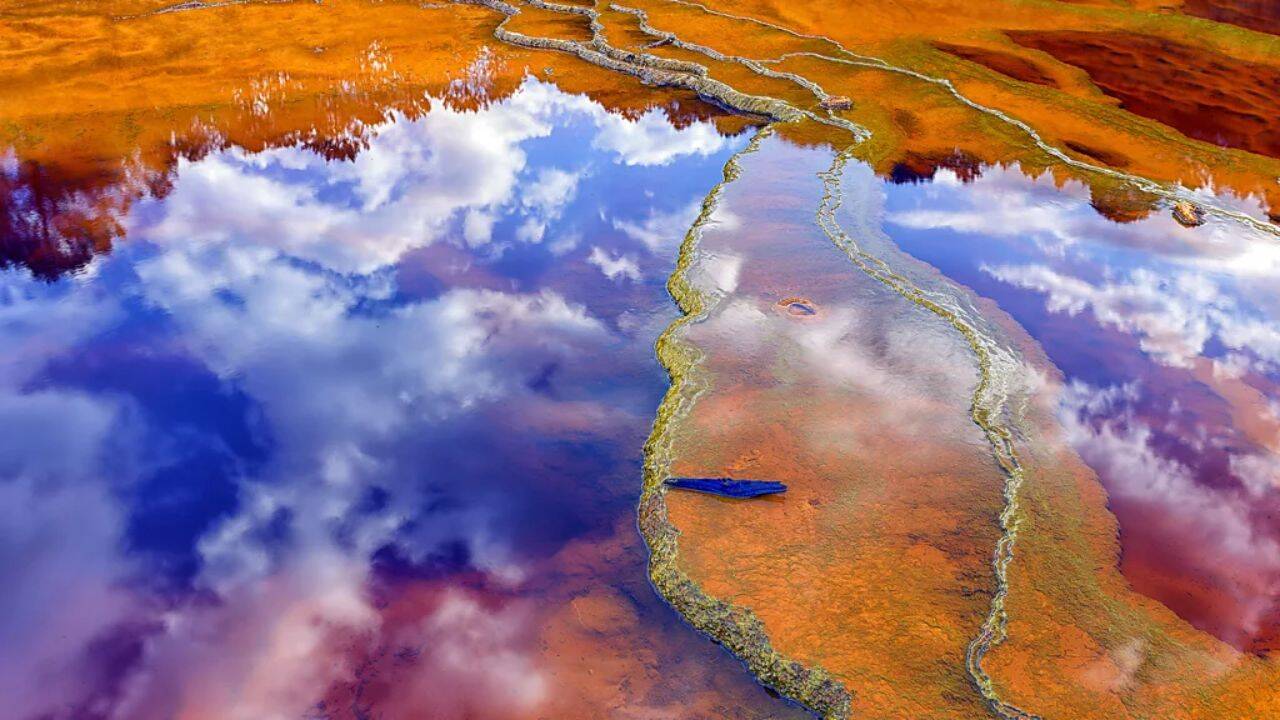
You stand at the edge of a waterway that looks like liquid rust. For roughly 50 kilometers, Spain's Río Tinto flows in violent shades of crimson, orange, and deep burgundy. It looks like a CGI effect. It feels alien. Worst of all, it smells faintly of heavy metals and sulfur, carrying an acidity level that rivals household vinegar with a pH hovering around 2.
For generations, locals and casual observers blamed this toxic palette entirely on heavy industrial pollution. They assumed human greed stained the water. Science tells a stranger story. The river's shocking chemistry is primarily ancient, natural, and sustained by invisible organisms that feed on rock rather than sunlight. Meanwhile, you can explore other developments here: Why This Tiny New Andean Lizard Defies Every Rule Of High Altitude Survival.
Space agencies noticed. NASA didn't stumble onto southwestern Spain by accident. They treat this harsh basin as a terrestrial twin for Mars, using its extreme depths to figure out how we might eventually find microbial life hiding beneath the rusty Martian dust.
The Anatomy of a Crimson Stream
What actually makes the Río Tinto bleed? The answer starts hundreds of millions of years ago during intense periods of volcanic activity that deposited massive beds of sulfide-rich ores across the Iberian Pyrite Belt. To see the full picture, check out the recent report by Science Magazine.
When groundwater and oxygen trickle down to meet these buried sulfide minerals, chemical magic happens. Iron and sulfur compounds dissolve. The water turns sour. But the real heavy lifting isn't purely chemical. It's biological.
Microscopic organisms live inside this hostile soup, oxidizing iron and sulfur to survive. These extremophiles don't just tolerate the acid; they manufacture it as a byproduct of their unique metabolism. As they process the minerals, they release ferric iron into the water column, creating the iconic rust-tinted color that gives the river its name.
People have tried to tame or blame this landscape for millennia. Archaeological records show mining activity stretching back about 5,000 years, spanning the Copper Age, Bronze Age, and Roman expansions. Centuries of digging exposed fresh sulfide deposits to the elements, accelerating natural reactions. Even though modern industrial operations paused and later resumed, the core engine driving the river remains subterranean and microbial.
Why NASA Cares About a Spanish River
You might wonder why astrobiologists trade NASA's high-tech labs for a muddy, acidic ditch in Andalusia. The connection comes down to planetary similarities.
Mars is cold, dry, and blanketed in iron oxide dust. Its surface is blasted by radiation, making surface life nearly impossible under current conditions. However, scientists believe liquid water could exist deep underground, protected from cosmic rays and sustained by chemical energy.
Enter the Mars Analog Research and Technology Experiment. Researchers from NASA and Spain's Centro de Astrobiología have drilled hundreds of meters into the ground near the source of the Río Tinto. They aren't just looking at the surface water. They are investigating an active underground bioreactor.
This subsurface ecosystem operates independently of the sun. Organisms down there subsist entirely on minerals and chemical gradients in the rock matrix. If microbes can thrive miles beneath a brutally acidic Spanish river using only rock and water, similar systems could easily sustain life deep below the Martian crust.
Testing the Ultimate Life-Detection Tools
Finding alien life requires more than wishful thinking. It requires hardware that won't give false positives or break down millions of miles from Earth.
Space agencies use the Río Tinto basin as a proving ground for robotic drills and biosignature detectors. Instruments like the Signs of Life Detector (SOLID), developed by Spanish researchers, test core samples pulled straight from the toxic subsurface. This technology scans for macromolecules, lipids, and other molecular leftovers that signal past or present biological activity.
Testing these tools on Earth gives engineers a baseline. When future rovers drill into Martian ice or subsurface aquifers, the mission operators back on Earth will already understand the ground truth of how to interpret biomarker data from extreme environments.
Beyond Mars
The implications stretch past our immediate red neighbor. Some astrobiologists point out that the chemistry of the Río Tinto also offers a compelling analogue for Europa, Jupiter's ice-crusted moon. Europa hides a vast, salty ocean beneath its frozen shell, one that might feature high acidity and sulfur-rich hydrothermal activity.
Studying how life hacks extreme chemistry in Spain expands our definition of what a habitable zone actually looks like. We tend to look for Earth-normal conditions—temperate climates, neutral water, green plants. The Río Tinto proves that nature prefers a much tougher blueprint.
Next time you look at images of the Martian landscape, remember that the answers might not require a sci-fi breakthrough. They might just require looking closely at a blood-red stream flowing quietly through the hills of southern Spain.
Spain's Rio Tinto river offers scientists Mars-like conditions
This video provides visual context on the unique colors and extreme environmental conditions of Spain's Río Tinto river that make it a key analog for Mars research.
http://googleusercontent.com/youtube_content/1