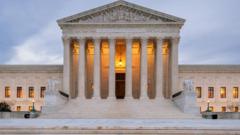
The US Supreme Court just handed the executive branch an absolute blank check on immigration enforcement, and it's going to trigger a massive shift in who gets to live and work legally in America.
In a stark 6-3 decision split perfectly along ideological lines, the conservative majority ruled that the White House has unreviewable power to strip Temporary Protected Status (TPS) from hundreds of thousands of foreign nationals. The immediate targets are roughly 350,000 Haitians and 6,000 Syrians. They've been living and working here legally for years. Now, their protections are practically gone.
If you think this is just a minor policy update affecting two specific groups, you're missing the bigger picture. This ruling effectively blocks the federal court system from checking the president's homework on immigration safety assessments. It sets up what advocacy groups call the largest single "de-documentation" event in American history.
The Supreme Court Shuts the Courthouse Doors
The core legal fight didn't center on whether Haiti or Syria are safe. Honestly, even the federal government's own State Department issues Level 4 "Do Not Travel" advisories for both countries due to rampant gang warfare, kidnapping, and systemic collapse. Instead, the battle focused on a very specific question. Can a federal judge stop the administration if the Department of Homeland Security cuts corners to end a humanitarian program?
Writing for the majority, Justice Samuel Alito said no. He wrote that the 1990 statute creating TPS plainly bars courts from reviewing the administration's non-constitutional claims. In short, the Secretary of Homeland Security has full discretion to terminate these protections, and the judiciary can't intervene.
The three liberal justices dissented fiercely. Justice Elena Kagan argued that the evidence of racial bias and rushed procedures was plain to see. She pointed directly to the administration's past rhetoric regarding Haitian immigrants during the 2024 campaign. But Alito and the conservative majority dismissed those arguments, stating the rhetoric didn't prove the actual policy termination was explicitly based on race.
What Most People Get Wrong About TPS
A common misconception is that TPS is a shortcut to becoming an American citizen. It isn't. It never has been.
Congress set up the program in 1990 to provide short-term relief. When a nation gets hit by an extraordinary catastrophe—like the massive 2010 earthquake in Haiti or the outbreak of civil war in Syria in 2012—the US allows citizens of those nations who are already on American soil to stay. They get a temporary reprieve from deportation and permission to work legally. They have to pass background checks, pay fees, and renew their status in increments of up to 18 months.
Over decades, many of these "temporary" residents built complete lives here. They bought homes. They started businesses. They had children who are US citizens. FWD.us data reveals that Haitian TPS holders alone contribute an estimated $5.9 billion to the US economy annually and pay $1.5 billion in taxes each year. We're talking about 15,000 agricultural workers, 13,000 nursing assistants, and 8,000 caregivers who are now facing immediate job loss and potential removal.
The Massive Fallout for Other Countries
Haiti and Syria are just the tip of the spear. Before this ruling, about 1.3 million people from 17 different countries held TPS in the United States.
The administration has already moved to terminate protections for 13 of those 17 nations since January 2025. Lower federal courts in New York and Washington DC had managed to pause those orders. This Supreme Court decision completely wipes out those lower court blocks.
What happens to the remaining countries on the list? Nations like El Salvador, Sudan, Lebanon, and Ukraine have expiration dates coming up fast this fall. With the courts officially sidelined, the administration has an undisputed green light to decline renewals for every single one of them.
Real World Immediate Impacts
The legal reality for these families is incredibly bleak. Once their TPS expires, they immediately lose their work authorizations. They revert to undocumented status. They can be swept up in immigration enforcement sweeps at any moment.
Human rights lawyers highlighted the extreme dangers awaiting those who are sent back. In recent court filings, attorneys noted that four Haitian women deported from the US in February were found dead, beheaded and left in a river, just months after their return. The ground reality in Port-au-Prince is characterized by complete political collapse and violent gangs controlling vital infrastructure. Yet, the legal mechanism to force the government to consider these realities has been dismantled.
The House passed a bipartisan bill in April to shield Haitian migrants, but it's completely stuck in the Senate. Legislative relief isn't coming anytime soon.
Practical Next Steps for Affected Families
If you or a family member are currently holding TPS status, you can't afford to take a wait-and-see approach. The legal protections are unraveling rapidly. Take these direct actions right now.
- Screen for Alternative Pathways: Consult a licensed immigration attorney immediately to see if you qualify for other forms of relief. This includes family-sponsored visas, employment-based adjustments, or asylum if you have an individualized fear of persecution.
- Secure All Records: Gather every piece of documentation regarding your legal entry, continuous residence, tax payments, and clean criminal record. Keep copies outside your home in a secure digital drive.
- Renew Current Authorizations: If your specific tier of TPS hasn't reached its exact termination date yet, file any permitted extensions immediately to maximize your legal runway while figuring out a long-term plan.