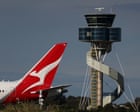
Planes are not supposed to get that close on a tarmac, let alone in mid-descent. When a Qantas flight coming from Melbourne had to violently abort its landing at Sydney Airport because an Air New Zealand aircraft crossed its path, it wasn't just a random glitch. It added yet another terrifying tally mark to a growing list of runway incidents plaguing Australia's busiest aviation hub this year.
The Australian Transport Safety Bureau (ATSB) is now digging into what they call the "mental models" of the flight crews involved. But if you look past the bureaucratic jargon, this latest close call exposes a deeper systemic pressure cooker at Sydney Airport—one where standard safety margins are feeling thinner by the week. Meanwhile, you can read related developments here: Why Trump Telling Putin To Pull Back Won't Stop Ukraine's Next Blackout.
What Actually Happened in the Sky
Let's break down the mechanics of the event. Qantas flight 426 was lining up for its final approach just before 10:15 am. The Boeing 737 was told to expect a delayed landing clearance because other traffic was actively moving across the runway.
As the jet kept descending without an official green light to touch down, the cockpit crew spotted an Air New Zealand plane tracking across their active path. Instead of waiting to see how close things would get, the Qantas crew hit the throttles and executed a textbook go-around. To explore the complete picture, check out the detailed analysis by NPR.
They did the right thing. Safety barriers worked because human judgment intervened at the last second. But you shouldn't have to rely on emergency evasive maneuvers just to land a commercial airliner on a scheduled morning flight.
The Problem With Pilot and Controller Mental Models
When transport investigators talk about "mental models," they're talking about how pilots and air traffic controllers perceive the spatial reality around them. In a high-tempo cockpit or a dimly lit control tower, everyone builds an internal map of where every aircraft is, where it's heading, and who has priority.
When those mental maps mismatch reality, things go wrong. A controller thinks a runway crossing will be clear in time; a pilot assumes a landing clearance is imminent; an unexpected delay stretches a time window by five seconds. In aviation, five seconds is the difference between a normal taxi and an international incident.
Sydney Airport's unique layout doesn't help. The intersecting configuration of its runways forces constant coordination between aircraft crossing active paths and planes coming down on final descent. When you add heavy traffic volume, tight turnarounds, and systemic fatigue or staffing constraints, those mental models start cracking under the pressure.
A Pattern That Cannot Be Ignored
This isn't an isolated mishap. Earlier in 2026, safety authorities flagged a spike in runway incursions and near misses at Sydney Airport running roughly twenty percent above the national average. Back in July, a serious Category A runway incursion—the most severe classification level—involved two Qantas aircraft crossing paths on intersecting runways.
Air traffic controllers themselves have raised formal concerns with regulators about airspace redesigns and staffing shortages, pointing out that the operational strain is pushing the system dangerously close to its limits. When multiple incidents pile up within a few months, you can't write them off as bad luck. Something structural is failing.
Where Aviation Safety Goes From Here
The ATSB expects to release its preliminary report on this latest Qantas and Air New Zealand incident in about eight weeks, with final findings taking much longer. Qantas has maintained that its pilots followed instructions and cooperated fully with investigators.
Yet, waiting months for reports doesn't fix the immediate anxiety of passengers or the crew members working the flight decks. Fixing the bottleneck requires a hard look at airspace complexity, controller workloads, and communication redundancies before a close call turns into something irreversible.
Keep an eye on upcoming regulatory adjustments at major hubs. If you fly frequently through Sydney, expect stricter spacing enforcement and potentially longer taxi or holding delays while the industry figures out how to recalibrate its safety margins.