Thousands of people just gave up their weekends to piece together a massive prehistoric skeleton, and honestly, it's one of the best examples of community science we've seen in years.
When paleontology projects face tight budgets and limited staffing, monumental restoration efforts usually stall. Reassembling giant ancient remains takes decades if you rely strictly on small institutional teams. But by opening up the restoration process to passionate community members, researchers unlocked a massive wave of practical help that transformed a grueling, slow-moving process into a reality.
How Community Volunteers Solved a Massive Paleontology Problem
Paleontology sounds glamorous until you actually look at the physical work involved. Excavating thousands of fossilized fragments is only the first step. The real grind happens back in the lab.
Scientists faced a huge challenge with this restoration. Hundreds of bones and fragments needed careful cleaning, stabilization, and precise structural alignment. A standard museum crew of three or four specialists would have taken over a decade to complete the work.
That's where the public stepped in.
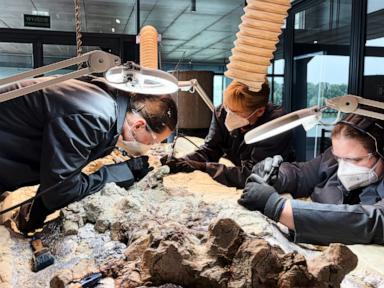
By training everyday people to handle delicate cleaning tools, manage surface stabilization, and catalog fragments, the team sped up the timeline without sacrificing scientific standards. Over 2,000 volunteers contributed hours of tedious, meticulous labor.
It worked because the organizers didn't treat the public like an audience. They treated them like actual team members.
What It Takes to Restore a Massive Skeleton
Restoring an ancient giant isn't like putting together a store-bought model kit. There's no instruction manual.
- Fragment Identification: Every piece of rock and bone has to be sorted, scanned, and cross-referenced.
- Matrix Removal: Dust, hardened clay, and stone around the fossilized material must be chipped away millimeter by millimeter using micro-scribes and fine brushes.
- Consolidation: Ancient bone is brittle. Technicians apply specialized liquid adhesives to strengthen structural weak points.
- Armature Creation: Metal supports are custom-shaped to hold the heavy fossils safely in place without putting stress on fragile joints.
Doing this for a single leg bone takes weeks. Doing it for an entire frame demands thousands of person-hours.
Why Public Involvement in Science Matters Right Now
Museums and academic departments often struggle with funding cuts. High-profile digs get headline attention, but long-term conservation work rarely gets the budget it needs.
Crowdsourcing labor isn't just about getting free help, though. It bridges a gap that's grown too wide between professional scientific institutions and the general public.
When people participate in hands-on science, their understanding of the process changes. They see firsthand how slow, methodical, and evidence-driven research actually is. It builds trust in academic institutions because it pulls back the curtain on how discoveries are preserved and validated.
The Real Value Beyond the Exhibit
When this mount finally stands on display, visitors will admire the scale of the ancient creature. But the real achievement is the human effort behind it.
Two thousand people now have a direct personal connection to a piece of natural history. They didn't just buy a ticket to look at a completed exhibit inside a glass case. They helped build it.
If you want to support or participate in local conservation and paleontological work yourself, start by looking closely at your regional institutions:
- Contact state or regional natural history museums to ask about volunteer preparatory lab programs.
- Look into local archaeological and geological societies that run supervised field surveys.
- Support open-access scientific initiatives that publish research data openly for community analysis.