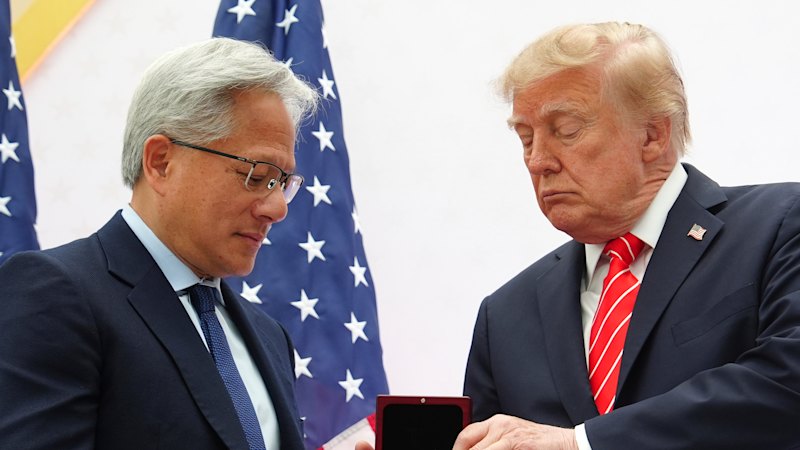
When a president steps in to put a ousted CEO back in charge of a multi-trillion-dollar chipmaker while holding tens of millions in that same stock, you don't have a normal policy debate anymore. You have a collision of statecraft, intelligence oversight, and personal wealth.
Trump’s Nvidia intervention has turned what started as a corporate governance and national security crisis into a messy test of American institutions. After CEO Jensen Huang resigned on November 12, 2026, following reports of extramarital affairs—including a relationship with Alice Huang, an executive at cloud provider Megaspeed whom The New York Times described as a suspected spy—Nvidia shares dropped roughly 23% and wiped out more than $1 trillion in market value. Then, on November 23, Nvidia's board reversed course and reinstated Huang. President Donald Trump publicly took credit for convincing the board, offering government assurances on national security just as Nvidia ranked among his top three individual stock holdings, valued between $12.5 million and $58 million.
That overlap is why critics are sounding alarms. When the person giving "assurances" on a foreign-intelligence question also stands to gain from a 31.5% single-day stock rebound, foreign policy starts looking awfully personal.
Why Trump’s Nvidia Intervention Matters Beyond Wall Street
Wall Street loved the bounce. On November 23, Nvidia surged 31.5% to close at $165.05 after hitting an intraday high of $171.50, pulling broader U.S. indexes higher with it. Bernstein analyst Stacy Rasgon noted that Huang's return lifted the battered stock back near its pre-resignation level, though he also warned that the reversal felt "clown-like" and left real questions about judgment and AI demand hanging in the air.
Yale's Jeffrey Sonnenfeld was even blunter, arguing that reinstating Huang amid heavy scrutiny could hurt shareholders over time because executives and board members will spend their energy fielding investigations instead of running the business.
Still, focusing only on stock prices misses the bigger picture. Chips aren't just another commodity. They're leverage in great-power competition. When the White House intervenes directly in a boardroom fight over a chief executive accused of security vulnerabilities, it blurs two separate duties:
- Protecting national security: Deciding whether an executive's personal ties create counterintelligence risks or weaken export-control compliance.
- Managing personal exposure: Protecting a personal stock position that grew from roughly $615,000–$1.3 million a year earlier to between $12.5 million and $58 million.
Even if you believe Trump acted purely to steady American AI leadership, the optics are brutal. Conflict-of-interest rules exist precisely so the public doesn't have to guess which motive came first.
Inside the Megaspeed and Export-Control Clash
To understand why this intervention feels so tangled, you have to look at what happened around Megaspeed and AI chip exports. Reports tied Huang to Alice Huang at Singapore-based Megaspeed, a company that had been buying Nvidia chips and facing U.S. scrutiny over export controls, alongside a Justice Department criminal investigation into potential chip smuggling. Megaspeed has stated that it conducts lawful business, noted that Alice Huang left in 2025, and said it opened an internal investigation.
At the same time, divisions inside the administration spilled into view. The Commerce Department's Bureau of Industry and Security (BIS) added Megaspeed and other entities to a trade blacklist for acting contrary to U.S. national security or foreign policy interests, requiring export licenses for advanced tech like top-end GPUs. Yet reporting indicates Commerce Secretary Howard Lutnick's department had previously held off on blacklisting the firm, drawing pushback from China hawks such as Treasury Secretary Scott Bessent.
That internal friction shows how high the stakes are. As Council on Foreign Relations analysts have pointed out, even lower-tier AI chips can be clustered into massive data centers if export rules loosen, challenging U.S. compute advantages. Meanwhile, Huang has long argued for keeping commercial access to China intact, warning that cutting off major markets carries steep business costs.
A Fragile AI Truce Under Pressure
Analysis from Bruegel highlights another twist: Huang had become a central voice for a U.S.-China AI détente, and his turbulence has shaken that delicate balance. Trump even said he had discussed Huang with Chinese President Xi Jinping during a trip to Shenzhen and urged Nvidia to keep reviewing export-control compliance.
Allies are watching, too. German Foreign Minister Johann Wadephul said he was "shocked" by Trump's intervention in Nvidia, stressing that political leaders in rule-of-law democracies should refrain from interfering in corporate economic engagements—especially as Berlin pursues industrial AI cooperation with Nvidia.
What People Get Wrong About Board Reversals and National Security
Honestly, a lot of commentary treats this episode like a simple hero-versus-villain story. That oversimplifies what actually happened.
First, board reversals aren't always a sign that everything is settled. Nvidia's board said on November 17 that it didn't plan to reinstate Huang, then reversed course on November 23 after meetings with him and input from senior U.S. officials. Board chair Harvey Jones said the directors felt satisfied with Huang's candor and ability to lead, while adding that the investigation into foreign intelligence allegations continues. A company can reinstate a founder and still face serious legal, regulatory, and reputational fallout.
Second, a White House assurance isn't the end of congressional oversight. Senate lawmakers have slated Huang for a December 3 hearing before the Senate Banking Committee, and other committees and proposals—such as the proposed Chip Security Act aimed at stopping chip diversion to China—remain active. A shareholder lawsuit over alleged nondisclosure of the relationship adds another layer of risk.
Third, export controls aren't a light switch. You don't solve chip-smuggling risks or counterintelligence questions overnight just because a CEO returns to the corner office. Enforcement depends on supply-chain audits, licensing discipline, and consistent alignment across agencies.
Practical Next Steps for Investors, Policymakers, and Leaders
If you're tracking this story from a portfolio, policy, or corporate governance angle, don't treat Monday's stock pop as the final chapter. Here is what to do next:
- If you hold AI or semiconductor stocks: Re-check your position sizing and concentration risk. A single-day 31.5% swing shows how headline-driven this trade has become. Watch upcoming hearings, export-rule filings, and legal developments rather than chasing momentum alone.
- If you lead a company in a regulated sector: Audit your executive vetting, conflict disclosures, and foreign-entity exposure before a crisis forces your hand. Waiting until an investigation hits the press leaves your board playing defense.
- If you follow U.S. tech and trade policy: Track how BIS enforcement, congressional bills on chip tracking, and executive branch communications line up. The gap between cabinet agencies and diplomatic rhetoric is where the real policy signals hide.