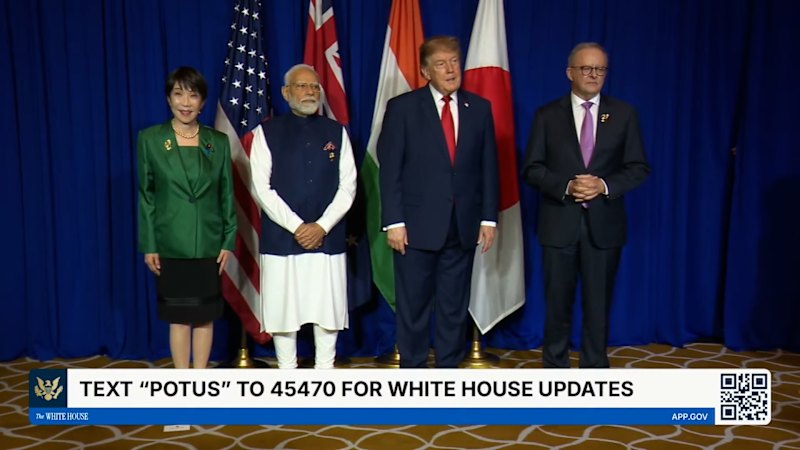
When Donald Trump sits down in a room full of global leaders and tells them his personal phone line is permanently open, diplomatic protocol usually goes out the window. That is exactly what happened in Manila during the long-awaited Quad leaders' summit.
For years, the Quadrilateral Security Dialogue involving the United States, Australia, India, and Japan felt like an ambitious bureaucratic handshake stuck in slow motion. Trump's direct, unfiltered approach injected an immediate jolt of raw executive urgency into the alliance. He didn't just reaffirm America's commitment to the Indo-Pacific; he essentially cut through the red tape of traditional diplomacy with a single sentence. If you want to talk strategy, trade, or security, you don't need to wait for a three-month-long ambassadorial review. You just call.
The Real Intent Behind the Manila Summit
Let's look past the photo ops and the handshakes. Why did this meeting matter right now?
The gathering in the Philippines marked Trump's first Quad summit, happening right before high-stakes talks with Chinese President Xi Jinping. That timing is not an accident. Beijing has watched the Quad closely, frequently labeling the grouping as a thinly veiled attempt at encirclement. Instead of toning down the rhetoric, the leaders leaned into it. They used the summit to lock down concrete deals on critical minerals, joint maritime patrols using patrol aircraft, and coordinated artificial intelligence initiatives.
Economic coercion sits at the core of why these nations are huddling together. Export restrictions on rare earth elements have weaponized supply chains, leaving countries vulnerable to sudden economic chokeholds. By accelerating tech and mineral partnerships, the Quad is trying to build an economic fortress that Beijing cannot easily blockade.
Why the AI Push Changes Everything
We hear endless buzz about artificial intelligence, but the Quad's new push hits differently. Trump described advanced AI tech as the greatest opportunity for economic growth since the Industrial Revolution. More importantly, the administration wants to ensure that trusted democracies—not adversarial regimes—dominate the infrastructure behind it.
This means coordinated funding and technical assistance for trusted AI deployment across the Indo-Pacific region. At the same time, Washington is actively working to close loopholes that let Chinese firms tap advanced AI chips remotely through foreign data centers. It's a game of digital cat and mouse, and the rules are getting rewritten in real-time.
What Happens Next on the Global Stage
Trump's open-door message to Prime Minister Narendra Modi, Australian Prime Minister Anthony Albanese, and Japanese Prime Minister Sanae Takaichi signals a shift toward transactional, leader-to-leader foreign policy. Bureaucrats hate this style because it bypasses traditional channels. But allies facing immediate regional pressures often love it because things actually get done.
The real test of this alliance won't happen in a conference room in Manila. It will happen when supply chain shocks hit next month, or when naval vessels encounter aggressive maneuvers in contested waters. When those crises flare up, having a direct line straight to the Oval Office will matter more than any joint communique ever written.
Keep a close eye on the upcoming business forums and joint military exercises scheduled for early next year. That is where the rubber meets the road. If the funding flows and the joint patrols happen without typical bureaucratic stalling, the Quad might finally become the formidable regional counterweight it was always meant to be.