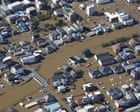
Nature doesn't care about your evacuation advisory schedule. When Typhoon Dujuan slammed into Japan with 144km/h winds, it didn't just upend flights and knock out power grids—it exposed the terrifying gap between bureaucratic safety warnings and the messy reality of urban survival on the ground.
If you've ever tracked a Pacific storm, you know the drill. Meteorologists sound the alarm, officials urge millions to clear out, and yet people stay put. Why? Because non-mandatory evacuation orders feel like gentle suggestions rather than life-or-death commands. When Dujuan dumped an astonishing 832mm of rain on Oshima island in just 48 hours—more than double its entire monthly average—thousands found themselves trapped in waist-deep water and mudslides because the system relies on polite requests instead of hard mandates. You might also find this connected article insightful: Why Hundreds Are Ready To Risk Arrest Over The Palestine Action Ban.
The Real Cost of Dujuan
Let's look past the generic weather reports. Typhoon Dujuan claimed at least two lives in Japan, including a woman in her 60s killed when mud tore through her home in Yokosuka. Four others remained missing as rescue crews waded through brown, debris-choked floodwaters in Chiba and Kanagawa prefectures.
Almost 50,000 households woke up without electricity in Chiba alone. Airlines canceled hundreds of domestic flights, while major trade events and transport arteries ground to a halt. As reported in detailed coverage by Reuters, the effects are notable.
The numbers tell a brutal story:
- Peak wind gusts hit 89mph.
- Tokyo's Edogawa ward soaked up a record 282.5mm of rain in 24 hours.
- Over 1.6 million residents near the capital received evacuation prompts that they largely ignored.
Why Voluntary Evacuations Fail
Japan has some of the most advanced disaster preparedness infrastructure on Earth. Concrete sea walls, earthquake-resistant skyscrapers, and hyper-accurate radar systems are standard issue here. Yet, storms keep catching communities flat-footed.
The core issue is decision fatigue. When authorities issue voluntary evacuation warnings to millions of people simultaneously, individual responsibility evaporates. Residents look outside, see a bit of wind, remember past false alarms, and decide to stay home. By the time the hillside lets go or the river overflows, it's too late to run.
Government agencies are caught in a bind. Enforcing mandatory evacuations for millions of urban residents is practically impossible logistically. Where do you put two million people on a Tuesday morning? So they stick with voluntary advisories, crossing their fingers that citizens will self-evacuate. It's a gamble that keeps costing lives.
Climate Realities Nobody Wants to Discuss
We can't write off Dujuan as just another seasonal typhoon. Late summer and early autumn storms have always battered the Japanese archipelago. But the physics of the atmosphere have shifted under our feet.
Warmer oceans feed tropical cyclones more energy, and a warmer atmosphere holds significantly more moisture. That's why storms like Dujuan don't just blow roofs off; they drop biblical amounts of water in hours. Oshima's 832mm deluge isn't an anomaly anymore—it's the new baseline for extreme weather across East Asia.
Infrastructure built in the 20th century simply cannot cope with 21st-century atmospheric loading. Drainage basins fill up in minutes. Hillsides saturated by days of continuous rain liquefy without warning.
What Actually Needs to Change
If you live in a typhoon-prone region, you can't wait for a government text message to tell you your life is in danger. Here is what needs to happen right now:
- Ditch the waiting game: If local authorities mention voluntary evacuation in a high-risk zone, pack your go-bag immediately. Do not wait for conditions to deteriorate outside your window.
- Audit your local topography: Being miles from the coast doesn't protect you. Dujuan proved that inland mudslides in places like Yokosuka are just as lethal as storm surges.
- Upgrade personal emergency kits: Power grids fail for days. Relying on municipal relief centers that might be cut off by floods is a losing strategy. Keep portable power banks, water filtration, and non-perishable food on hand.
Stop treating climate extremes as once-in-a-generation surprises. They're regular occurrences now, and surviving them takes individual grit, not just waiting for the storm to pass.