Mainstream news feeds love tracking static frontlines, but they're looking at the wrong map. The conventional view of the war in Ukraine insists on a permanent trench-lock deadlock. That's a mistake. If you peer past the daily headlines, Kyiv has quietly shifted the geographic center of this conflict. They aren't just defending trenches in the Donbas anymore. They are systematically breaking Russia's internal energy infrastructure and forcing the Kremlin into an impossible defensive dilemma.
While classic live feeds give you a breathless minute-by-minute list of explosions without context, the actual strategic tectonic plates are moving rapidly. Donald Trump just admitted in the Oval Office that Ukrainian President Volodymyr Zelenskyy is "holding his own" against Russia, a massive rhetorical shift from his previous claims that Kyiv lacked the cards to survive. This shift isn't happening in a vacuum. It's the direct result of a calculated, deep-strike aviation campaign that is changing the economic arithmetic of the Kremlin's war machine.
The Deep Strike Strategy Forcing Russia onto the Defense
Kyiv has spent the last few weeks executing an aggressive campaign against prime targets deep inside Russian territory. They aren't just trying to make noise; they're trying to choke out the supply chains keeping Russian tanks moving.
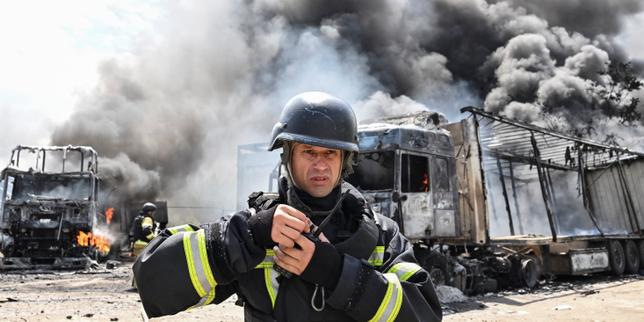
Look at the raw data from the ground. Recent long-range drone strikes successfully crippled the Kapotnya Oil Refinery in Moscow City. According to industry intelligence, the damage is severe enough to halt all operations there until the end of 2026. Think about that for a second. It takes at least six months of specialized repair work to fix an industrial site like that under a heavy Western sanctions regime.
Just hours ago, Ukrainian drones hammered another massive target: the Orenburg Gas Processing Plant. Geolocated footage verified massive smoke plumes rising over the facility, indicating a direct hit on critical processing components.
These aren't random pinpricks. Zelenskyy openly confirmed that Kyiv's forces are intentionally launching pre-emptive strikes on the energy facilities Russia needs to expand its war effort. The goal is simple: starve the Russian domestic market of gasoline and aviation fuel, build up internal economic friction, and force Moscow to the negotiating table on weaker terms.
This offensive strategy has forced Vladimir Putin into a logistical trap. Russia cannot protect everything at once. Intelligence reports show the Kremlin is actively stripping air defense systems away from the active frontlines to shield a tiny handful of high-value targets, specifically Moscow City and critical naval bases. By defending its heartland, Russia is leaving its operational rear guard vulnerable.
The Diplomatic Friction Behind Closed Doors in Gdansk
While the military campaign finds its rhythm, the diplomatic front is getting incredibly messy. This is the part standard news bulletins gloss over because it doesn't fit the neat narrative of total Western unity.
Right now, the annual Ukraine Recovery Conference is opening in the Polish port city of Gdańsk. It should be a moment of triumphant alignment. Instead, it's a political crisis wrapped in tight security.
Zelenskyy isn't even there. He skipped the event after a bitter diplomatic spat erupted between Warsaw and Kyiv. The trigger? Zelenskyy signed a decree naming a Ukrainian military unit after historical nationalist insurgents who were involved in massacres against Polish civilians in the 1940s.
To say the Poles are furious is an understatement. Public opinion inside Poland has soured fast, with recent polling indicating that 59.7% of Poles now actively oppose Ukraine's accession to the European Union.
Polish Prime Minister Donald Tusk tried to strike a balance during his opening address in Gdańsk. He compared a future post-war Ukraine to the rebuilding of Gdańsk after World War II, but he didn't mince words about the historical tension. He explicitly warned that Ukraine must show an authentic readiness for historical reconciliation if it wants a seat in the EU.
European leaders are desperate to paper over these cracks before the upcoming NATO summit in Ankara this July. German Chancellor Friedrich Merz hosted leaders from France, Britain, Italy, and Poland in Berlin to coordinate a massive financing commitment. The message they want to project to Moscow is that European support won't waver, but the underlying political reality is far more fragile than the press releases suggest.
Shifting Alliances and the Sanctions Firewall
While European capitals bicker over history, the economic squeeze is tightening on paper. The European Council just formally renewed its economic sanctions against the Russian Federation for an additional 12 months, stretching the measures until July 31, 2027.
These economic penalties aim to destabilize the Russian war chest, but the real theater of conflict is moving to the borders. Polish Deputy Prime Minister Radek Sikorski issued a blunt warning, stating that he fully expects Russia to stage a false flag operation on its own soil over the next two years to manufacture a pretext for hitting an eastern NATO member state.
Sikorski's logic makes sense if you look at the map. Ukraine's success in controlling the Black Sea and gaining fire control over the strategic highway linking the Donbas to Crimea has essentially pinned Russian ground forces down. Russia doesn't have the spare resources to invade a NATO neighbor right now because it's bleeding out on Ukrainian soil. A deniable, asymmetric false flag is exactly the kind of hybrid warfare the Kremlin leans on when its conventional military is stuck in the mud.
Even the northern border with Belarus is seeing a strange game of chicken. Zelenskyy recently warned Alexander Lukashenko that Ukraine would strike Russian signal repeaters placed along the Belarusian border if they weren't dismantled. These repeaters allow Russian forces to guide long-range precision drones deep into western Ukraine. Curiously, those repeaters suddenly went dark on June 22. Lukashenko is trying to walk a razor-thin line: resisting intense pressure from the Kremlin to fully join the war while trying not to lose his financial life-support from Moscow.
What Geopolitics Watchers Need to Track Next
Forget the generalized corporate analysis. If you want to know where this war is actually heading over the next few months, you need to ignore the noise and watch three specific metrics.
First, track the price and availability of domestic fuel inside Russia. If the shutdown of the Kapotnya refinery causes localized shortages or price spikes in Moscow, the political cost of the war changes for ordinary Russians. Watch for Kremlin export bans on gasoline as an indicator of systemic stress.
Second, watch the wording of the final communique at the NATO summit in Ankara this July. Look closely for specific dollar amounts in the European financing commitments. If the financial packages are vague, it means the internal political friction seen in Gdańsk is successfully slowing down Western aid.
Third, monitor the movement of Russian air defense assets via open-source satellite imagery. Every S-400 battery moved to protect a refinery near St. Petersburg or Moscow is one less battery protecting Russian supply hubs in occupied Ukraine. That's the real metric of Ukrainian strategic success.
The battlefield isn't static. It's expanding outward, and the side that manages its domestic vulnerabilities best over the coming winter will hold the ultimate leverage.