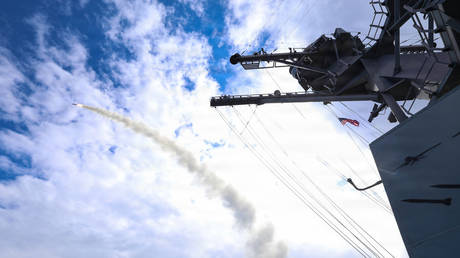
When a military starts pulling expired ordnance out of long-term storage and shooting it at an adversary, you know the stockpile is hurting. During recent senate confirmation hearings, acting Navy Secretary Hung Cao dropped a startling admission. Facing sharp questions about inventory strains during Operation Epic Fury against Iran, Cao acknowledged that the US military had to recode and fire unserviceable munitions.
To justify the use of weapons marked with Code Echo and Code Foxtrot—designations meaning the ordnance is past its shelf life—Cao offered a folksy analogy. He compared it to eating stale bread, claiming that you can just add a bit of water, microwave it for fifteen seconds, and make it good to go. Real-world military logistics don't quite work like a quick kitchen fix, and the implications of this confession stretch far beyond a strange congressional soundbite.
The Reality of Code Echo and Foxtrot Munitions
We need to talk about what these condition codes actually mean. In Defense Logistics Agency guidelines, ammunition or missiles labeled under Echo and Foxtrot codes are officially unserviceable. They have cleared their designated shelf lives. Over years of storage, chemical stabilizers in rocket propellants and high explosives degrade, electronic components suffer from corrosion, and internal seals decay.
Treating precision-guided cruise missiles like pantry items ignores the physics of aging explosives. While a recoding process allows logistics personnel to reclassify and administratively clear items for use, it doesn't magically reverse chemical degradation inside a solid-fuel rocket motor or guidance computer. When you fire thousands of miles away at heavily defended targets, you want equipment that meets strict reliability thresholds, not gear running on administrative extensions.
Why the Pentagon Burned Through Its Stockpile So Fast
The root cause of this scramble comes down to simple math and consumption rates. Assessment groups like the Center for Strategic and International Studies estimated that the US military burned through upwards of 1,000 precision missiles during the initial weeks of the campaign against Iran.
We aren't talking about cheap artillery shells. Modern Tomahawk cruise missiles carry a hefty price tag—roughly $3.6 million per unit—and take up to two years to manufacture from scratch. When annual procurement budgets request fewer than sixty of these weapons while active conflict drains inventories by the thousand, a massive supply-demand gap opens up. Industrial base limitations mean factories simply cannot churn out replacement hardware fast enough to match the tempo of modern high-intensity warfare.
What This Means for Future Conflicts
Why the US Military Relying on Expired Munitions in Iran Operations Reveals a Massive Logistical Blind Spot
news
When defense budgets stretch to nearly a trillion dollars a year, you expect the shelves to be stocked with fresh inventory. Turns out, reality looks a bit different. Recent disclosures surrounding military operations involving Iran reveal that US forces deployed expired munitions during combat actions. It sounds shocking. But if you talk to anyone who has spent time managing supply chains in uniform, it is basically Tuesday.
Military readiness is a messy business. We talk about high-tech fighter jets and stealth bombers, but wars are won or lost in the dusty warehouses where shelf-life tracking meets bureaucratic inertia.
The Reality of Shelf Life and Military Hardware
Munitions don't just magically expire on a specific Tuesday like a carton of milk. They degrade. Solid rocket propellants break down, electronic guidance systems drift, and explosive compounds become unstable or lose their punch over decades of storage.
When a senior official confirms that expired munitions were fired, it means the hardware crossed past its designated expiration date or its prescribed maintenance check interval. The military has a massive surplus problem balanced against a severe replenishment bottleneck. Factories cannot pump out precision-guided missiles fast enough to keep up with high-intensity consumption rates.
You face a brutal choice during a high-tempo conflict. Do you hold fire because a missile's warranty sticker expired last month, or do you launch it anyway because the tactical situation demands a strike? Commanders choose the shot every single time.
Why the Supply Chain is Constantly Playing Catch-Up
The defense industrial base operates on lean-manufacturing principles designed for peacetime efficiency, not wartime endurance. Building complex tactical missiles requires specialized microchips, rare earth elements, and highly skilled engineering talent. You cannot just flip a switch and double production overnight.
Stockpiles get depleted during regional escalations in the Middle East. When inventory runs low, logistics officers dig deep into long-term storage facilities. That is where you find older lots of weapons.
- Production bottlenecks: Lead times for advanced guidance systems often span multiple years.
- Testing costs: Re-certifying old stockpiles requires destructive testing, which destroys the very inventory you are trying to evaluate.
- Bureaucratic friction: Moving hazardous materials through bureaucratic procurement channels takes months of red tape.
The Pentagon runs complex tracking systems, but the sheer volume of global deployments makes absolute inventory freshness nearly impossible.
The Performance Risk of Aged Hardware
What actually happens when you fire an expired missile? Usually, nothing good.
Sometimes, the propellant degrades chemically, resulting in a sluggish motor burn. The weapon might fall short of its intended target, failing to clear mountains or missing a moving vehicle by dozens of meters. In worst-case scenarios, the booster fails entirely on the rail, creating a catastrophic hazard for the launch platform itself.
Guidance systems suffer too. Gyroscopes lose calibration, and internal batteries lose their charge capacity. When you spend over a million dollars on a precision strike package, you expect pinpoint accuracy. Old electronics introduce error margins that defeat the entire point of using precision ordnance.
Yet, military risk management is all about calculated gambles. If an expired missile has an 85 percent chance of hitting the target instead of a 98 percent chance, and you have no other weapons left in the theater, you take the odds.
What This Means for Future Conflicts
This revelation exposes a vulnerability that goes far beyond a single theater of operations. If short, regional engagements strain the supply chain to the point where expired ordinance is entering active combat zones, imagine a peer-to-peer conflict.
Deterrence relies on magazine depth. Potential adversaries watch these logistical strains closely. They know that a superpower's actual combat power is limited not just by the number of platforms it owns, but by the physical lifespan of the ordnance sitting in its bunkers.
Fixing this requires massive capital investment in domestic manufacturing capacity and deep-storage modernization. Until Congress and the defense contractors streamline production lines, military logists will continue walking a tightrope between operational necessity and expired shelf lives.
Stop pretending our logistical engine is invincible. Real security requires honest accounting of our industrial limitations, starting with clearing out the expired stock and fixing the factories that build the replacements.