The empire is bleeding. For decades, Volkswagen treated China as its private piggy bank, an unstoppable growth engine that propped up the entire group. That era is officially over.
Fresh data reveals that Volkswagen Group deliveries in China plummeted 26% year on year during the first half of 2026. The company managed to clear just 973,000 units between January and June through its three local joint ventures. You have to go all the way back to 2010 to find numbers this low. If you isolate the second quarter alone, the picture gets downright terrifying. Deliveries in China collapsed by 36.6% to 424,300 vehicles.
This isn't a temporary blip or a minor supply chain hiccup. It's a structural displacement. Traditional global automotive giants are being pushed out of the world’s biggest car market by domestic players who move faster, price lower, and build tech that Chinese buyers actually want.
If you want to understand why the world's legacy car industry is suddenly in a state of panic, you have to look at what's happening on the ground in China.
The Brutal Math Behind the Slump
For years, Volkswagen could count on selling millions of petrol-powered Santanas, Lavidas, and Sagitars to a rising middle class. Now, the mainland market is moving away from internal combustion engines at a speed that has left Wolfsburg completely flat-footed.
Let's break down the actual volume drop. Over the first six months of 2026, Volkswagen's total global deliveries fell 6% to 4.13 million units. Small gains in South America, where sales grew 8%, and modest increases in Western Europe could not save the balance sheet. China swallowed those gains whole.
The mainland passenger car market as a whole contracted by about 20% in the first half of the year, landing at 8.7 million units. But Volkswagen didn't just slide with the market. It slid faster than the market. It lost market share to local tech-heavy competitors.
The decline hit almost every badge under the corporate umbrella. The core Volkswagen brand dropped significantly. Audi fell 8% globally in the second quarter, heavily dragged down by China. Porsche had a disastrous first half, showing a 16.5% drop in global sales. When wealthy Chinese consumers stop buying Porsches and mid-tier buyers abandon the VW badge, you know the brand equity is leaking.
Pure battery-electric vehicles didn't offer a rescue package either. Globally, Volkswagen’s all-electric deliveries fell nearly 6% to 438,500 units. In China, the company's electric sales dropped a massive 47.9% in the first half of the year, down to a tiny 30,900 units. To put that in perspective, a single domestic player like BYD can sell more than that in a few days.
Local Rivals Are Dictating the Terms
Western executives used to think Chinese automakers were just making cheap copycats. They don't think that anymore. Domestic companies like BYD, Li Auto, and Geely are outmaneuvering Volkswagen on software, battery tech, and pricing.
The real battleground right now isn't even pure electric vehicles. It's the massive surge in plug-in hybrids and extended-range electric vehicles. Chinese drivers love these because they eliminate range anxiety while keeping running costs incredibly low. Local brands populated this space years ago with sophisticated, couch-like interiors, massive infotainment screens, and advanced driver assistance systems.
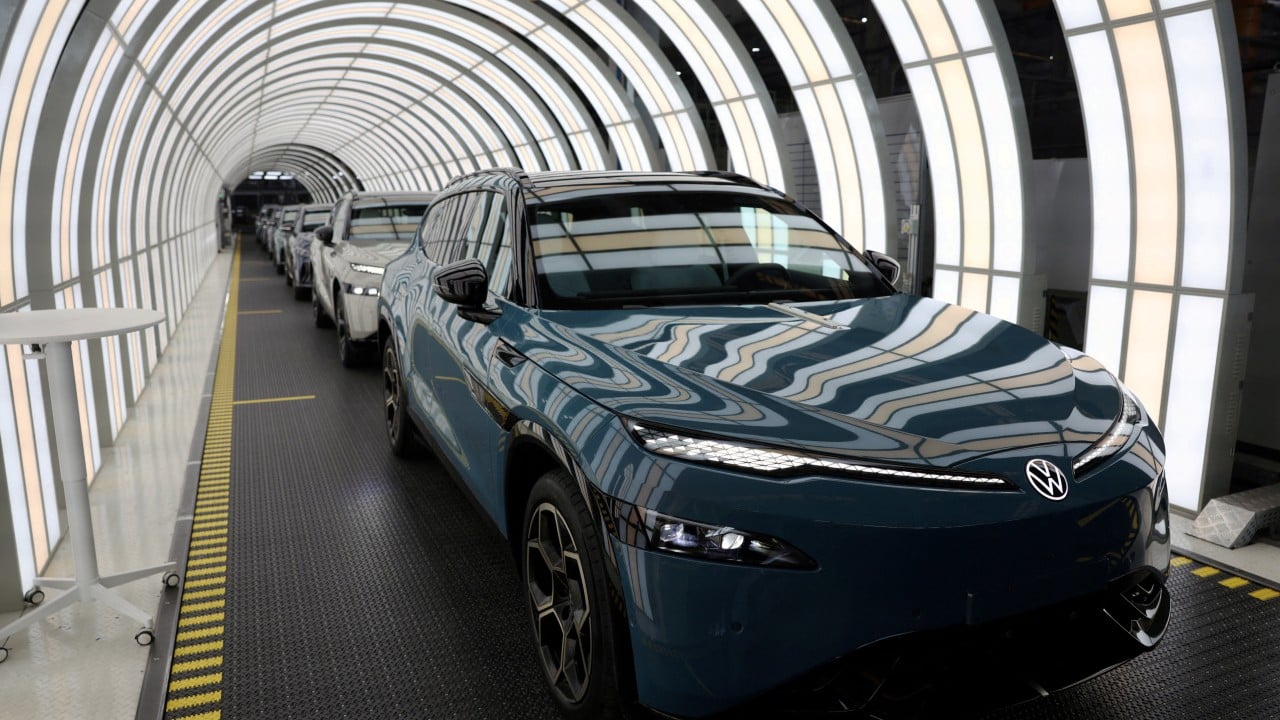
Volkswagen tried to counter this. They introduced their first extended-range electric model in China, the ID. ERA 9X04. It has logged over 10,000 deliveries so far, which the company calls a positive sign. But it's a drop in an ocean of domestic options.
The hard truth is that Chinese consumers view Volkswagen’s electric and hybrid offerings as outdated. The software feels slow compared to the smartphone-like responsiveness of local cars. The interiors look conservative next to the rolling living rooms being built by local start-ups. When local brands offer faster chips, better digital ecosystems, and lower prices, a European badge doesn't carry the premium it used to.
The Panicked Overhaul in Wolfsburg
You can tell how bad the situation is by looking at the emergency response from Volkswagen Chief Executive Oliver Blume. The company is currently mapping out a radical industrial downsizing to stop the bleeding.
The targets are unprecedented. Volkswagen wants to shrink its global production capacity back down to around 9 million vehicles per year. Before the pandemic, the entire group architecture was built to churn out 12 million cars annually. Even as recently as last year, they were hoping to hold the line at 10 million. Axing 3 million vehicles of capacity means closing factories and shrinking footprints.
The product portfolio is getting a massive trim too. The Board of Management plans to kill off up to half of its current car models. They want to cut total vehicle variants by 75%. The era of offering a dozens of slightly different petrol sedans and crossovers is over.
There's heavy talk of cutting up to 100,000 jobs across the global operation through structural reorganizations and plant closures. When your primary profit engine in China stops generating cash, you have to find savings everywhere else.
Volkswagen is trying to fight back with its "In China, For China" strategy. They're investing heavily in local R&D hubs and partnering with Chinese firms like Xpeng to co-develop platforms that match local tastes. They want to cut development times by 30%. But building cars takes time, and the Chinese market changes every six months.
Western Myths and China Realities
The biggest mistake Western car companies made was assuming they had time. They believed the transition to new-energy vehicles would be a slow, orderly multi-decade process. They thought their century of engineering heritage in transmissions and engines would protect them.
It didn't. The Chinese market completely redefined what a car is. To a buyer in Shanghai or Shenzhen, a car is a rolling digital device. It’s part of their digital life. If the navigation system doesn't sync perfectly with their favorite apps, or if the voice assistant can't control every window in the vehicle, the car is considered broken.
Volkswagen’s legacy structure became an active disadvantage. Decisions had to go back to Wolfsburg. Local joint venture partners had to argue with German engineers about why a larger screen or a different software stack was necessary for the Chinese market. By the time Germany approved a design change, local competitors had already launched two new models.
This is a lesson for every global business operating in China. Brands can't rely on history. Consumer loyalty can vanish in a single product cycle if a local alternative offers better value and superior technology.
What Legacy Carmakers Must Do Right Now
The data from Volkswagen’s horrific first half of 2026 makes one thing clear. Doing more of the same will result in total market eviction. If you are running a legacy industrial business facing agile local competition, there are immediate structural adjustments required to survive.
- Decentralize local decision-making power completely. Stop forcing local teams to wait for headquarters approval on software updates and product features. If your local office can't approve a design change within 48 hours, you've already lost.
- Pivot capital away from dying legacy portfolios. Volkswagen is finally doing this by cutting models by 50%. Don't waste money refreshing slow-selling petrol models when that cash needs to go into software architectures.
- Accept your role as a partner, not a ruler. Western companies must buy into local ecosystems instead of trying to build proprietary systems that nobody wants to use. Partnerships like the one VW made with Xpeng must become the default baseline, not a desperate last resort.
- Build aggressively for regional preferences. If a market demands extended-range hybrids with massive rear-seat legroom and integrated gaming systems, build exactly that. Do not try to educate the consumer on why a classic European hatchback is better. They will not buy it.
Volkswagen's 26% drop is a massive wake-up call. The company is trying to rebuild its engine while driving down the highway at 100 miles per hour. The next two years will determine whether Wolfsburg remains a global automotive titan or shrinks into a regional European manufacturer.