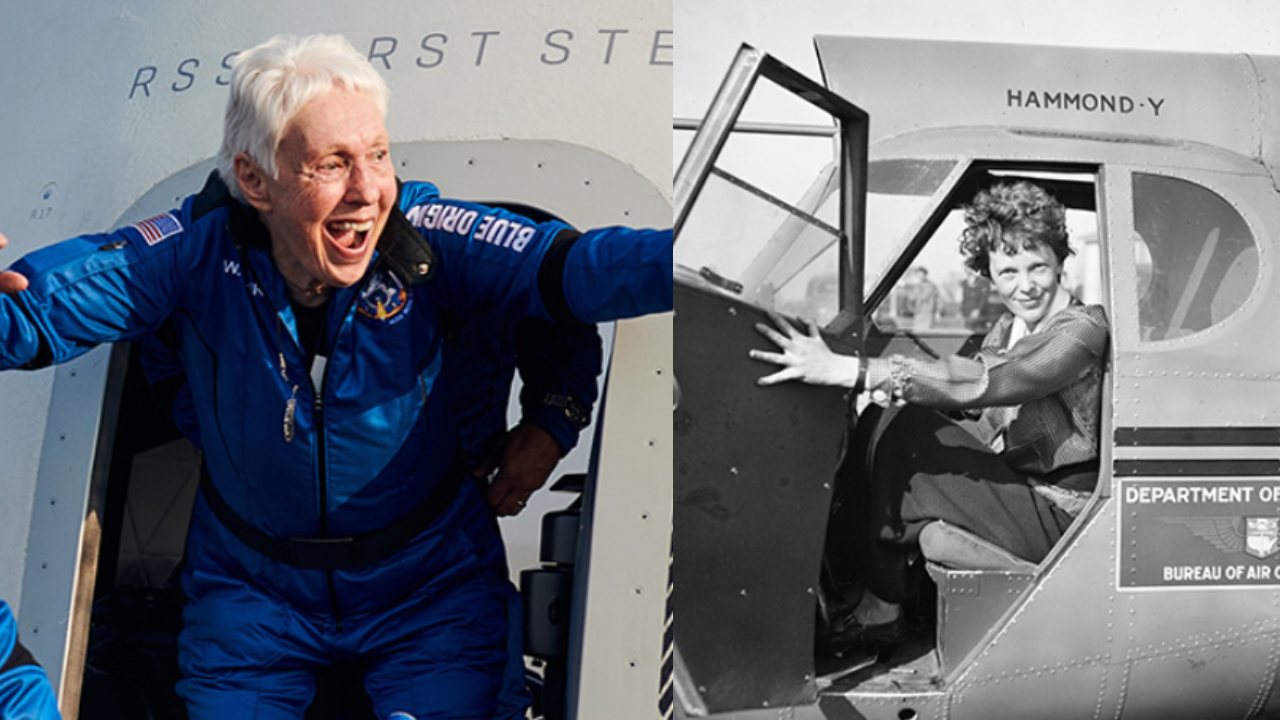
When Jeff Bezos took off on Blue Origin's New Shepard rocket on July 20, 2021, most news outlets focused on the billionaire space race. But sitting right beside him was an 82-year-old aviator who stole the entire spotlight. Her name was Mary Wallace "Wally" Funk.
For many casual viewers, her inclusion in that suborbital flight looked like a heartwarming publicity stunt or a neat feel-good story. The reality is far grittier. Wally Funk didn't get invited into space because of luck or corporate generosity. She was there because she had earned her seat 60 years earlier, only to have the door slammed in her face because of her gender.
The standard story about Wally Funk usually treats her as a footnote to NASA's history or a symbol of patience. That framing completely misses the point. Funk wasn't just patient—she was relentless, fiercely competitive, and flat-out better qualified than most men who flew during the early space race. Understanding her life requires looking beyond the feel-good headline to see how systemic institutional bias delayed one of America's finest pilots for six decades.
The Mercury 13 and the Lie of NASA Qualification
In 1961, Dr. William Randolph Lovelace II—the same physician who developed the rigorous physical testing regimen for NASA's original all-male Mercury Seven astronauts—decided to run a privately funded experiment. He wanted to know if women could withstand the exact same physical and psychological stresses of spaceflight.
He invited 25 accomplished female pilots to undergo testing at his clinic in Albuquerque, New Mexico. Nineteen enrolled, and 13 passed every single phase. Among them was 21-year-old Wally Funk, the youngest participant in the group later dubbed the Mercury 13.
The tests were brutally painful and invasive. Candidates swallowed rubber tubes for stomach tests, had ice water injected into their ears to induce vertigo, and endured endless needles to measure nerve responses. Funk didn't just endure the ordeal; she dominated it.
In the sensory deprivation test—where candidates were placed in a dark, soundproof tank filled with water to test psychological endurance without hallucinating—Funk set a record. She stayed in the tank for 10 hours and 35 minutes before the doctors called an end to the test. She didn't panic. She didn't hallucinate. She floated there calmly, outperforming almost every male candidate evaluated by the clinic.
Yet NASA never recognized the program. When the Mercury 13 tried to arrange military jet testing at Pensacola, the U.S. Navy refused access without an official request from NASA. NASA declined to make the request.
The official excuse was simple. NASA required all astronaut candidates to have completed military test pilot school and hold an engineering degree. Because the U.S. Armed Forces barred women from flying military combat aircraft or entering test pilot programs, women were neatly locked out by a deliberate circular rule. When Funk and her fellow aviator Jerrie Cobb testified before a Special Subcommittee of the House Committee on Science and Astronautics in 1962, high-profile figures including John Glenn argued that keeping women out was simply a reflection of social norms. The program was canceled overnight.
Building a Legendary Career Out of Rejection
Most people would have walked away bitter after being told they couldn't pursue their dream job because of an arbitrary rule. Funk did the exact opposite. She poured her energy right back into the sky.
When major commercial airlines refused to hire female pilots in the 1960s, Funk worked around them. She took jobs as a charter pilot, flew regional routes for Sierra Pacific Airlines, and entered transcontinental air races like the Powder Puff Derby. By age 20, she was already serving as the first female civilian flight instructor at Fort Sill in Oklahoma, teaching male military officers how to handle aircraft.
Her career became a long chain of historic firsts:
- 1971: Became the first female flight inspector for the Federal Aviation Administration (FAA).
- 1973: Became the first woman to serve as an FAA Systems Worthiness Analysis Program specialist.
- 1974: Joined the National Transportation Safety Board (NTSB) as its first female air safety investigator.
Over her 11 years with the NTSB, Funk investigated roughly 450 aviation accidents. She approached crash investigations with the same intense precision she brought to her flying, even discovering a key pattern showing how impact forces in small-plane crashes tended to strip victims' clothing off.
Between her government roles, racing, and running her own flight school in Taos, New Mexico, Funk accumulated over 19,600 flight hours and personally taught more than 3,000 students to fly.
Whenever NASA opened astronaut applications—including in the late 1970s when the agency finally allowed women into the astronaut corps—Funk applied immediately. Four times she submitted her application to NASA. Four times she was rejected, primarily because she lacked a formal engineering degree, despite holding commercial, multi-engine, flight instructor, and instrument ratings that few male applicants could match.
The Misconceptions Surrounding Her 2021 Blue Origin Launch
When Jeff Bezos announced that Wally Funk would fly on the inaugural crewed launch of Blue Origin's New Shepard capsule on July 20, 2021, the media celebrated it as a poetic closing of the circle. While it was certainly a triumph, several common misconceptions still skew how people view that mission.
Myth 1: She Was Just an Honorary Passenger
Many headlines treated Funk like a special guest taking a high-altitude ride. That framing ignores her background. She approached the mission with the mindset of a veteran aviator. Even in her eighties, she was acutely aware of the capsule's telemetry, g-forces, and operational mechanics. During interviews following the flight, her primary reaction wasn't just awe—it was a desire to stay up longer and go higher, reflecting her lifelong aviation instinct.
Myth 2: The Blue Origin Flight Replaced Her NASA Dream
Suborbital spaceflight crosses the Kármán line at 100 kilometers (62 miles), offering about four minutes of weightlessness before descending under parachutes. It is a stunning technological achievement, but it isn't orbital spaceflight. Funk openly acknowledged this distinction. While she expressed immense gratitude for the Blue Origin opportunity, she maintained a deposit with Virgin Galactic and continually voiced a desire to fly into orbital space. The ride was a long-overdue triumph, but it didn't rewrite the six decades of missed orbital missions she was fully equipped to handle in her youth.
Myth 3: Her Record Was Solely About Age
When Funk launched at age 82, she broke John Glenn's 1998 record to become the oldest person to fly in space. Actor William Shatner later eclipsed that record at age 90 in October 2021. Yet focusing strictly on the age record misses the genuine historical weight of her journey. Funk remains the oldest woman to ever travel into space, and more importantly, she was the only member of the Mercury 13 who ever crossed the boundary into space.
What Wally Funk's Legacy Means for Modern Aviation
Wally Funk passed away on July 8, 2026, at the age of 87 in Grapevine, Texas. Her death closed a major chapter in aviation history, but the lessons from her career remain critical for the aerospace industry today.
Her journey isn't just a historical trivia question about space flight. It highlights how rigid bureaucratic barriers can lock out exceptional talent. When institutional rules prioritize narrow credentials over proven skill and endurance, the entire organization loses out on world-class performers.
If you want to draw practical lessons from her career and legacy, keep these key principles in mind:
- Focus on unassailable skill: Funk didn't just meet standards; she outperformed men across isolation tests, flight hours, and safety audits. When facing institutional bias, raw technical capability remains your strongest leverage.
- Diversify your path: When NASA blocked her path to space, Funk didn't wait around idle. She built a parallel legacy across private instruction, air safety, and federal inspection. Never let one closed door freeze your progress.
- Pave the way for others: Training over 3,000 pilots ensured that Funk's impact extended far beyond her own flight log. Mentorship creates a structural legacy that outlasts individual career roadblocks.
To study her career directly, review historical archives covering the 1962 House Committee hearings on special space qualifications or read Funk's 2020 memoir, Higher, Faster, Longer. Her life stands as absolute proof that real passion doesn't expire with time or red tape.