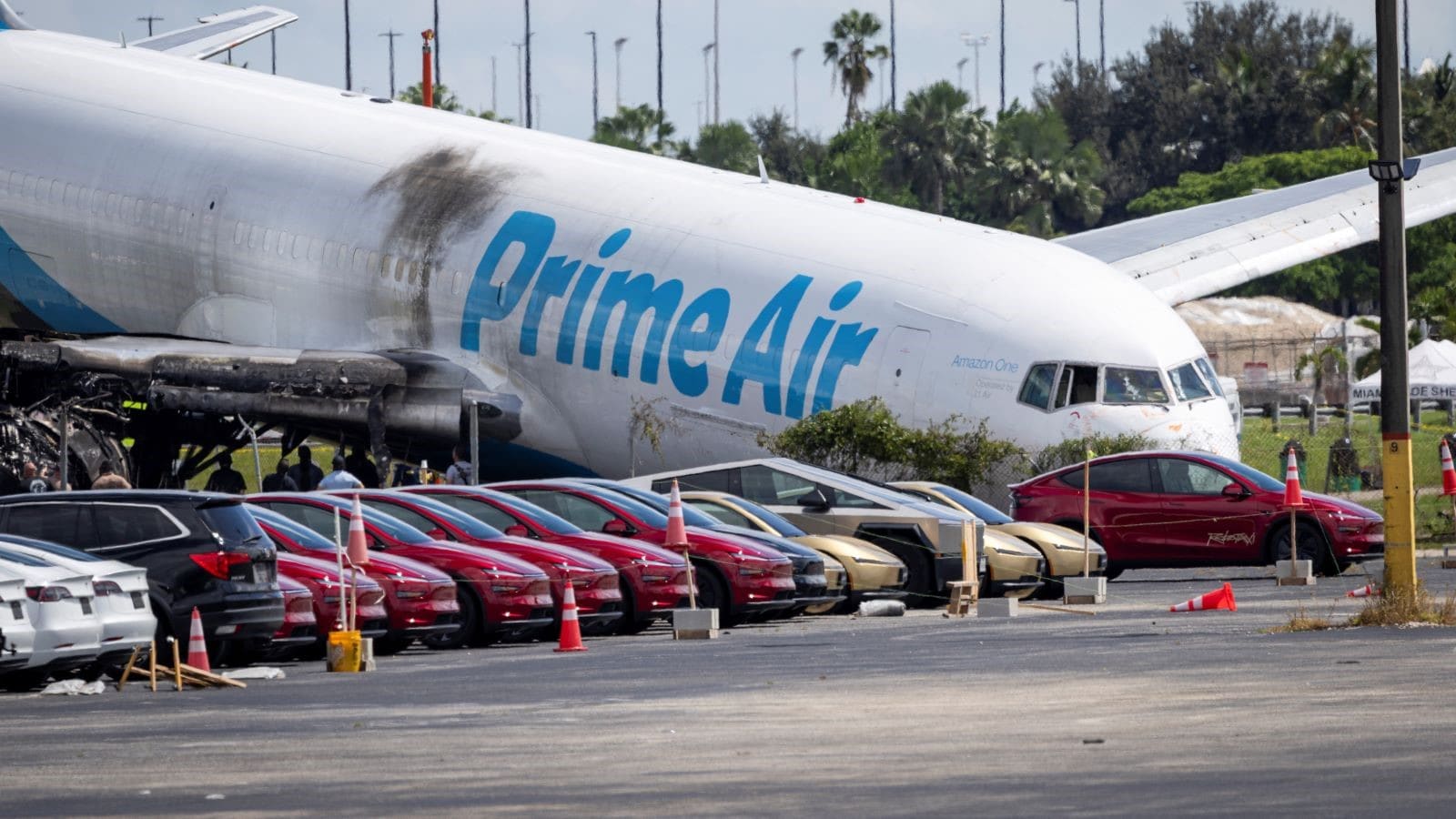
Planes are not supposed to land halfway down the asphalt. Yet that is precisely what happened when an Amazon Air cargo jet touched down at Miami International Airport, triggering a catastrophic sequence that left five people dead on the ground.
If you have been following the fallout from the crash of Flight 7598, you already know the basic headlines. A 32-year-old Boeing 767-33A operated by 21 Air overran the runway by roughly 1,300 feet, smashed through a perimeter fence, and plowed into vehicles before bursting into flames. But the official NTSB data and cockpit audio released in the days following the disaster point to a deeper story of cockpit communication breakdowns, severe weather pressures, and missed windows to abort a doomed descent. You might also find this similar coverage interesting: Why The Latest Houthi Attacks On Saudi Arabia Change Everything.
Let us break down what actually happened on that tarmac.
The Approach and the Fatal Hesitation
The flight was arriving from San Juan, Puerto Rico, wrapping up the third leg of a busy daily rotation. Storms were swirling around Miami, creating messy wind conditions and a strong tailwind that pushed the heavy jet forward. As highlighted in recent articles by Wikipedia, the implications are worth noting.
Flight data recorder readouts tell a terrifying tale. For nearly two minutes before touchdown, one pilot repeatedly warned the other that the aircraft was coming in far too fast. Yet, according to National Transportation Safety Board summaries, the fellow pilot never gave a consistent verbal response to those warnings.
The jet crossed the threshold unstable, hovering high above the tarmac before its nose and right landing gear finally slapped the ground. By that point, the plane had consumed nearly half of the 9,360-foot runway.
Did the crew try to fix it? Briefly.
Investigators revealed that the pilots momentarily disengaged the brakes and shoved the throttles forward, attempting a sudden "go-around" to salvage the landing and take back off. They abandoned that maneuver just four seconds later. It was far too late. Without enough remaining pavement to stop, the aircraft barrelled off the edge, smashing into a van carrying airline cleaning crew workers and an SUV on a nearby perimeter road.
Who Was Lost and How the Ground Impact Occurred
All five fatalities occurred inside the vehicles struck by the runaway jet. The victims were identified by the Miami-Dade Sheriff's office as Rolando Aleman Leon, 55; Yoel Rodriguez Naranjo, 53; Julio C. Pineda, 75; Carlos Acosta Fajardo, 53; and Javierkys Reyes Quevedo, 47.
Seven people were inside the white Ford Econoline van owned by Professional Ocean Service Corporation, a contract cleaning company working for airlines. The van was positioned inside the airport grounds when the Boeing 767 tore through the perimeter. The plane also struck a Toyota Corolla Cross traveling on Northwest 67th Avenue before finally coming to rest in a field.
Miraculously, both the pilot and co-opilot survived the impact and were subsequently treated and released from local hospitals. Five other individuals sustained injuries during the chaotic moments following the crash, with multiple victims hospitalized in critical condition.
What the Black Boxes Are Revealing
Federal investigators recovered both the flight data recorder and the cockpit voice recorder shortly after the accident. Transporting those devices back to Washington for deep evaluation gave safety experts a second-by-second look at the physical realities of the flight deck.
Aviation experts reviewing the preliminary NTSB disclosures have zeroed in on a glaring issue: crew coordination. Former airline pilot and safety analysts noted that the junior first officer was left shouting speed warnings while the pilot flying remained laser-focused on forcing the plane onto the ground rather than executing a timely go-around.
When a plane is unstable two minutes out, standard aviation protocols demand an immediate aborted landing. Waiting until touchdown to decide whether to stop or fly again strips the crew of their safety margins.
Broader Safety Questions Facing Cargo Operations
This incident puts heavy scrutiny on the operational pressures faced by regional cargo carriers operating under major logistics umbrellas like Amazon Air. While 21 Air and Amazon both issued statements expressing condolences and pledging full cooperation with federal authorities, regulatory bodies are facing tough questions.
Investigators are also examining infrastructure questions, including the presence or absence of engineered material arresting systems (EMAS) designed specifically to safely stop aircraft that overrun runways. Miami International Airport faced days of localized flight disruptions, delayed holiday weekend schedules, and prolonged runway closures while hazardous materials crews cleared jet fuel and investigators documented the wreckage.
As the NTSB continues conducting interviews with surviving crew members and reviewing full audio transcripts, the aviation community is left confronting an avoidable tragedy born from weather pressure, speed management errors, and a breakdown in flight deck communication.
Pay attention to upcoming NTSB safety recommendations regarding unstable approaches and runway overrun protections. These findings will dictate whether similar accidents can be prevented in the future.