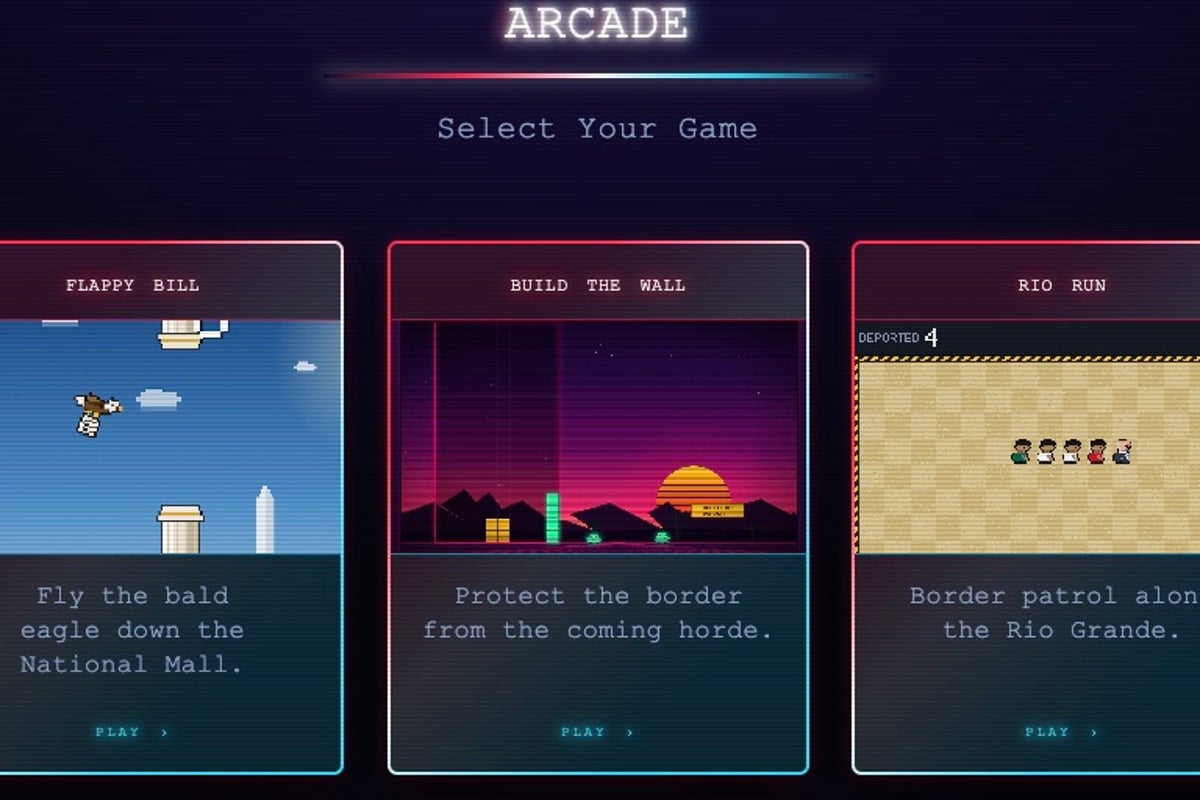
Governments love boring press releases. They love dense PDFs filled with bureaucratic jargon that nobody reads. They love dry policy briefs published at 5 PM on a Friday to bury bad news. So when the administration launched an interactive arcade website on the official White House domain, political communication traditionalists didn't quite know what to do with it.
You can now visit the official White House portal and play retro-style mini-games. One lets you build border barriers. Another has you sorting school cafeteria foods to filter out seed oils and artificial additives in line with the "Make America Healthy Again" agenda.
It is weird. It is loud. It is completely intentional.
Let's look at what is actually on the site. The platform features five distinct browser games with retro graphics and fast-paced mechanics. There is "Flappy Bill," where players guide a bill held by a bald eagle through Washington monuments. There is "Build The Wall," which plays out like a variation of Tetris where users position colorful blocks to stop pixelated entities. There is "Rio Run," which mimics classic arcade mechanics while steering border patrol elements along a river pathway. There is "Supply Line," which tasks players with swatting away packaged snacks containing specific food colorings and industrial oils off a moving conveyor belt. Rounding out the lineup is "Trump Savings Tycoon," where players swing a net to catch funds directed toward child investment accounts. A placeholder for a sixth game indicates more content is rolling out.
Critics immediately pointed out the absurdity of gamifying complex and heavy federal policies. Immigration enforcement and child detention are high-stakes, human issues. Reducing them to retro pixel graphics sparked intense backlash across social media platforms like X, where commentators called the move unserious and offensive. On the flip side, supporters praised the strategy as brilliant digital marketing that bypasses traditional media filters entirely.
This brings up a larger shift in political messaging that has been building for years. Politics has officially merged with internet culture.
The Death of the Traditional Press Release
Why spend millions on cable news ad buys when you can build a browser game that goes viral on social media for free?
We have watched political communication evolve from Sunday morning talk shows to Twitter threads, TikTok edits, and now, interactive web apps. The Trump administration has never played by standard rules. Earlier experiments mixed military footage with pop culture movie clips and video game aesthetics. Turning executive priorities into playable mini-games is just the next logical step in the evolution of attention-economy politics.
If you want to understand modern public relations, look at engagement metrics, not policy papers. Traditional news outlets spend hours analyzing the optics of a press conference. Meanwhile, a teenager on a smartphone spends thirty seconds playing a browser game and absorbs the core policy pillars of an entire political movement without opening a single news article.
The strategy treats voters like internet users rather than constituents waiting for a town hall.
What the Critics Miss About Digital Gamification
The primary complaint against the White House arcade is tone deafness. Translating immigration enforcement and dietary guidelines into arcade challenges trivializes human suffering and policy failures. That criticism is entirely valid from a traditional governance perspective.
Governments are supposed to project solemnity and authority. They are supposed to sound like lawyers and historians.
This administration figured out that internet culture rewards irreverence. When you make people angry or make them laugh, they share your content. When you publish a standard white paper about child savings accounts or agricultural subsidies, nobody shares it. By turning policy preferences into a game, the White House bypasses the editorial filters of major newsrooms. They speak directly to their base using the native language of the internet: memes, nostalgia, and rapid-fire entertainment.
You don't have to like it. You do have to recognize that it works.
Where Public Policy Meets the Attention Economy
We are living through a massive restructuring of how citizens interact with the state. The barrier between entertainment and governance has completely dissolved.
Think about how other campaigns will respond. Once one political actor successfully integrates interactive browser gaming into official government domains, copycats will follow. Expect future administrations of all political stripes to experiment with app-based advocacy, interactive infographics disguised as games, and digital environments designed to capture Gen Z and millennial attention spans.
The traditional press release is dying a slow death. It is being replaced by viral web assets designed to trigger immediate emotional reactions—whether outrage from opponents or delight from supporters.
Check out the site yourself if you want to see the future of political messaging. It is fast, it is polarizing, and it is here to stay.