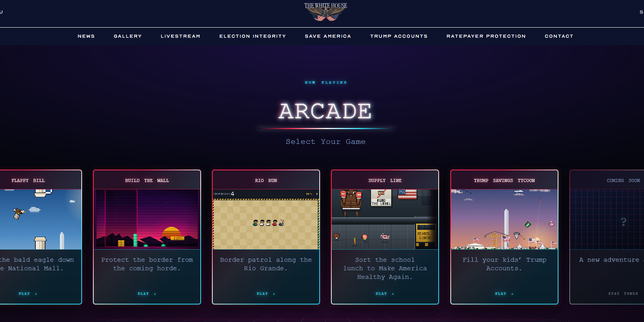
Governments trying to use internet culture usually end up embarrassing themselves. When the White House launched a digital arcade on its official website to promote policy priorities, nobody expected it to survive a clash with copyright lawyers. Yet, the controversial block-stacking minigame titled "Build the Wall" vanished from official servers just days after its debut, following immediate public outcry and legal pressure from the intellectual property holders of a legendary puzzle franchise.
If you missed the initial rollout, the administration published a handful of web minigames designed to troll political opponents and tout hardline stances. Among them, the border-themed clone stood out because it borrowed heavily from the mechanics and visual style of Tetris. Instead of clearing lines to make blocks disappear, players were tasked with stacking falling bricks to hold back characters depicted as a zombie border siege. You might also find this connected story useful: Why One Random Phone Case Clean Saved A Million Pound Lottery Win.
The Rapid Copyright Backlash
The aesthetic theft didn't go unnoticed. The Tetris Company moved swiftly, issuing public statements clarifying they had zero involvement in the project. Representatives made it clear that corporate branding and intellectual property rights had been used without authorization, emphasizing that they take infringement very seriously.
Corporate legal teams do not usually play games when government entities appropriate their iconic assets for partisan messaging. The pressure mounted instantly. By Tuesday, the game quietly disappeared from the official arcade page, serving as a swift reminder that public domain rules still apply even to the highest office in the land. As highlighted in latest coverage by USA.gov, the implications are notable.
Beyond the Block Game
While the border-themed puzzle clone took a swift exit, the digital experiment didn't end entirely. Other mini-titles remained active on the site, including a Snake-inspired minigame called "Rio Run" that tasks users with tracking border crossings. The administration also kept titles focused on personal savings accounts, school nutrition policies, and eagle-flying simulations on the active roster.
Critics pointed out that the entire arcade initiative fits a broader pattern of using provocative, internet-trolling aesthetics for official government communications. Past social media pushes have relied on heavy-handed visual tropes, ranging from AI-generated movie poster parodies to stylized video game crossovers mimicking classic Nintendo franchises.
The Reality of Digital Political Messaging
Using nostalgic gaming tropes to capture short attention spans online is a common modern strategy. Organizations want viral moments, quick shares, and younger demographics. However, tying official state infrastructure to unauthorized intellectual property creates an avoidable legal mess.
When you build political stunts on top of copyrighted foundations, the house of cards tends to collapse the moment copyright holders make a phone call. The rapid disappearance of the border wall game proves that even executive branch web developers are bound by basic intellectual property laws.
Check out The White House Made a Tetris Game… Then It Got REMOVED to see a complete walkthrough of all the arcade titles released during this controversial campaign.
http://googleusercontent.com/youtube_content/1