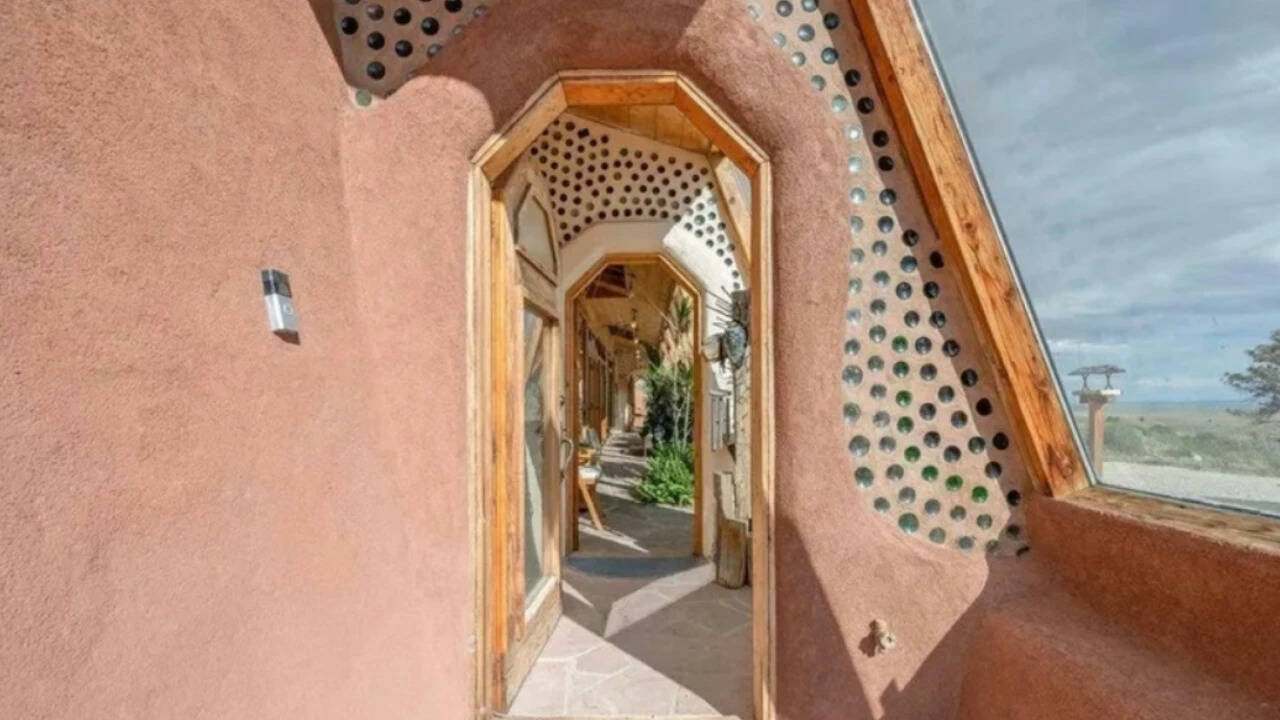
Fifteen years ago, a couple in Wyoming decided to build a house out of garbage and earth. They didn't do it to save a buck. They did it because standard building methods make zero sense in a climate that swings from freezing winters to blistering summers. Now, that exact 1500-square-foot off-grid Earthship sitting on 55 acres near Wheatland is listed for $625,000.
If you think building with used tires sounds like a bizarre DIY experiment destined to fail, you're missing the entire point of autonomous architecture. This property isn't some crumbling hippie shack. It's a fully engineered, highly resilient bunker that handles Wyoming's punishing weather better than most conventional stick-built homes in Cheyenne.
Let's look at how this property was built, why Earthships are uniquely suited for the American West, and what you actually get for your half-a-million-plus investment.
The Engineering Behind 1343 Pounded Tires
You can't just stack old Goodyear radials and slap drywall over them. Building a true Earthship takes brutal physical labor. The original owners spent countless hours pounding earth into 1,343 tires by hand.
Why tires? Thermal mass. Tires packed densely with dirt absorb heat during the day and slowly release it at night. This creates a natural thermal battery. Combined with hand-trowelled plaster walls, flagstone and crushed-shell brick floors, and peeled log vigas across the ceilings, the structure maintains an interior temperature that stubbornly refuses to drop below 62 degrees in winter or climb above 82 degrees in summer. No central heating furnace required.
Co-listed by Rowan Bennett and Holly Allison of #1 Properties Ranch and Recreation, the home sits in an elevation sweet spot near the foothills of Laramie Peak. It borders 280 acres of Bureau of Land Management land, meaning your nearest neighbors are essentially wild pronghorn and mule deer.
Off-Grid Living Without Giving Up Modern Comforts
Most people hear "off-grid" and picture shivering in the dark while eating cold beans out of a tin can. That's a myth. Modern off-grid setups like this one are engineered with redundancy so you never have to sacrifice basic creature comforts.
This Wyoming retreat runs on a comprehensive independent matrix:
- A dedicated solar array paired with a wind turbine for primary electricity.
- A backup diesel generator and a propane system for the water heater when Mother Nature refuses to cooperate.
- A roof water catchment system backed by a permitted domestic well.
- A 66-foot greenhouse attached directly to the home, allowing for year-round food production regardless of outside blizzards.
Inside the kitchen, you won't find primitive camp stoves. There's custom pine cabinetry with hand-carved diamond inlays, tile countertops, a Sun Frost energy-efficient refrigerator, and a countertop ice maker. The bathroom features a claw-foot soaking tub and a shower combination equipped with an air-massage system. Custom bottle-glass work lets natural light filter through the thick earthen walls in brilliant patterns.
What Buyers Forget About Owning an Earthship
Before you rush to write an offer for $625,000, you need to understand the reality of owning alternative real estate. Properties like this require active management. You aren't just calling a property manager when a breaker trips. You have to monitor your solar inverter, check your rainwater catchment filters, and manage your greenhouse humidity.
The sellers used this property as a secondary retreat rather than a primary residence since building it in 2011. That tells you something important. It's built to be locked up, left alone, and fired back up whenever you need an escape from city life.
There's also room to expand. The acreage includes a level building pad already plumbed for sewer, waiting for a future garage or a second guest dwelling. Water utilities are stubbed across the road, and the land is primed for a private pond or expanded garden.
Is It Worth the Price Tag?
At $625,000 for 1,500 square feet on 55 acres, you're paying roughly $416 per square foot of living space, plus the land and the heavy-duty infrastructure. In traditional housing markets, that might sound steep for rural Wyoming. But you aren't paying for square footage. You're paying for absolute energy independence, zero monthly utility bills, structural resilience against extreme weather, and complete privacy bordering federal land.
If you want a cookie-cutter suburban box where your HOA tells you what color to paint your front door, look elsewhere. If you want a self-sustaining compound built to outlast the next energy crunch, schedule a showing.