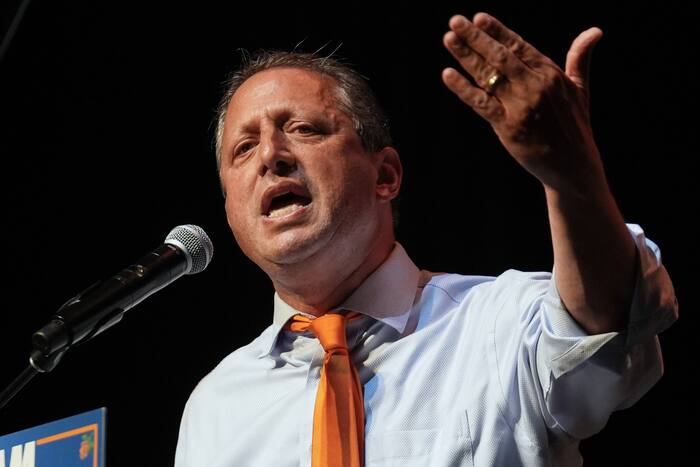
Long before hitting the 2026 California gubernatorial campaign trail against Steve Hilton, Xavier Becerra spent over twenty-five years navigating the high-stakes machinery of Washington. If you trace his path from Capitol Hill hallways to the executive branch, you find a classic bureaucratic climb defined by careful alliances, party loyalty, and a sudden, turbulent landing at the Department of Health and Human Services.
Voters looking at his resume see two very different stories. Supporters point to a seasoned legislator who climbed to House Democratic Caucus leadership and later served as California's attorney general, defending healthcare laws against fierce opposition. Critics remember a polarizing federal cabinet tenure where he managed massive pandemic policies and migrant child facilities under intense public scrutiny. If you found value in this article, you should check out: this related article.
From Capitol Hill Novice to House Leadership
Becerra arrived in Washington in 1993, representing parts of Los Angeles in the House of Representatives. Back then, congressional newcomers faced steep hierarchies. Becerra didn't try to reinvent the institution overnight. Instead, he worked the committees, built relationships with party heavyweights like Nancy Pelosi, and steadily accumulated influence.
By 2009, he was vice chair of the House Democratic Caucus, moving up to chair by 2013. That trajectory required institutional patience. He wasn't a bomb-thrower or a viral media senator. He was a disciplined party soldier who understood how to count votes and toe the line. That steady ascent earned him respect among institutionalists, even if it didn't always excite progressive or populist flanks who wanted faster systemic disruption. For another angle on this event, check out the recent coverage from TIME.
The State Attorney General Interlude
Before his final federal appointment, Becerra took a sharp detour back to California in 2017 when Governor Jerry Brown appointed him state attorney general to succeed Kamala Harris. This chapter transformed his political identity. Rather than legislating quietly behind closed doors, Becerra became the litigious face of the resistance against federal policies.
He filed dozens of lawsuits against the federal government, challenging environmental rollbacks, immigration restrictions, and attempts to dismantle the Affordable Care Act. For California Democrats, he looked like a protective shield. For critics, he looked like an ambitious politician using the state's legal machinery to score partisan points. Either way, it raised his national profile and set the stage for his return to Washington under President Joe Biden.
The Cabinet Stumble
In late 2020, Biden nominated Becerra to lead the Department of Health and Human Services. It should have been a victory lap for a seasoned public servant with healthcare policy experience. Instead, the confirmation battle was brutal. Senate Republicans pushed back hard, questioning his lack of a medical background and his aggressive legal record on abortion and healthcare mandates. He squeaked through with a razor-thin 50-49 Senate vote in March 2021.
Once in office, the difficulties multiplied. Managing HHS during the tail end of a global pandemic meant fielding unending criticism from both sides of the aisle. The agency faced immense pressure over the logistics surrounding unaccompanied migrant children at the southern border and intense scrutiny over federal public health guidelines. While his supporters credit him with pushing through historic Medicare drug price negotiations, his public-facing communication often struggled to cut through the noise, leaving many lawmakers feeling underwhelmed by his executive leadership style.
What His Track Record Means Now
Decades inside the beltway leave a heavy paper trail. As Becerra campaigns for the California governorship, that long Washington tenure remains his greatest talking point and his heaviest anchor. Experience matters in government, but voters rarely reward executives purely for surviving institutional friction.
Whether his decades of bureaucratic maneuvering prepare him to run America's most populous state or simply remind voters of federal-level headaches is the central question of this election cycle. Past longevity doesn't guarantee future success, and how California evaluates those years will determine the next chapter of his career.