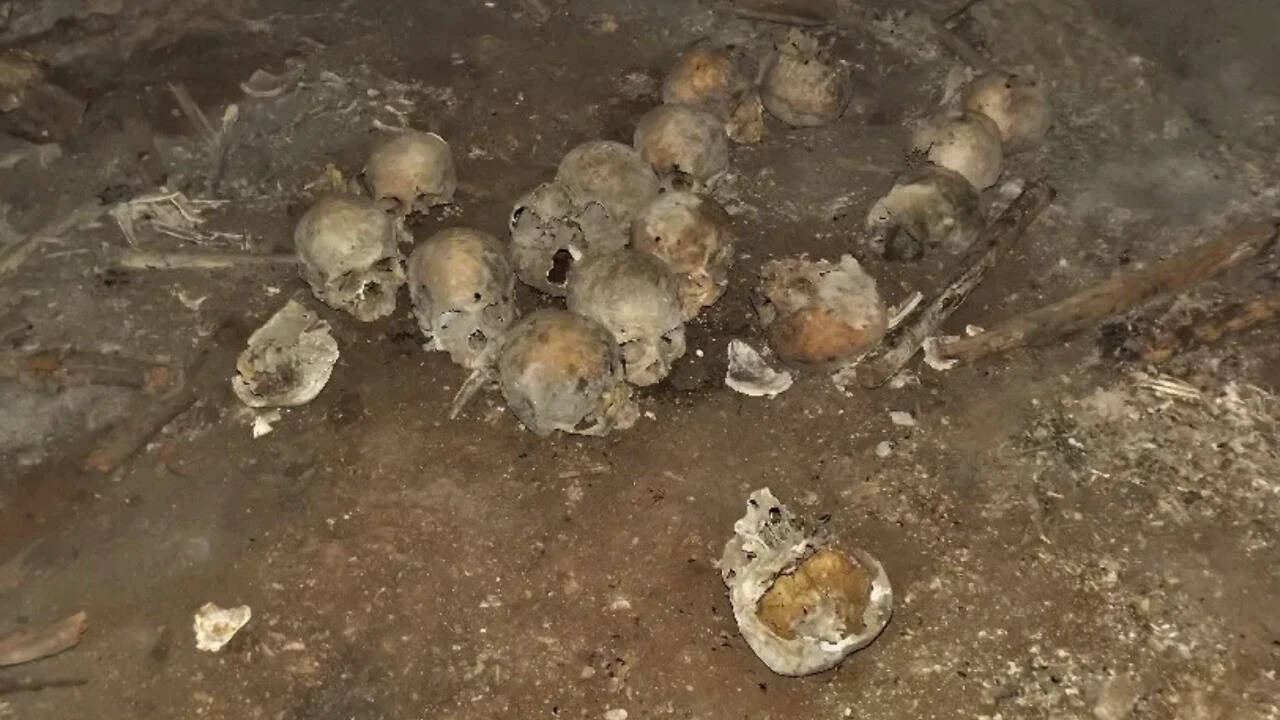
In 2012, explorers walked into a dark cave in the Frontera Comalapa region of Chiapas, Mexico, near the Guatemalan border. What they found shattered simple assumptions about ancient Mesoamerican warfare. Staring back from the gloom were 165 human skulls, part of a thousand-year-old Maya skull rack known as a tzompantli. For years, conventional archaeological wisdom assumed these displays were reserved exclusively for captured enemy male warriors. Recent anthropological analysis by Mexico's National Institute of Anthropology and History (INAH) changes that narrative entirely. Roughly half of those skulls belonged to women, and fifteen belonged to children.
History loves tidy categories, but ancient civilizations rarely fit them. When researchers like physical anthropologist Javier Montes de Paz, along with Cristell Delesma Pérez and Abigail Reyes López, re-examined the assemblage dating back to the Early Postclassic period between AD 900 and 1200, the demographic breakdown shocked the scientific community. Finding women and children on a tzompantli forces archaeologists to rethink who was selected for these high-stakes ceremonial displays and why. If you liked this piece, you might want to look at: this related article.
Beyond the Battlefield Myth
Popular culture paints ancient Mesoamerican skull racks as trophies of war, built strictly to display the heads of defeated male combatants captured during territorial clashes. The Chiapas cave discovery dismantles that single-minded theory. You don't put children aged just a few years old or nearly equal numbers of adult women on a military trophy wall if the sole purpose is flexing martial dominance over rival city-states.
Instead, researchers point toward complex religious pilgrimages, ritual sacrifices, and community-wide sacred practices. During the Early Postclassic period, local Maya communities used remote caves as portals to the underworld. These subterranean chambers weren't just hiding spots; they were sacred spaces where priests and pilgrims gathered to perform ceremonies, possibly seeking rain during severe droughts or honoring cosmic cycles. The presence of women and children suggests that entire segments of society—not just frontline warriors—held vital ritual roles or became offerings during societal crises. For another perspective on this story, refer to the latest update from TIME.
Reading the Bones Without Pelvic Data
Working with ancient crania is an exacting science, especially when complete skeletons are missing. Anthropologists didn't have pelvic bones available, which are typically the gold standard for determining biological sex. They had to rely entirely on skull morphology, analyzing the shape of the lower jaw, the prominence of the brow ridges, and the bony structures above the eye sockets.
Out of the 165 skulls recovered, experts classified 83 as women, 79 as men, and 15 as children, leaving just three too fragmented to identify. Most of the adults died between 25 and 35 years old, though two individuals lived to be roughly between 55 and 70.
Physical evidence inside the cave tells an even stranger story about how these remains were handled. Researchers identified cut marks on three individual specimens and found clear evidence of heat exposure. Soot deposits caked the cave ceiling, proving that priests and participants burned torches during dim, smoky rituals. Furthermore, almost all the skulls lacked lower jaws, and their upper teeth had been intentionally removed. Some individuals also featured intentional cranial deformation, a childhood practice where boards bound the growing skull to achieve a specific elongated or flattened shape.
The Spiritual Weight of the Human Head
Why go to such lengths? In ancient Mesoamerican cosmology, human body parts held immense spiritual power. The head, in particular, was believed to house the tonalli, a person's vital life force or spiritual essence. Displaying or manipulating these crania wasn't just about death; it was about channeling power, appeasing deities, and maintaining the fragile balance of the cosmos.
The recovery of 51 long bones alongside the skulls shows meticulous post-mortem curation. In one remarkable instance, researchers found a tiny malleus—the hammer bone in the middle ear measuring a mere eight to nine millimeters—still preserved inside a temporal bone. Such fragile micro-structures survive only when remains are handled, repositioned, and protected carefully over long periods. These skulls weren't dumped once and forgotten. They were curated objects moved through generations of ritual cycles.
As ongoing analyses continue to refine our understanding of Mesoamerican ritual behavior, the Chiapas cave remains a stark reminder that ancient people operated under belief systems far more intricate than our modern labels can capture. Every new bone analyzed peels back another layer of a world where life, death, and the divine were tightly bound together in the dark.