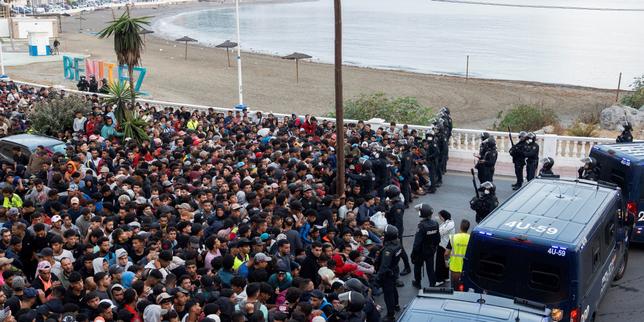
When Spanish authorities opened new temporary reception facilities in Ceuta to clear makeshift beach settlements, the spaces filled up almost instantly. Hundreds of migrants were moved from the beaches of Benítez and El Trampolín during a massive police operation involving roughly 150 National Police officers and 70 Civil Guard personnel. Yet, within hours, the port facilities hit their maximum capacity of 1,700 people. Thousands of individuals were left outside, forcing many to return right back to the sand and streets they had just left.
If you want to understand why European border management is stumbling in North Africa, look no further than Ceuta. The mismatch between immediate processing needs and actual infrastructure reveals a deeper administrative gridlock that emergency shelters simply cannot fix.
The Bottleneck at the Port
The operation began early in the morning, aiming to transition people away from exposed coastal areas into controlled registration zones. Divided into two sections—one holding 1,080 spaces and the other 620—the camp at the Poniente dock processed arrivals slowly, handing out wristbands and conducting basic security checks.
By noon, the "full" sign went up.
This rapid saturation exposes a fundamental flaw in how local and national authorities calculate capacity during peak migration surges. While the Spanish government defends the port facilities as a necessary step to establish administrative oversight, critics and local port officials argue that the strategy lacks scale and operational foresight. Juan Manuel Doncel, president of the Ceuta Port Authority, criticized the lack of coordination, pointing out that critical infrastructure and local logistics cannot safely absorb thousands of individuals without severe disruptions.
Why Temporary Tents Fail Long-Term Demands
Building makeshift port camps provides a temporary visual fix for authorities wanting to clear beaches, but it does little to solve the underlying humanitarian equation. Thousands of migrants remain stranded in the enclave following the massive arrivals in late July. Estimates from local officials place the remaining population in the enclave between 9,000 and 13,000 people, while thousands more continue to navigate complex legal and asylum channels.
When a facility designed for 1,700 people is overwhelmed in hours, the overflow has nowhere to go. People pushed out of the queue drift back to makeshift camps on the beaches because the broader European and national transfer systems cannot process or relocate individuals fast enough.
The Political Finger-Pointing
Behind the operational chaos lies intense political friction. Local leaders have repeatedly called for structural support rather than quick-fix emergency measures, arguing that Ceuta's public services are fundamentally unequipped to handle persistent inflows. Meanwhile, police unions like Jupol have slammed the central government for failing to guarantee adequate human resources and operational security before launching high-tension relocations.
When security forces have to manage surging crowds at gates while thousands more wait outside in the heat, the operation stops looking like a solution and starts looking like containment. Until national authorities establish reliable, high-capacity pathways off the enclave rather than temporary holding pens at the docks, Ceuta will remain caught in an endless cycle of beach clearances and immediate overcrowding.