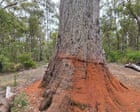
Someone took a chainsaw to a 500-year-old King Jarrah tree in Western Australia's Wellington National Park. Honestly, that sentence still makes my stomach drop. Western Australian police are investigating the alleged vandalism after the 36-metre giant was targeted over a weekend in late November 2026, and Environment Minister Matt Swinbourn didn't mince words when he called whoever did it an "absolute jerk".
A quick news brief stops at the shock value of the quote and the police hunt. That misses the bigger picture. When someone cuts into a tree that started growing roughly around the time European ships were first charting distant coasts, you aren't just damaging park property. You're severing centuries of ecological history, Noongar cultural heritage, and slow-motion survival that can't be replaced in a few human lifetimes.
What Happened to the King Jarrah Tree in Wellington National Park
Police in Western Australia opened an investigation into suspected criminal damage at Wellington National Park, south of Perth in the state's South West region near Bunbury. Officers indicated the chainsaw attack occurred between Saturday, November 21, and Sunday, November 22, 2026, in an apparent attempt to bring down the iconic 36-metre tree.
State authorities are now weighing every available option to give the tree the best chance of survival. Matt Swinbourn described the damage as appalling, senseless, and heartbreaking, capturing the frustration felt by locals, visitors, and conservationists who know the tree as a centerpiece of the park.
In my view, incidents like this expose how vulnerable high-value natural landmarks remain even inside protected parks. Chainsaws are portable, loud only up close in dense bushland, and fast enough to inflict deep wounds before rangers or nearby visitors ever hear a thing. Once a giant specimen is cut into, emergency triage looks very different from patching up a young sapling.
Why Authorities Face a Tough Race to Save an Old Giant
Saving a massive Eucalyptus marginata after deep mechanical cutting isn't simple. A tree that has stood for up to half a millennium carries huge structural weight on top of a massive trunk. Any cut that compromises load-bearing wood or cuts through vital transport tissues changes how water moves up to the canopy and how wind stresses the remaining structure.
Arborists and land managers have to look at two separate problems at once. First, is the tree structurally safe and capable of sustaining its canopy without catastrophic collapse? Second, can it seal off or compartmentalize the wound against decay fungi, wood-boring insects, and secondary stress?
What Most People Get Wrong About Jarrah Trees
A lot of people picture jarrah trees as ordinary bushland gums or think a thick trunk automatically means a tree is invincible. That's a mistake. Jarrah (Eucalyptus marginata) is tough as nails in certain ways, yet surprisingly delicate in others.
Let's clear up a few common misconceptions before judging how this tree might fare:
- They aren't fast growers waiting in the wings: Jarrah grows slowly on the ancient, nutrient-poor lateritic soils of southwestern Western Australia. You can't just plant a replacement and wait twenty years for the same ecological role to return.
- Fire resistance doesn't equal chainsaw immunity: Jarrah has rough, fibrous bark and a deep lignotuber root system that helps it survive frequent bushfires and resprout after heat damage. A chainsaw blade slices right past fire adaptations and exposes internal wood directly to air, moisture, and pathogens.
- Old growth isn't the same as regrowth: Forest ecology research in Western Australia shows that older Eucalyptus marginata trees hold a different balance of heartwood and sapwood than dense young regrowth, and old stands use water differently across the landscape. Big old trees aren't interchangeable with young poles.
There's also a debate among foresters and arborists whenever a veteran tree gets damaged. Some people push for aggressive intervention to keep every old icon standing at almost any cost, while others worry about public safety if structural integrity drops or about spending scarce conservation dollars on a tree already pushed to the brink. Honestly, both concerns are real, and pretending the trade-offs don't exist doesn't help anyone.
Why 500-Year-Old Jarrah Giants Matter Ecologically and Culturally
When a tree lives for 300 to 500 years—or even longer—its value compounds over time. In southwestern Australia, Noongar people know the tree as djarraly and have lived alongside jarrah forests for tens of thousands of years, weaving them into traditional tools, shelter, and Country.
From an ecological angle, giant jarrah trees anchor their corner of the forest. Their deep root systems tap moisture during dry spells, while large hollows and heavy branches in mature eucalypts provide critical shelter and nesting habitat for native wildlife over decades. Forest research on Eucalyptus marginata and co-occurring species also highlights how older trees and hollow-bearing trunks interact with fire and structural stability over long cycles.
Historically, jarrah timber became famous worldwide for sheer density and durability—used in heavy construction, railway sleepers, and marine structures because of its strength and natural resistance to decay and pests. Western Australia later moved away from native forest logging, shifting timber supply toward plantations and ending broadscale native logging in state forests. Seeing an iconic protected tree attacked by a chainsaw hits even harder when the state has worked so hard to keep remaining old-growth and native forest giants standing.
A Quick Look at How Jarrah Compares to Younger Regrowth
Think of a 500-year-old jarrah like a historic stone bridge that has carried traffic for centuries, versus a brand-new footbridge built down the creek. The new bridge is useful and fresh, sure. It still doesn't carry five hundred years of history, massive timber volume, or irreplaceable local character.
Because jarrah trees may flower only every few years and face tough germination and seedling survival in the wild, losing or severely weakening a signature old tree leaves a gap that takes generations to close.
Practical Next Steps If You Care About Protecting Ancient Trees
Outrage alone won't catch whoever did this or protect the next ancient tree in a national park. If you want to help in a practical way, here is what actually makes a difference:
- Report suspicious activity immediately: If you are in Wellington National Park or any other WA reserve and hear chainsaws, spot unusual vehicles late at night, or notice fresh cuts on trees or signage, call police or report it to the Department of Biodiversity, Conservation and Attractions right away. Early tips matter in bushland investigations.
- Stick to marked trails and respect closures: Stay on designated walking tracks and obey any safety barriers or area closures around damaged trees. Walking off-track compacts soil around shallow feeder roots and puts you near potentially unstable limbs.
- Support local conservation and arboriculture groups: Back community groups, botanical societies, and ecological restoration initiatives working in Western Australia's South West. Practical habitat protection and public education do far more over time than outrage posts online.
- Learn to spot tree stress and hazards: Pay attention to leaning trunks, fresh wood chips at the base, split bark, or bracket fungi when walking in wooded areas. Knowing what healthy versus damaged trees look like makes you a sharper pair of eyes in the bush.
Ancient trees don't get second chances easily once their core is hacked away. Protecting what's left starts with paying attention—and holding vandals accountable.