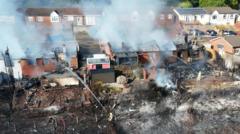
When a massive fire rips through a residential neighborhood, the official narrative usually sounds smooth and controlled. Authorities issue warnings, residents file out in neat lines, and emergency crews handle the threat with mechanical precision. Reality looks entirely different.
Streets evacuated after a massive fire destroys homes aren't quiet zones of orderly departure. They're chaotic, gridlocked, and defined by split-second decisions that alter lives forever. If you’ve never lived through a fast-moving urban disaster, you underestimate how quickly normalcy evaporates. One minute you're working at your kitchen table; the next, smoke is banking against your windows and police are pounding on your door with zero time to spare.
The Chaos Behind the Police Tape
Let's talk about what happens when the sirens start. Standard emergency response plans assume people will grab their go-bags and head straight for the nearest highway. They don't account for panic, narrow residential streets choked with parked cars, or residents running back inside for pets and sentimental items.
When neighborhoods face sudden destruction from extreme blazes—similar to the catastrophic suburban firestorms seen across drought-stricken regions in recent years—the infrastructure fails almost instantly. Power grids drop, traffic lights go dark, and single-lane roads turn into parking lots. Evacuation orders sound absolute on paper, but executing them requires navigating a maze of falling embers and zero visibility.
Local emergency management agencies often report high compliance rates, but boots-on-the-ground reality reveals a different story. First responders frequently have to abandon standard traffic control to physically pull stranded residents out of harm's way.
Why Modern Communities Are So Vulnerable
We build denser, we build faster, and we push further into high-risk wildfire or industrial hazard zones. That creates a dangerous multiplier effect. When a major fire ignites in a densely populated area, the thermal radiation alone can crack windows and ignite adjacent structures before the fire even reaches them.
Consider the physical anatomy of a disaster zone:
- Embers travel up to a mile ahead of the main front, sparking spot fires behind evacuation lines.
- Water pressure in municipal mains often drops as thousands of hydrants open simultaneously.
- Narrow suburban streets designed to slow down commuter traffic suddenly trap fleeing families.
You can't out-engineer physics. When wind speeds spike and humidity plummets, traditional firebreaks lose their stopping power.
What You Actually Need to Do When the Sirens Start
Most preparedness advice is useless because it assumes you have hours to think. You don't. When an evacuation order drops, you have minutes.
First, ignore the instinct to pack your entire life into a trunk. Focus purely on survival essentials: critical medications, important legal documents, and hard drives or backups of irreplaceable family history. Everything else is replaceable.
Second, know two distinct exit routes out of your immediate neighborhood. If the main artery is blocked by an abandoned vehicle or a downed power line, you need a secondary neighborhood escape path that avoids major intersections.
Finally, keep your vehicle's fuel tank at least half full if you live in a high-risk zone during peak hazard seasons. Gas stations rely on electrical grids that fail the moment a transformer blows.
Preparation isn't about buying fancy gear. It's about accepting that when the worst happens, you're on your own for the first crucial hour.
Thousands told to abandon Los Angeles homes as three wildfires rip through suburbs
This video provides an on-the-ground look at the chaotic reality of emergency evacuations and rapid-fire residential blazes.
http://googleusercontent.com/youtube_content/1