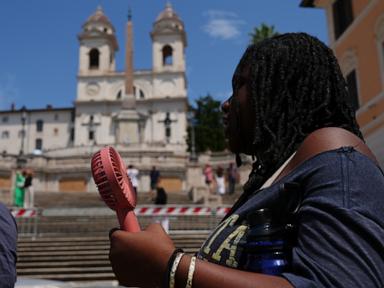
Right now, millions of people across Western Europe are trapped inside what feels like a giant, preheated kitchen oven.
In Paris, the night-time temperature just broke all-time records by refusing to drop below 24 degrees Celsius. In the UK, schools are shuttering doors, and the Met Office issued a rare red alert warning that temperatures will smash historic records. Over in France, emergency workers are dealing with dozens of tragic drownings as desperate citizens plunge into treacherous rivers just to cool down.
The culprit behind this misery isn't just a standard summer heatwave. It's a meteorological monster known as a heat dome.
If you are trying to understand why the weather suddenly turned hostile, you don't need a complex degree in meteorology. You just need to understand basic physics, a bit of pressure, and how human activity is changing the baseline of our atmosphere.
The Mechanics of the Atmospheric Lid
A heat dome happens when a massive region of high atmospheric pressure stalls over a specific area. Think of it as a heavy, rigid lid placed tightly over a pot of boiling water.
Under normal circumstances, hot air rises into the upper atmosphere, cools down, and disperses. High-pressure systems completely wreck this cycle. When a strong high-pressure ridge moves in, it pushes the air down with immense force.
As that air sinks, it compresses. Basic physics tells us that when you compress a gas, its temperature spikes.
This descending air creates a vicious cycle. It acts like a physical barrier that shoves away cooler marine breezes and deflects cloud formations. Without clouds, the sun beats down directly onto the earth's surface with zero filter. The soil dries out completely. Because dry ground can't use the sun's energy to evaporate water, 100% of that solar radiation goes straight into baking the air.
The longer the high-pressure system parks itself over land, the hotter it gets. The trapped air just keeps circulating, absorbing more heat day after day, cooking everything underneath it.
Why the Jet Stream is Keeping Us Trapped
You might wonder why these systems don't just blow away. Blame the jet stream.
The jet stream is a fast-flowing ribbon of air high up in the atmosphere that normally moves weather systems along from west to east. Sometimes, the jet stream develops deep, lazy curves. It stretches out into massive waves that move incredibly slowly, or stop moving altogether.
Meteorologists call this an atmospheric block. When the jet stream gets stuck in a wavy, stagnant pattern, it locks the high-pressure dome directly over a region.
Liz Bentley, chief executive at the Royal Meteorological Society, pointed out that the current conditions are annihilating old June records by several degrees. The jet stream isn't sweeping the hot air away; it's anchoring it in place right over France, Spain, and the UK.
The Human Fingerprint on Extreme Weather
It's tempting to look at this and say weather is just cyclical. That's a mistake. While heat domes are a natural atmospheric phenomenon, climate change is giving them a terrifying boost.
Think of greenhouse gases as an extra layer of insulation inside that atmospheric pot. The planet's baseline temperature is already roughly 1.2 degrees Celsius warmer than it was in the pre-industrial era. When a heat dome forms today, it starts building on top of a much hotter foundation.
UN Secretary-General Antonio Guterres didn't mince words during London Climate Action Week, stating bluntly that the capital is "cooking" and pointing the blame directly at our continued reliance on fossil fuels.
A warmer world also alters the behavior of the jet stream itself. Because the Arctic is warming much faster than the equator, the temperature difference between the two regions is shrinking. This temperature difference drives the speed of the jet stream. When the contrast weakens, the jet stream slows down, gets wobblier, and creates more frequent, highly persistent blocking patterns that trap heat domes for days or weeks at a time.
Surviving the Danger of Tropical Nights
When people read about extreme heat, they usually focus on the peak daytime temperature. Will it hit 39 or 40 degrees Celsius? While daytime spikes cause immediate heat exhaustion, the real killer is actually what happens after dark.
Meteorologists track "tropical nights"—periods when the temperature fails to drop below 20 degrees Celsius (68 degrees Fahrenheit).
Your body requires a dip in ambient temperature at night to lower its core heat and recover from daytime strain. When the night stays suffocatingly hot, your heart has to keep pumping rapidly to push blood to your skin to release heat. This prevents deep sleep, causes severe dehydration, and places immense cardiovascular strain on the elderly, young children, and those with pre-existing health conditions.
The World Health Organization reported that over the last four years, Europe saw more than 200,000 heat-related deaths. Most of those happened because homes, especially in places like the UK and northern France, were built to retain heat, not vent it. Without widespread air conditioning, these buildings turn into indoor heat traps overnight.
Immediate Action Steps for the Current Heatwave
If you are currently sitting under this atmospheric lid, you can't afford to treat this like a normal summer week. It's a legitimate safety hazard. Take these concrete steps right now to protect yourself and your home.
- Create an evening cross-breeze: Do not keep your windows open all day. Keep windows and blinds tightly shut while the outdoor air is hotter than your indoor air. Open them only late at night or early in the morning when the outside temperature drops below your indoor baseline.
- Identify your coolest room: Heat rises. If you live in a multi-story home, sleep on the ground floor or the basement during the peak days of the dome.
- Hydrate before you feel thirsty: Sip water constantly. Avoid alcohol and heavy caffeine intake. Alcohol dehydrates you rapidly and impairs your body's ability to regulate its own temperature, making you highly susceptible to heat stroke.
- Check on vulnerable neighbors: Spend five minutes calling or knocking on the door of elderly neighbors or anyone living alone without cooling systems. Ensure they have access to water and a cool space.