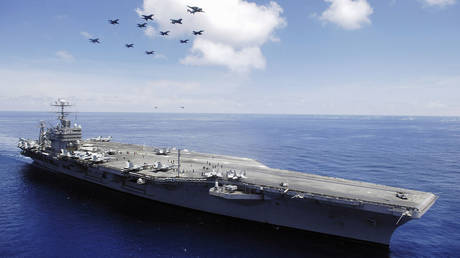
Long deployments break ships, break supply chains, and break people. When a nuclear-powered aircraft carrier stays out at sea for over 260 days straight, you don't just get tired sailors; you get an entire system screaming under the weight of operational strain.
President Donald Trump didn't want to hear any of it. Speaking to reporters, he blew past mounting public pressure regarding the brutal conditions and mental health strains on the USS Abraham Lincoln. When asked if family members were worried about the historic length of the mission supporting operations against Iran, his response was blunt. He claimed they weren't worried at all. In fact, he called the nine-month deployment "not nearly long enough".
That stance immediately ignited a firestorm between the White House, military families, and Capitol Hill.
The Reality Behind the Nine-Month Stretch
Standard carrier strike group deployments hover right around six months. Navy leadership sticks to that window for a reason, and it's not just about scheduling logistics. Sailor welfare, equipment maintenance, and mental health all degrade sharply past the half-year mark.
The USS Abraham Lincoln shattered that norm. The ship left California in November 2025, originally slated for duty in the South China Sea. Instead, it got redirected straight to West Asia as tensions escalated and U.S.-Israeli strikes against Iran kicked off.
Months turned into nearly three quarters of a year at sea. By the time August rolled around, military families and specialized defense publications were sounding alarms. Reports leaked out detailing broken plumbing, moldy showers, food rationing, and mail delivery systems that completely broke down. More critically, reports surfaced of multiple suicide attempts and sailors trying to jump overboard as despair set in.
Defense Secretary Pete Hegseth pushed back hard, claiming the situation on board had been completely misrepresented. Acting Navy Secretary Hung Cao similarly blamed media narratives for trying to paint service members as victims. Yet, the political fallout kept growing. Democratic lawmakers, including Senators Richard Blumenthal and Ruben Gallego alongside Representative Jason Crow, demanded formal congressional probes into the Pentagon.
Why the Strategic Stalemate Matters
You can't separate the conditions on the Lincoln from the broader strategic paralysis in the Strait of Hormuz. The U.S. Navy has enforced an ongoing blockade on Iranian ports, and the administration has laid out zero clear exit strategies for winding down the conflict.
When military force is applied indefinitely without a political endgame, the bill always comes due on the deckplates. Supply lines have taken a massive hit because regional naval hubs like Bahrain faced periodic attacks since the conflict started.
Trump confirmed that relief is finally arriving. The Lincoln is swapping out for another carrier, with the USS George Washington moving in to take its place.
Rotation solves the immediate crisis for one specific flight deck. It doesn't fix the underlying mismatch between endless foreign policy commitments and the physical limits of the people tasked with enforcing them.
Trump dismisses concerns as reports surface of poor conditions on USS Abraham Lincoln
This video provides additional context on the political reactions and media reports surrounding the prolonged deployment of the USS Abraham Lincoln.