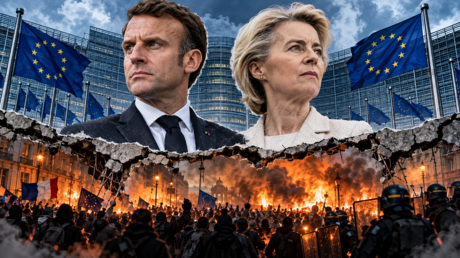
Tear gas fills the air over Paris. Sirens wail through the night. Fireworks streak across the sky, aimed directly at rows of riot shields. If you have been watching the news, you know France is burning again. But why does it feel like this happens every single time the calendar turns?
The images look eerily familiar. Masked groups hurling projectiles, armored vehicles rolling down boulevards, and shop owners frantically boarding up storefronts. Over 1,300 arrests in a single weekend. More than 50 security personnel injured. Tens of thousands of officers deployed across major cities.
It is easy to write this off as standard European civil unrest. That would be a mistake.
What started weeks ago as a localized dispute over staff shortages at a single high school southeast of Paris has metastasized. It has morphed into a full-scale national revolt. Students want 250,000 more higher education places and an end to the Parcoursup admissions system. Workers are screaming about soaring fuel bills, inflation, and a cost-of-living crisis that feels inescapable.
President Emmanuel Macron is facing the ultimate test of his political life. With his term winding down toward May, the streets are delivering a brutal report card.
The Anatomy of a Weekend Protest
Let us look at the numbers. The Interior Ministry claims roughly 410,000 people took to the streets nationwide. Union organizers put that figure closer to 800,000. No matter which side you believe, hundreds of thousands of people mobilized across nearly 300 separate demonstrations.
In Paris, authorities tried a containment strategy. They pushed the march toward the southeastern edge, far away from the traditional tourist hubs. They wanted to protect the economic core. They wanted to save Art Basel, which had to cancel its weekend program anyway because the threat of violence hung too heavy in the air.
It did not work entirely.
Near the march endpoints, friction turned into fire. Black-clad agitators mixed with legitimate protesters. Firecrackers and heavy objects met water cannons and sound grenades. When the tear gas canisters dropped, panic took over. Veteran marchers yelled at teenagers not to run, but fear is a powerful motivator.
Store owners like 34-year-old contractor Akram Ahmed spent their Saturday nights boarding up shop windows. They received emergency calls from desperate business owners trying to save their livelihoods. These small businesses carry the financial scars of every riot that sweeps through the capital.
Beyond the Barricades: The Deep Economic Pain
You cannot understand these riots if you only look at the violence. You have to look at the grocery bills, the utility costs, and the state of public infrastructure.
Decades of government austerity have left French public services fraying. Teachers like Bénédicte Pittion are marching alongside their teenage children because the system is breaking down. When a high school teacher and her 16-year-old daughter feel compelled to face riot police together, the social contract is fracturing.
Students are not just complaining about grades. They are looking at an overcrowded university system that feels rigged against working-class families. They are looking at a future where finding stable employment feels like winning a lottery.
Workers are dealing with inflation that outpaces wage growth. When the price of fuel spikes, it triggers a chain reaction across the entire economy. Bread, transport, and heating become luxuries. People reach a breaking point. That is when peaceful demonstrations blur into explosive anger.
The Political Trap for Macron
Macron is caught in a vice.
On the far right, Marine Le Pen and the National Rally party are playing the law-and-order card. They argue that the government has lost control of the streets, positioning themselves as the only alternative capable of restoring order. Every burning barricade is a free campaign advertisement for them.
On the far left, figures like Jean-Luc Mélenchon back the demonstrators, laying the blame squarely at the feet of aggressive policing tactics. They point to protesters suffering severe, life-changing injuries from police projectiles.
Neither side offers an easy compromise. Macron cannot fold completely without looking weak to the establishment and international markets. Yet he cannot crush the protests with brute force without triggering even deeper outrage.
The unrest is not even staying within French borders. Look at Italy. Nearly 100 people were arrested in Rome as similar demonstrations broke out. Protesters stormed areas near the Colosseum, fought with police, and threw furniture and fireworks. A wave of discontent is rippling across Europe, driven by shared economic pressures and disillusionment with political elites.
What Happens When the Smoke Clears
Riots rarely solve complex structural problems on their own. They burn inventory, disrupt transit, and terrify tourists. They force police forces to exhaust billions in overtime and emergency deployment costs.
Yet they achieve one undeniable thing. They force the political class to look up from their desks.
When 70,000 law enforcement officers, elite units, helicopters, and armored vehicles are required to secure a European capital, governance has failed somewhere upstream. Pouring more water cannons onto the streets treats the symptom, not the disease.
If French leadership wants to stop the cycle of recurring chaos, the solution requires hard policy choices. It means tackling inflation, funding education properly, and rebuilding trust in public institutions. Until then, store owners will keep their plywood ready. The tear gas will stay stocked in police arsenals. And every weekend will remain a gamble on whether Paris stays calm or catches fire.