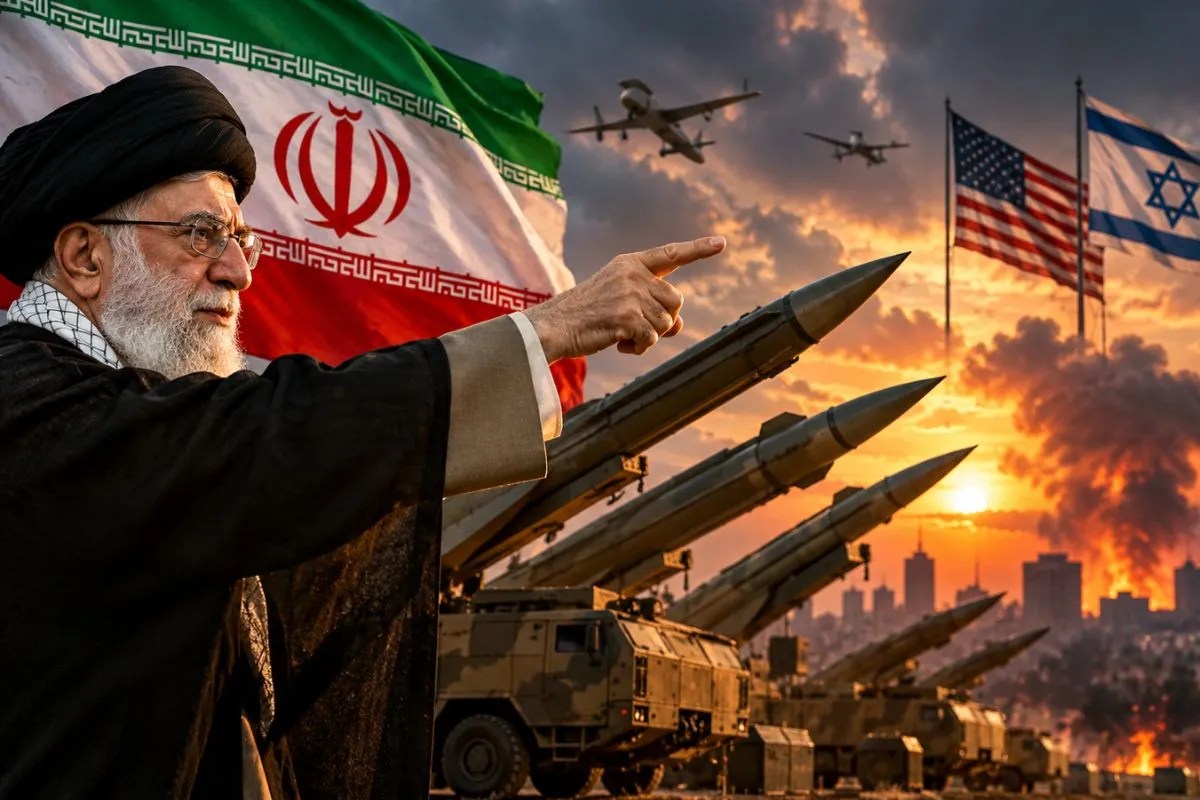
Military posturing in the Middle East rarely stays quiet for long. When top military officials start talking about hidden surprises, global defense analysts stop scrolling and start paying attention. Iran has thrown down another heavy marker against Washington and Tel Aviv, claiming its armed forces possess advanced technology that hasn't seen the battlefield yet.
Let's look past the standard rhetoric. What do these constant warnings actually mean for the regional balance of power?
Brigadier General Abolfazl Shekarchi, the senior spokesperson for Iran's armed forces, recently made headlines by stating that any fresh aggression from the United States or Israel will be met with entirely new military capabilities. According to statements carried by regional outlets, Tehran insists its missile and drone development has shifted away from traditional, bulky stockpiles toward decentralized, cost-effective systems that are much harder to track and neutralize.
You need to understand how military doctrines evolve under heavy economic restrictions. When a nation faces decades of sweeping international trade bans, it doesn't stop building weapons. It adapts.
The Economics of Asymmetric Warfare
Western defense think tanks often make the mistake of measuring a country's military strength purely by its defense budget numbers. That's a trap. Iran doesn't try to match the United States or Israel dollar-for-dollar in aircraft carriers or stealth jets. That would be financially impossible.
Instead, Tehran leans hard into asymmetric warfare. By focusing heavily on domestic production of low-cost loitering munitions, precision-guided rockets, and swarm-capable drones, they've created a completely different defensive puzzle.
- Low-Cost Production: Building hundreds of inexpensive drones changes the math of air defense. Interceptor missiles used by advanced defense shields often cost millions of dollars each, while asymmetric threats can cost a fraction of that.
- Decentralized Launch Sites: Instead of relying on massive, easily targetable fixed airbases, modern asymmetric doctrines use mobile launchers hidden in rugged terrain or civilian infrastructure.
- Indigenous Supply Chains: Because foreign military imports are tightly restricted, domestic engineering departments have had to solve supply chain problems internally, creating a self-sustaining defense manufacturing base.
When General Shekarchi talks about having "surprises" ready for adversaries, he's referring to these doctrinal shifts. It's an open secret in defense circles that surprise isn't just about a new weapon type. It's about deploying familiar technology in unexpected tactical formations or coordinated waves that overwhelm standard radar architectures.
Why Washington and Tel Aviv Take Notice
It is easy to dismiss these announcements as domestic propaganda meant for local consumption. State television networks in any country at high alert will always broadcast strength. But military planners in the Pentagon and the Israel Defense Forces don't have the luxury of ignoring them.
Every time Iranian Revolutionary Guard Corps officials hint at upgraded missile guidance or new electronic warfare capabilities, intelligence agencies scramble to update their threat assessments. The risk isn't necessarily that Iran has invented some science-fiction superweapon. The real danger is the sheer volume and unpredictability of upgraded conventional systems hitting key regional infrastructure simultaneously.
Think about how modern conflict zones operate. A single overlooked vulnerability in a radar tracking grid can allow dozens of low-flying projectiles to slip past multi-layered shields. That's why every sharp statement from Tehran triggers immediate defensive adjustments across allied bases in the region.
The Real Cost of Perpetual Escalation
Nobody wins when the baseline of communication between nuclear-capable or heavily armed states drops down to public threats. Ordinary people across the Middle East bear the brunt of this ongoing tension, living under the constant shadow of potential escalation.
Sanctions haven't crippled Iran's technical ambitions the way policymakers in Western capitals originally hoped. In fact, isolation forced a level of domestic military self-sufficiency that surprised foreign observers years ago.
If you're watching the global news cycle, stop looking for signs of a sudden diplomatic breakthrough. Right now, both sides are locked into a cycle of deterrence by signaling. Every public warning is designed to raise the political and military price of an adversary's next move.
The situation remains volatile, highly unpredictable, and deeply tied to domestic political survival on all sides. Keep an eye on how defense budgets and regional alliances shift over the coming months, because the real test of these military "surprises" will happen the moment deterrence fails.