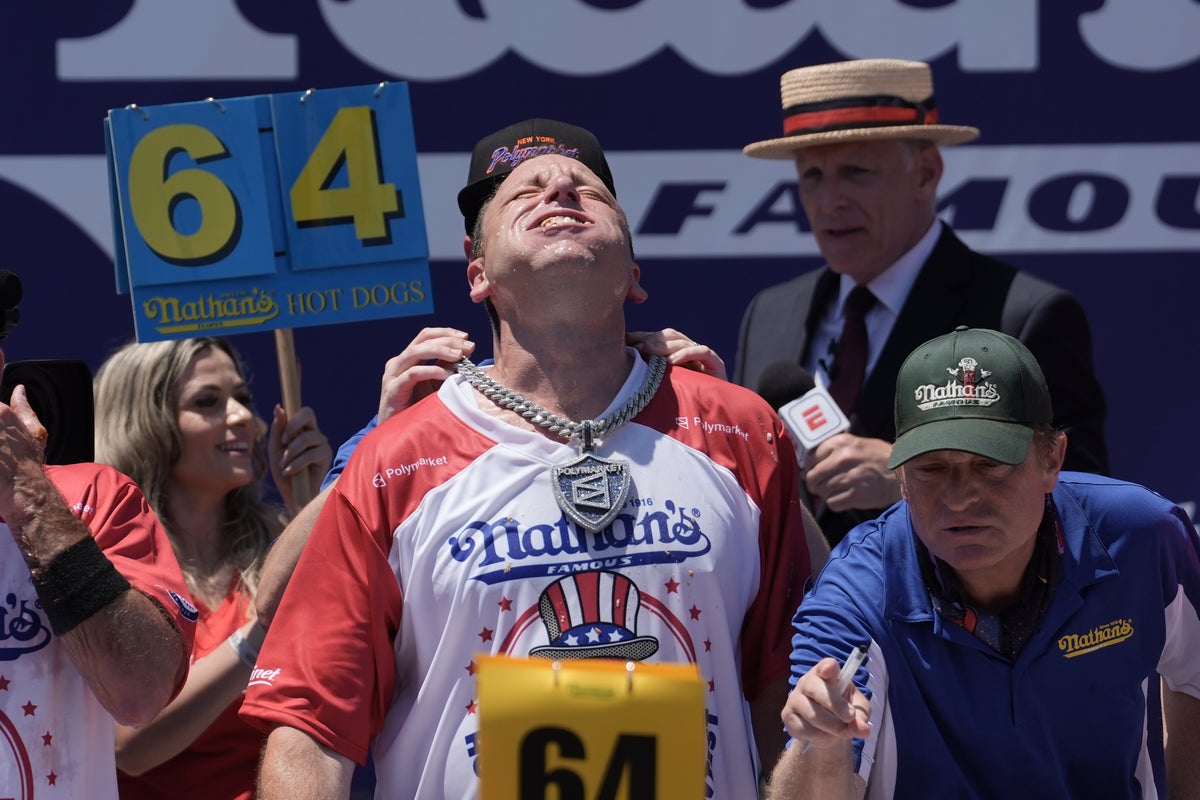
Coney Island on the Fourth of July isn't for the faint of heart. When the thermometer hits triple digits and the humidity wraps around you like a wet wool blanket, most people look for air conditioning or a cold drink. Joey Chestnut looks for plates of meat.
If you thought a brutal 100-degree heatwave or a messy off-season arrest would finally derail the greatest competitive eater of all time, you don't know Joey "Jaws" Chestnut.
The 2026 Nathan’s Famous Fourth of July hot dog eating contest just wrapped up, and the headlines will tell you Chestnut missed his world record of 76 hot dogs. They'll focus on how the sweltering New York humidity kept him to a relatively modest 66 frankfurters and buns in 10 minutes. But focusing on the missed record misses the entire point of what happened on that stage.
Chestnut didn't just win his 18th Mustard Belt. He utterly destroyed a world-class field under conditions that would make an ordinary human physically ill within three minutes. He won by a margin of 15 hot dogs. His closest rival, Patrick Bertoletti, stalled out at 51. Australian powerhouse James Webb took third with 47.5.
This wasn't a failure to break a record. It was a masterclass in tactical survival and athletic dominance.
The Brutal Science of Eating in 100-Degree Heat
People think competitive eating is just about having a massive stomach. It isn't. It's an intense cardiovascular challenge, and when you inject extreme heat into the equation, the mechanics of the sport change entirely.
When the air temperature hits 100 degrees Fahrenheit, your body naturally tries to cool itself down by shunting blood away from your core and toward your skin. If you're a competitive eater, you need that blood flow concentrated in your digestive tract to handle the massive, rapid expansion of your stomach. You're fighting your own biology from the very first bite.
Then you have to consider the buns.
The standard technique at Nathan's involves separating the meat from the bun, dunking the bread into warm water to lubricate it, squeezing out the excess liquid, and cramming it down. In high humidity, the structural integrity of the bread goes out the window before it even touches the water. The buns turn into a gummy, sticky paste rather than a smooth, easily swallowable slide.
Chestnut admitted immediately after the whistle that the elements got the better of his pacing.
"I knew early that I was going to win, but I also knew early I wasn't going to break the record," Chestnut told reporters. He didn't offer it as a pathetic excuse. It was just a cold, analytical assessment of the situation. Instead of pushing his body to the point of a catastrophic reversal of fortune—the polite competitive eating term for vomiting—he adapted. He slowed his rhythm, monitored his throat, and cruised to an easy victory.
That's experience. A rookie tries to force the issue in the heat and ends up disqualified. Chestnut just clocks in, gets the job done, and collects his $10,000 check.
Miki Sudo and the Women’s Dynasty
The men’s division wasn't the only place where history repeated itself in the sweltering mid-day sun. Earlier in the morning, before the heat reached its peak but while the humidity was still thick enough to chew, Miki Sudo stepped up to the table to defend her own legacy.
Sudo secured her 12th championship belt by downing 38.75 hot dogs and buns.
While she didn't hit her personal best of 51, she completely isolated herself from the rest of the women’s field. Michelle Lesco took a distant second place with 22, and Domenica Dee claimed third with 21.5. Sudo won by more than 16 hot dogs.
Think about that gap. In a 10-minute sprint, Sudo managed to eat nearly double what the second-best woman in the world could handle. Like Chestnut, Sudo relied heavily on muscle memory and the sheer energy of the Coney Island crowd to carry her through an off-day physically. When your body wants to reject every single bite because of the ambient temperature, your brain has to take over completely. Sudo has that mental lock.
Corporate Shifts and Legal Drama Behind the Scenes
The road to the 2026 contest wasn't smooth. The event looked vastly different behind the curtain this year, marked by corporate shakeups and legal troubles that threatened to sideline the champ.
In January, the packaged meat giant Smithfield Foods officially bought Nathan’s Famous. For an event deeply rooted in old-school Brooklyn tradition, a major corporate transition always brings anxiety. Fans wondered if the new ownership would try to sanitize the spectacle or alter the qualifying structure. Fortunately, the chaotic energy of Surf and Stillwell avenues remained entirely intact.
The bigger threat to the status quo was Chestnut’s own legal situation.
Back in April, Chestnut pleaded guilty to a misdemeanor battery charge following an altercation at an Indiana bar. For a few weeks, sportsbooks and competitive eating fans wondered if a probation ruling or travel restrictions would bar him from entering New York.
His legal team managed to secure permission for him to travel outside Indiana, arguing the incident was an unfortunate misunderstanding and noting that Chestnut took immediate, full responsibility for his actions. Major League Eating quickly confirmed the criminal case wouldn't affect his eligibility.
It takes a specific kind of mental fortitude to block out criminal court dates, corporate buyouts, and media scrutiny, only to show up on July Fourth and eat 66 hot dogs like nothing happened. Most athletes crumble under a fraction of that distraction. Chestnut just uses it as fuel.
Why the Margin of Victory Matters More Than the Total
The casual fan tunes in once a year hoping to see Chestnut hit 77 or 78 hot dogs. When he finishes with 66, they think the era of dominance is winding down. That's a fundamental misunderstanding of how sports longevity works.
Look at the raw data from the 2026 leaderboard:
- Joey Chestnut: 66 hot dogs
- Patrick Bertoletti: 51 hot dogs
- James Webb: 47.5 hot dogs
Bertoletti and Webb are elite, world-class eaters. They tour the circuit, train relentlessly, and can out-eat entire restaurants of normal humans. Yet, on Chestnut's self-described "bad day," he still beat them by 15 and 18.5 hot dogs respectively.
In any other sport, a athlete winning a championship while completely off their game by a margin of nearly 30% would be hailed as an untouchable god. In competitive eating, we just call it Saturday.
Chestnut is getting older, and the human body doesn't handle rapid stomach expansion or extreme sodium overloads better at 42 than it did at 32. The fact that his baseline performance is still miles ahead of the absolute peak performance of his closest competitors shows that the Mustard Belt won't be changing hands anytime soon.
What to Do Next if You Want to Understand the Sport
If you're done watching the surface-level highlights and want to actually understand what makes these athletes tick, stop looking at the total numbers on July Fourth.
First, watch the tape of the first two minutes of Chestnut's run. Pay attention to his hands, not his mouth. Notice the absolute synchronization between the hand dunking the bun, the hand breaking the frankfurter, and the rhythmic bob of his throat. It's a mechanical assembly line.
Second, track the upcoming Major League Eating summer circuit. The Nathan's contest is the Super Bowl, but the real technical adjustments happen at smaller regional events where eaters test new breathing patterns and water-temperature variations.
Joey Chestnut proved once again that he owns the Fourth of July. The weather tried to stop him, the law tried to slow him down, and corporate changes shifted the ground beneath his feet. None of it mattered. The belt stays exactly where it belongs.