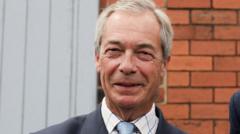
The rules are simple. If you're a member of parliament, you declare your financial interests. You don't hide where your security, your housing, or your campaign help comes from. Yet, a fresh political storm is brewing in Westminster, and it centers on Reform UK leader Nigel Farage. Predictably, Nigel Farage denies wrongdoing over unclaimed benefits and undeclared financial assistance, dismissing the mounting allegations as entirely baseless.
But this isn't just a minor administrative oversight. It strikes at the heart of political transparency. Learn more on a connected issue: this related article.
Why Nigel Farage Denies Wrongdoing Over Unclaimed Benefits
The controversy kicked off after a series of explosive reports revealed that Farage allegedly received massive financial support in the year leading up to his election as an MP for Clacton. According to investigations, the support came from George Cottrell, a long-standing ally and convicted fraudster who works in the cryptocurrency sector. Cottrell allegedly provided Farage with high-end accommodation in a London townhouse, dedicated security services, and specialized social media staff.
Under parliamentary rules, new MPs face strict disclosure requirements. They must register any gifts or financial benefits worth more than £300 received in the 12 months before their election if those perks connect to their political activities. Farage only registered a handful of travel expenses from Cottrell, leaving the broader operational support off the books. Further analysis by Reuters highlights comparable perspectives on this issue.
His team's defense is straightforward. They claim Farage wasn't an active politician during the exact period this support was active. His spokespeople call the entire narrative a contrived attack meant to stall Reform UK’s political momentum. They argue that personal friendships and private gifts don't fall under public disclosure mandates.
It sounds plausible on paper. But the standards commissioner might see it differently.
The Hidden Money Trail in Reform UK
This isn't an isolated headache for Farage. The watchdog was already looking into him. He is currently facing a separate probe into a massive £5 million donation from Christopher Harborne, a wealthy aviation entrepreneur and crypto investor based in Thailand.
Farage insists that the £5 million was a personal gift meant solely to fund his private security. He claims that because it didn't fund a political campaign directly, it didn't require immediate public disclosure.
Think about that for a second. Millions of pounds flowing from offshore accounts to fund the lifestyle and protection of a major political leader, completely hidden from public view until investigative journalists dragged it into the light. It leaves a bad taste in the mouth.
What Happens if the Watchdog Finds a Breach
Liberal Democrat MP Josh Babarinde didn't waste any time. He officially requested that Daniel Greenberg, the Parliamentary Commissioner for Standards, open a formal inquiry into the new allegations surrounding Cottrell's financial assistance.
The stakes are incredibly high here. If the watchdog determines that Farage committed a serious breach of disclosure rules, the consequences are severe. He won't just get a slap on the wrist.
A serious violation can lead to a suspension from the House of Commons. If that suspension lasts for ten days or more, it triggers a recall petition under UK law. That means voters in Clacton could force a by-election, potentially stripping Farage of his hard-won parliamentary seat.
Reform UK is riding high in national polls right now. Farage openly eyes the prime minister's office for the 2029 election. A prolonged ethics scandal, or worse, getting kicked out of parliament over secret cash and free housing, would shatter that ambition.
How to Track Parliamentary Transparency Yourself
You don't have to rely purely on media spin to know what politicians are earning or receiving. The system is public for a reason. Here is how you can verify these financial links yourself.
First, check the Register of Members' Financial Interests. The House of Commons updates this document every two weeks. It lists every single donation, second job salary, gift, and international trip an MP accepts.
Second, look at the Electoral Commission database. This tracks political party funding rather than individual MP gifts. If a crypto billionaire gives money to a party machine, it shows up here.
Keep an eye on the Parliamentary Commissioner for Standards' website. They regularly publish a list of MPs currently under active investigation. When a decision lands, the full report becomes public text.
Transparency isn't optional. Politicians love to complain about a rigged system, but the real issue is often the rules they choose to ignore. Watch the standards commissioner over the next few weeks. The ruling on Farage will set a massive precedent for how money flows through British politics.