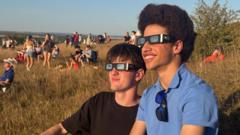
Skies darken unexpectedly in the middle of a summer evening. Temperatures dip. Hundreds of people stand shoulder-to-shoulder on windswept hillsides across the country, staring upward with cardboard glasses pressed tightly to their faces.
If you missed the solar eclipse, you missed the biggest shared public spectacle of 2026.
Crowds didn't just stay home to catch a glimpse on local television. They packed into elevated viewpoints, local parks, and open ridges—reminiscent of the historic August 1999 turnout. Why do we drop everything when the Moon passes in front of the Sun? It comes down to rare alignment, cosmic perspective, and the sheer human urge to gather when something extraordinary happens in the sky.
The Pull of High Ground
Hilltops have always been the default stage for celestial events. When the recent partial solar eclipse peaked—blocking roughly 90 to 95 percent of the Sun's light across various parts of the UK—elevated spots like Windmill Hill, Grinshill, and local Welsh ridges turned into spontaneous community festivals.
You didn't just watch an eclipse. You felt it.
As the peak approached, a strange, metallic twilight settled over towns. Shadows sharpened. The familiar hum of daytime life paused as hundreds of strangers shared protective eyewear, passing cardboard frames and specialized solar filters between groups. In an era dominated by screens and isolation, standing on a windy hill waiting for the universe to shift forces you to look up and connect with the person standing next to you.
What Science Tells Us About the Hype
The math behind an eclipse is straightforward, but the visceral reaction to it is deeply primal. A solar eclipse occurs when the Moon slips directly between the Earth and the Sun. Because the Sun happens to be about 400 times wider than the Moon—and coincidentally 400 times farther away—they appear almost identical in size from our vantage point.
That cosmic coincidence creates totality in narrow bands across the globe, while leaving millions of us outside that path with a deep partial eclipse.
Yet, even a 95 percent obscuration isn't total darkness. It is an eerie, silvery dimness that plays tricks on your eyes and your brain. Animals grow quiet. The air cools down rapidly. People gasp, not because the Sun has vanished entirely, but because the daylight feels fundamentally wrong.
The Long Wait Between Spectacles
Part of the reason hundreds flooded the hillsides is simple scarcity. If you missed this event, your timeline for the next comparable solar spectacle stretches decades into the future.
We aren't conditioned to see major eclipses every year. When memories of the 1999 blackout faded into history, a whole new generation grew up reading about astronomy in textbooks rather than experiencing it firsthand. That changed overnight. Families hauled camping chairs, picnic blankets, and homemade pinhole projectors up steep inclines just to catch an hour of cosmic alignment.
How to Prepare for the Next Big Celestial Event
If seeing crowds gather on a ridge inspires you to catch the next major astronomical milestone, don't just wing it. A little preparation turns a confusing smudge in the sky into an unforgettable memory.
- Secure certified eye protection early. Regular sunglasses—no matter how dark they look—do not block the infrared and ultraviolet radiation that destroys your retina. Look for ISO 12312-2 certified solar filters weeks before the event. Counterfeits flood online marketplaces the week of an eclipse.
- Scout your location with elevation in mind. City streets limit your western horizon. Find a local park, hill, or open trail with an unobstructed view of the sun's trajectory hours before peak time.
- Manage your expectations on weather. Clear skies are never guaranteed. Even a modest summer haze or intermittent cloud cover will alter your view, which is why mobility on foot is your best asset.
Next time the sky starts acting strange, grab your gear, head for the high ground, and look up.