Skipping one almond latte a week saves more water than ditching AI chatbots altogether.
Sounds backward, right? For the past couple of years, every time someone asked an AI model a question, a wave of guilt seemed to follow it. Headlines painted server farms as thirsty monsters draining local aquifers just to summarize emails or generate silly images. Then Enverus Intelligence Research dropped a report titled Data Center Water Use | Setting the Record Straight, and the math flips the usual narrative on its head.
Under Enverus's benchmark, spending $25 a month on AI services uses roughly 1.9 gallons of water. Spend that same $25 on almond milk, and you're looking at about 308 gallons. Put $25 toward golf green fees, and water use climbs to around 679 gallons. Even household electricity on an all-natural-gas grid clocks in at about 31 gallons for $25.
That doesn't mean AI is free of environmental tradeoffs. Far from it. It means comparing raw server cooling to everyday human habits requires looking at the whole picture instead of reacting to viral numbers out of context.
Why AI Water Consumption Looks So Different Per Dollar
Most viral arguments about AI water consumption compare apples to lawn sprinklers. Someone sees a figure for how much water a giant computing campus uses in a year and tries to judge a $20 or $25 monthly subscription against it. Enverus took a different route by equalizing monthly spending at $25 across several categories.
When you measure water per dollar spent, economic value enters the equation. A $25 monthly AI plan buys an awful lot of compute and text generation relative to the water required to run those models in Enverus's base-case estimate. Meanwhile, almonds are notoriously water-intensive crops grown in dry climates, and golf courses maintain vast expanses of turf grass that need constant irrigation.
Ryan Luther, director of energy transition research at Enverus, put the consumer takeaway plainly: skipping a single almond latte each week saves more water than giving up AI chatbots completely, while skipping a round of golf saves more water than spending over $16,000 on AI inference.
Honestly, that comparison hits hard because it exposes how selective our environmental outrage can be. We happily buy almond milk, water lawns, and pay for leisure activities with huge water footprints without thinking twice, yet we scrutinize every digital prompt as if it were pouring water straight onto desert sand.
Where the Water Actually Goes When AI Runs
Here's a detail that catches plenty of people off guard: roughly 90% of the water attributed to running AI models in Enverus's analysis isn't evaporated at the data center at all. It happens at power plants generating the electricity those servers need.
When you talk about AI water consumption, you're really talking about two distinct stages:
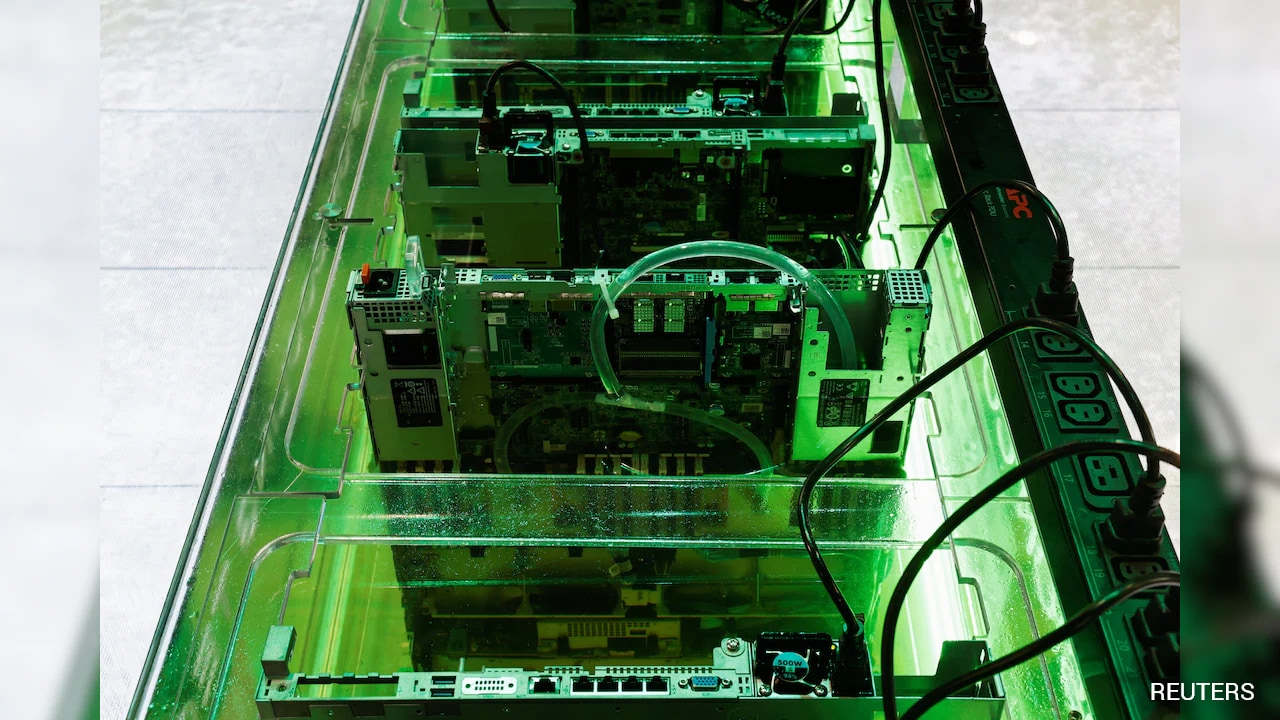
- Direct site cooling: Water used on-site to reject heat from dense racks of processors, which varies widely depending on whether a facility uses evaporative cooling towers, closed-loop systems, or air/dry cooling.
- Indirect power generation: Water consumed upstream at thermoelectric or fossil-fueled power plants that supply electricity to the grid feeding the data center.
Ignoring power-plant water undercounts the real footprint. At the same time, treating all water equally without checking local grid mix or regional drought stress misses why location matters so much. A facility sitting on a water-rich grid with clean power has a very different story than one built in an arid watershed straining municipal supply.
Per-Acre Numbers Tell Another Side of the Story
Enverus also looked at land intensity, estimating that a modern hyperscale data center campus uses around 32,100 gallons of water per acre per month. That sits below irrigated crops like rice, almonds, and alfalfa, and lands roughly in the same neighborhood as an average U.S. golf course on a per-acre basis.
Still, acre-for-acre comparisons have limits. A farm covers hundreds or thousands of acres and produces food, while a data center packs immense computing power into a tight footprint and pulls huge electrical loads from the regional grid. You can't flatten every land use into one neat score and call the debate settled.
The Nuance Big Reports Often Gloss Over
As a tech writer who has covered infrastructure and energy debates for years, I've noticed a pattern: every time a study comes out defending data centers, critics point to missing data, and every time a study warns about water strain, industry boosters point to agriculture. Both sides usually have a point, and both usually skip inconvenient caveats.
Researchers and policy analysts—including teams at the United Nations University Institute for Water, Environment and Health and academic engineers like Shaolei Ren at UC Riverside—have repeatedly stressed that public water disclosures from tech companies remain patchy or inconsistent. When numbers aren't standardized across regions, cooling methods, and time periods, even smart models rely on assumptions.
There's also a big difference between water withdrawal (water taken from a source) and water consumption (water permanently lost to the local watershed through evaporation or incorporation into a product). Mixing those terms up in casual commentary leads to wild claims on both sides.
And let's be real about workload differences. Generating a short text reply isn't the same as rendering high-resolution video or running massive continuous inference at scale. A June 2026 UNU-INWEH report highlighted how energy and water footprints jump sharply from basic text tasks to heavy media generation, and how efficiency gains can get swallowed by surging usage volumes.
Where Skeptics Have a Fair Argument
Even if AI uses far less water per dollar than almond milk or golf, local communities don't experience "per dollar" metrics. They experience local utility bills, local aquifer levels, and strain on regional power grids.
If a new facility moves into a town already facing water restrictions, telling residents that almonds use more water statewide won't fix a tight local water budget. Siting, transparency, and grid mix matter enormously in the real world.
Practical Ways to Cut Your Real Water Footprint
If you actually care about lowering your water footprint rather than just arguing about it online, focus on what moves the needle most.
- Look at food and yard habits first. Agriculture and turf irrigation account for massive shares of freshwater use, far outweighing personal AI prompts. Cutting back on water-heavy foods or over-watering lawns makes a measurable difference.
- Match the AI model to the job. Don't burn heavy reasoning or video-generation compute on trivial tasks that a lightweight model or quick search handles in a fraction of the effort.
- Push for real transparency, not hype. Whether you're evaluating a vendor, a cloud region, or a local project, ask for full lifecycle water disclosures—covering both on-site cooling and electricity generation—rather than cherry-picked figures.
Numbers give us better clarity, not an excuse to stop paying attention. Keep questioning the math, check the local context, and put your effort where the water actually goes.