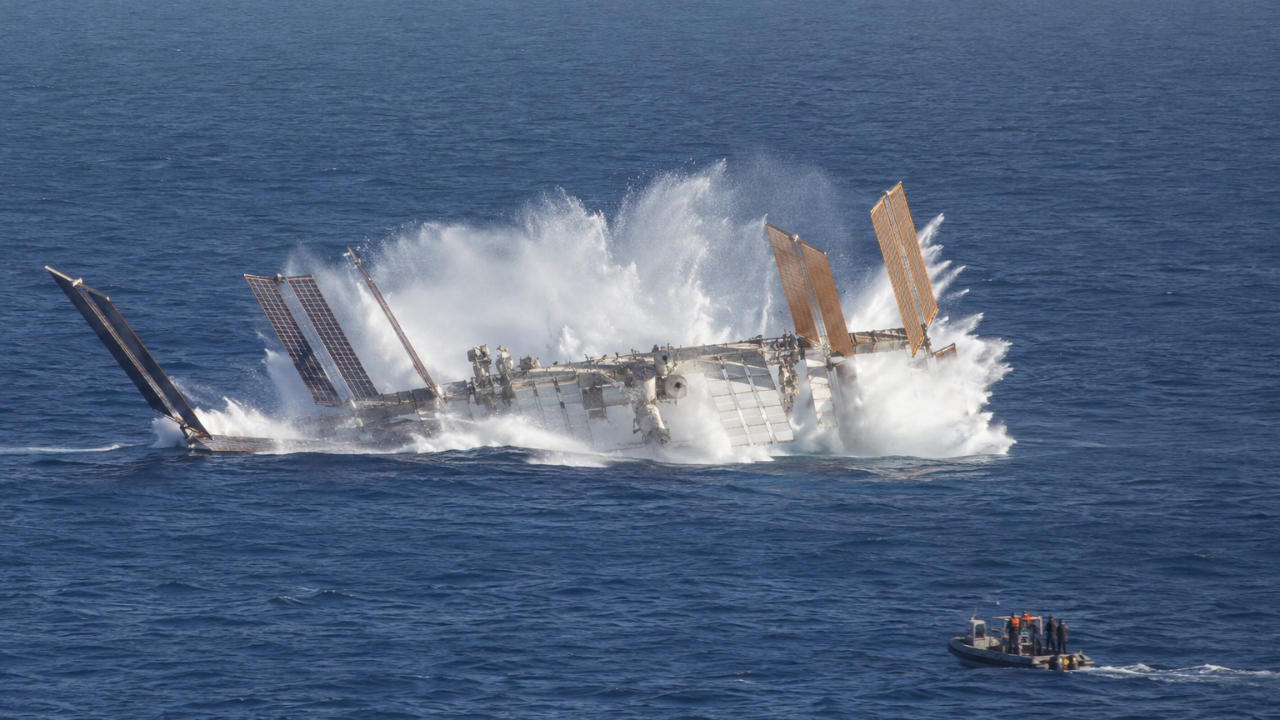
The International Space Station is old, tired, and structural fatigue means its days are numbered. By 2031, NASA plans to guide this football-field-sized behemoth through a fiery atmospheric entry, dumping whatever survives into the most remote stretch of water on Earth.
But treating our oceans as a final resting place for human space exploration is facing serious pushback.
For decades, space agencies operated under a simple premise. If you drop heavy space hardware far enough away from human civilization, it's safe. That logic led them straight to Point Nemo, a vast watery desert in the South Pacific Ocean. It sits 2,688 kilometers from the nearest speck of land. When astronauts fly over it aboard the ISS, they're actually closer to Point Nemo than anyone on the planet's surface.
It sounds like the perfect dumping ground. But ocean conservation groups like the Ocean Foundation are sounding the alarm. They argue that out of sight shouldn't mean out of mind, and the legal loopholes allowing this practice are catching up with us.
The Mechanics of a Controlled Crash
Let's look at what bringing down a 420-tonne space station actually takes. You can't just leave it alone. If NASA did nothing, Earth's natural atmospheric drag would eventually drag the station down on its own. That's an uncontrolled re-entry, and it's a nightmare scenario. Huge, dense chunks of heat-resistant material would rain down randomly over populated areas.
To prevent a catastrophic disaster, NASA awarded SpaceX an $843 million contract to build a massive United States Deorbit Vehicle. This specialized craft will attach itself to the station.
While much of the station will burn into ash, dense, heavy components like titanium structures, stainless steel nodes, and structural mounts will make it through the fire. They will plunge straight into the ocean.
The Problem With Point Nemo
Point Nemo is often called a biological desert. The spinning South Pacific Gyre blocks nutrient-rich currents from entering the area, meaning there's very little marine life compared to coastal waters. Because of this, it's become the world's premier spacecraft cemetery, swallowing up over 260 retired satellites and space laboratories since 1971.
But Mark Spalding, president of the Ocean Foundation, highlights a massive flaw in our thinking. Remoteness doesn't mean a complete lack of vulnerability. We honestly don't know the exact chemical and ecological impact of letting a massive space station rust on the seabed.
The biggest worry isn't just inert iron or aluminum. It's the highly toxic remnants of space propellants like hydrazine and nitrogen tetroxide that might survive the plunge inside sealed fuel lines or tanks. If those chemicals leak directly into deep-sea ecosystems, the local damage could be severe.
Then there's the legal hypocrisy. Under the Space Liability Convention of 1972, if a piece of a rocket falls on your house or hits a commercial aircraft, the country that launched it is fully responsible for paying every cent of the damage. But that same law completely ignores the high seas. If space debris ruins an international marine ecosystem, the launching nation owes absolutely nothing. There's no legal obligation to clean it up or pay for environmental restoration.
A New Era of Environmental Accountability
The free pass for space dumping might be expiring. The newly negotiated High Seas Treaty requires nations to perform rigorous environmental impact assessments for any major activity in waters outside national jurisdictions, especially when the long-term effects are poorly understood.
Crashing the largest human-made structure in space history into international waters should absolutely trigger these strict assessment requirements.
If you want to track how this environmental debate develops, look out for updates on NASA's formal environmental impact statements regarding the 2031 deorbit timeline. Public pressure is mounting for space agencies to fully disclose every material expected to sink, forcing the global space community to account for its footprint on Earth just as tightly as it manages its junk in orbit.