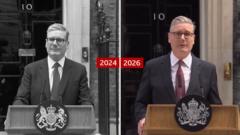
Keir Starmer just walked out of 10 Downing Street for the last time as Prime Minister. His sudden resignation on June 22, 2026, caught plenty of people off guard, but the cracks in his political armor had been widening for months. The man who marched into office with a historic landslide victory in 2024 ran out of road, crushed by internal party revolts and a public that grew tired of waiting for real change.
If you want to understand how his premiership unraveled so quickly, you have to look back at who he used to be. The media loves a simple narrative. They painted him as a boring, robotic manager who lacked vision. That is a massive oversimplification.
The real story of Starmer is a striking shift in identity. He went from a radical human rights lawyer who took on multinational corporations to a hyper-cautious politician who sacrificed his original ideals for the sake of winning power. In the end, that exact transformation became his undoing.
From Radical Defender to Downing Street Manager
Long before he ever wore a politician’s red tie, Starmer built a reputation as a fierce left-wing advocate. In the 1990s, he worked out of Doughty Street Chambers, a legal hub known for defending the vulnerable. He didn’t just handle standard criminal cases. He provided free legal defense for anti-McDonald’s activists during the famous "McLibel" trial. He worked alongside the National Union of Mineworkers against conservative pit closures. He even traveled to parts of Africa and the Caribbean to defend prisoners facing the death penalty.
He was a socialist. Friends from his youth remember him editing a radical magazine called Socialist Alternatives. He was a man driven by an anti-establishment streak. He wanted to dismantle unfair systems from the outside.
Then something changed.
In 2008, Starmer took a massive leap into the heart of the British establishment. He became the Director of Public Prosecutions, running the Crown Prosecution Service. Suddenly, the guy who used to sue the state was the one running its criminal prosecution apparatus.
He had to manage thousands of employees during a brutal period of austerity cuts. He handled high-profile cases like the prosecution of MPs over the expenses scandal and the conviction of Stephen Lawrence's killers. He accepted a knighthood in 2014. Sir Keir was born. The outsider had officially become an ultimate insider.
The Political Chameleon of Westminster
When Starmer entered Parliament in 2015 as the MP for Holborn and St Pancras, he was already 52 years old. He didn't have time to play the long game. When Jeremy Corbyn led Labour to a crushing defeat in 2019, Starmer saw his opening.
To win the Labour leadership in 2020, he ran on a platform of ten core pledges. These promises included nationalizing energy, water, and rail companies, scrapping university tuition fees, and raising taxes on the top 5% of earners. He essentially told the left wing of his party that he would keep Corbyn’s radical economic agenda but package it in a professional, electable suit.
It worked. He won the leadership. But almost immediately, those ten pledges started disappearing.
- He ditched the pledge to scrap tuition fees.
- He dropped the promise to nationalize water and energy.
- He watered down a massive £28 billion green investment plan.
Politics requires compromise, sure. But Starmer didn't just tweak his positions. He completely reversed them. He ruthlessly purged the left wing of his own party, even banning Corbyn from running as a Labour candidate.
He bet everything on a simple strategy. He wanted to look as safe, predictable, and non-threatening as possible to middle-England voters who were exhausted by years of Conservative chaos. He gambled that voters wouldn't mind the broken promises if he delivered stability.
The Illusion of the 2024 Landslide
The strategy look brilliant on paper in July 2024. Labour won a staggering majority in the general election, sweeping hundreds of seats across the country. Conservative dominance collapsed overnight.
But look closer at the numbers. That victory was incredibly fragile. Labour’s share of the total vote was actually quite low for a landslide victory. They won because the right-wing vote split between the Conservatives and Nigel Farage's Reform UK party. Voters didn’t suddenly fall in love with Starmer’s vision. They just wanted to kick the Tories out.
He inherited a country with crumbling public services, an NHS on its knees, and a stagnant economy. A cautious manager is great when a system just needs minor adjustments. It's a completely different story when the entire machine is broken.
What Left Him Exposed in 10 Downing Street
Once inside No 10, Starmer tried to govern like a chief executive. He focused heavily on incremental policy victories. He got some big things through, like the landmark employment rights bill that arrived in late 2025, giving millions of low-paid workers better sick pay and parental leave. His government bumped the national living wage up to £12.71 an hour. They pushed through the Renters' Rights Act to stop landlords from evicting people without a valid legal reason.
Those policy wins were genuine, but they lacked a cohesive narrative. He couldn't articulate a grand vision for where Britain was heading. He spent his first two years in power telling everyone how bad things were, setting incredibly low expectations.
He thought voters would appreciate his brutal honesty. Instead, it just made the national mood feel depressing. He became hyper-focused on avoiding mistakes. That caution made him look weak whenever a crisis flared up.
The international stage offered him a brief escape. He spent significant energy courting Donald Trump after the US election, trying to secure tariff exemptions for British steel and cars. He tried to rebuild broken bridges with the European Union, loudly advocating for a major post-Brexit reset. But back home, his authority was leaking away.
The Makerfield Turning Point
The real collapse began with Andy Burnham. The high-profile Mayor of Greater Manchester decided he was done sitting on the political sidelines. He staged a return to Westminster by running in the Makerfield by-election.
Burnham ran a smart campaign. He positioned himself as the voice of ordinary working people outside the London bubble, directly beating back a major challenge from Reform UK. The second Burnham secured his seat in Parliament, Starmer's days were numbered.
Labour MPs who were terrified of losing their seats at the next election suddenly saw an alternative leader. Burnham offered an optimistic, emotional vision that Starmer simply couldn't replicate. The momentum shifted instantly.
Cabinet ministers began whispering to the press. High-profile figures like Transport Secretary Heidi Alexander openly suggested that Starmer needed to set a date for his departure to avoid total chaos. By mid-June 2026, over 200 Labour MPs had signaled they wanted a change. Starmer lost the room. He realized he could no longer command his own party, leading to his resignation speech outside Downing Street.
The Practical Lessons for Modern Leadership
Starmer's rise and fall offers a fascinating case study in how modern politics works. If you are analyzing political strategy or running an organization, his career provides crucial takeaways.
Authenticity Trumps Strategy Every Time
You can't pretend to be one thing to win a promotion and then completely flip your identity later. Voters, like employees or consumers, have a high sensitivity to authenticity. When Starmer abandoned his ten leadership pledges, he permanently damaged his credibility. People didn’t know what he actually stood for.
Ruthless Efficiency Has a Ceiling
Starmer was an exceptional prosecutor and an organized party manager. He successfully rebuilt a shattered Labour Party in four years. But management is not the same as leadership. Running an organization requires a clear, inspiring goal. If you only talk about fixing processes, people will lose interest.
Don't Mistake an Opponent's Failure for Your Success
Labour's 2024 victory was built on the collapse of the Conservative Party, not a groundswell of enthusiasm for Starmerism. He misread his mandate. He thought he had a license to govern with quiet caution, failing to realize the public wanted bold, decisive action.
What Happens Next
Britain is now searching for its seventh Prime Minister in a single decade. The Labour Party will plunge into a leadership contest, with Andy Burnham as the clear frontrunner to take over the keys to Downing Street.
If you want to track how this transition impacts the broader political climate, keep an eye on three specific indicators over the coming weeks.
- The Legislative Agenda: Watch whether key policies like the EU-UK reset bill get paused or pushed through by the interim cabinet.
- Polling Movements: Track whether Reform UK capitalizes on Labour’s internal civil war or if the public rallies behind a more communicative leader.
- Market Reactions: Monitor how sterling and government bonds react to the sudden vacancy in the Treasury, especially with a summer summit on the horizon.
The era of Keir Starmer is officially over. He proved that a disciplined, hyper-focused manager can successfully climb to the very top of the political mountain. But his sudden fall proves that you cannot stay there without a clear, authentic vision to keep you grounded.