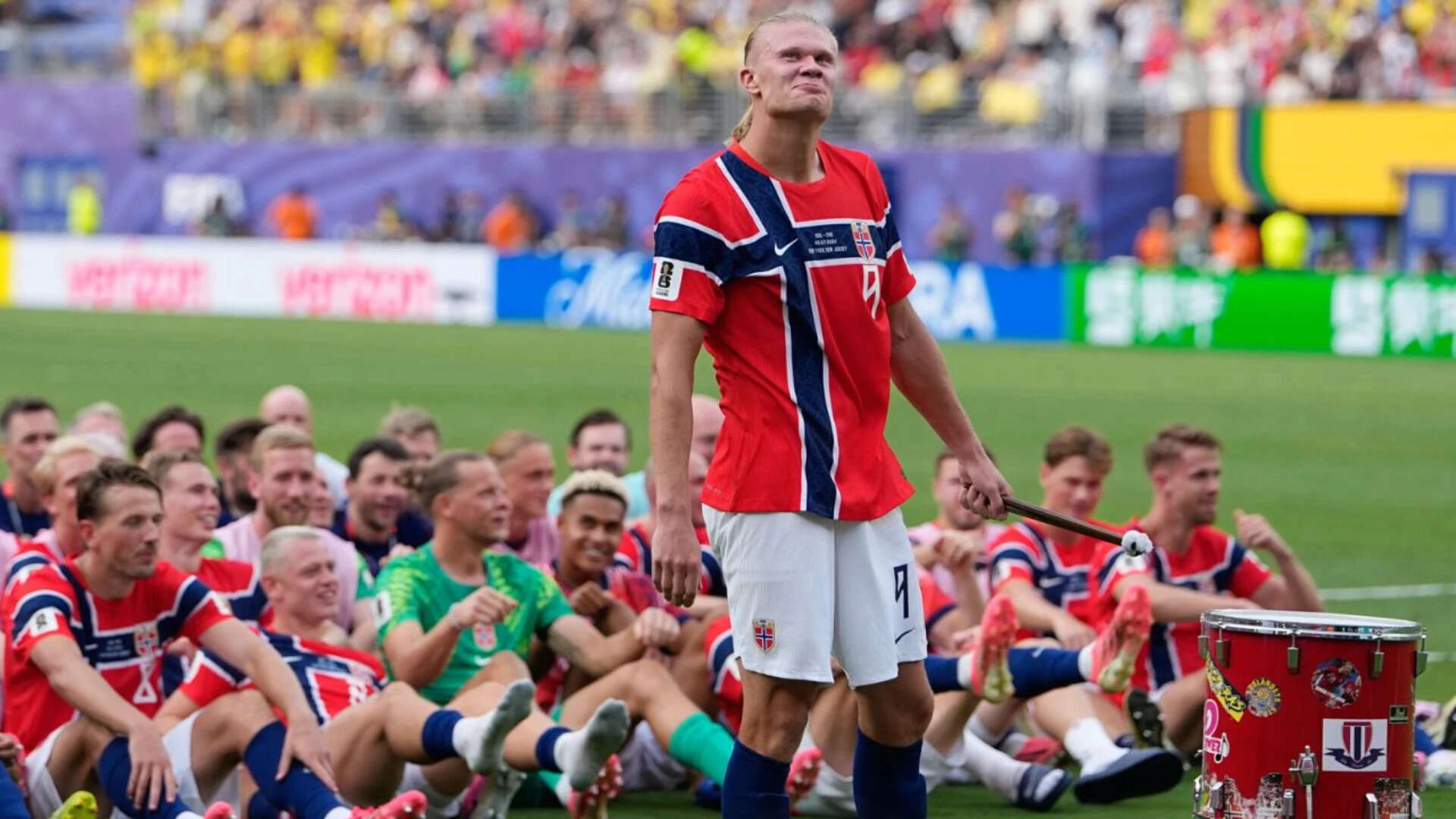
Erling Haaland looks like he stepped straight out of an 8th-century saga. Standing 6-foot-4 with a towering frame and explosive speed, the Manchester City goal machine has earned every Viking comparison thrown his way. When he celebrates big wins by leading his teammates in the famous row-boat chant, it feels like history coming alive.
Here is what most football fans completely miss. The surname on his back isn't just a Norwegian marker. It's fundamentally, structurally English.
If you trace the etymology of the name Haaland back a thousand years, you don't find two alien cultures colliding. You find one shared Germanic tongue split across the North Sea. The name Haaland doesn't just sound like the English phrase "high land"—it is literally the exact same word.
Why the name Haaland is practically English
Names tell stories about terrain. When medieval Scandinavians needed to identify a family, they named them after the dirt beneath their boots.
The surname Haaland originated as a habitational farm name in western Norway, primarily in the rugged coastal districts of Rogaland and Agder. In Old Norse, the original form was Hávaland. Break that compound word down, and the pieces become clear immediately. The prefix hár meant high or elevated. The suffix land meant farmstead or territory. Put them together, and you get "farm on the high ground."
Now look at Old English from the exact same era. Anglo-Saxon settlers used heah for high and land for ground. Because Old Norse and Old English were sister languages within the Germanic family, they operated with nearly identical vocabularies.
Professor Richard Dance, an authority on Old Norse and medieval language at the University of Cambridge, points out that a Viking raider landing on the Yorkshire coast in the 9th century and an Anglo-Saxon farmer living there could genuinely understand each other. They didn't need interpreters. They spoke dialects of the same mother tongue.
When an Anglo-Saxon looked at an elevated meadow, he called it high land. When a Norseman looked at the same hill, he called it hávaland. The surname sitting on the back of Manchester City's primary goal scorer isn't a foreign exoticism—it is an ancient relative of standard English geography.
How the Vikings permanently changed the English language
To understand why Haaland's name feels so at home in British stadiums, you have to look at the Danelaw.
Starting in the late 8th century, Scandinavian seafarers did more than raid monasteries like Lindisfarne. They moved in. Thousands of Norse families settled across northern and eastern England, establishing an area governed by Scandinavian customs known as the Danelaw.
York became Jórvík. Farmers cleared fields, established trade routes, and married into local families. In doing so, they left an indelible mark on the daily vocabulary of Northern England.
Think about common northern English words still spoken every day in Yorkshire and Lancashire:
- Beck (a small stream) comes directly from the Old Norse bekkr.
- Fell (a mountain or hill) comes from fjall.
- Tarn (a mountain lake) traces to tjörn.
- Lass and tyke both have direct Scandinavian ancestry.
- Place name endings like -by (Whitby, Grimsby) come from the Old Norse word for village or farmstead.
The English language didn't just borrow a few fancy terms for food or politics from the Vikings. It adopted core functional words. Pronouns like "they," "them," and "their" were imported straight from Old Norse settlers, replacing the older Anglo-Saxon equivalents that caused confusion.
When Erling Haaland runs onto the pitch at Elland Road or the Etihad Stadium, he is walking through a linguistic environment that his direct ancestors helped build.
You're probably pronouncing his name wrong anyway
Turn on any English-language broadcast, and you'll hear commentators call him "HAH-land."
That isn't how his family says it.
In standardized Norwegian, the family name was originally written as Håland. The letter å represents a long, rounded vowel sound, identical to the "aw" in the English word "raw" or "law." The correct Scandinavian pronunciation is actually "Haw-land."
Why did the spelling change?
Historically, Scandinavian written language didn't have the letter å. Medieval scribes and early printers used a double aa to represent that deep, rounded vowel sound. Sweden officially adopted the letter å in the 16th century, but Norway and Denmark kept the double aa in formal records well into the 20th century. Norway only officially made the switch in 1948.
Many Norwegian families chose to retain the traditional aa spelling in their surnames for historical continuity. When Erling's father, Alf-Inge Haaland, made the move to English football in the 1990s, the double aa served a dual purpose. It preserved the ancestral spelling while avoiding the technical nightmare of international passports, sports databases, and press registries trying to render the letter å.
So while the shirt reads Haaland, the sound is pure Old Norse "Haw-land"—a vocal twin to the English phrase "high land."
Born in Leeds but loyal to the flag of Norway
The connection between Erling Haaland and England isn't purely linguistic. It's personal.
Erling Braut Haaland was born in Leeds, West Yorkshire, on July 21, 2000. At the time, his father Alfie was wearing the white shirt of Leeds United in the Premier League.
Because he was born on English soil, Erling was legally eligible to represent the England national team. Had his life taken a slightly different turn, he could have been pairing up with Harry Kane in the England frontline.
Instead, the family returned to Norway when Erling was three years old, settling in the small agricultural town of Bryne. He grew up through the Norwegian academy system, playing alongside childhood friends and developing the fierce national pride that defines his international career.
When he steps onto the pitch for Norway, he pays tribute to both sides of his athletic heritage. On his national team jersey, he wears the name Braut Haaland.
While Haaland comes from his father's side, Braut belongs to his mother, Gry Marita Braut, who was an elite national heptathlon champion in Norway. The word Braut itself is another ancient Old Norse farm name, referring to a road, path, or cleared track through a forest.
On the international stage, he wears both names as a point of pride. At the club level with Manchester City, he keeps it streamlined with just Haaland.
The shared heritage hiding in modern football
It's easy to view modern football through the lens of modern borders. We talk about Norwegian powerhouse strikers, English tactics, and Spanish possession styles as if these cultures developed in isolated silos.
Linguistics tells a very different story.
When we watch a player like Haaland dominate the English game, we're witnessing a quiet historical loop. A thousand years ago, Northmen sailed west to establish settlements along the English coast, giving rise to names like High-land, Howland, and Håland. Today, their descendants return to the same northern cities, carrying those exact same names back to the turf.
The next time you hear a stadium chant Erling Haaland's name, don't think of it as a foreign tongue. You're just listening to Old English with a Scandinavian accent.
Practical key takeaways for linguistic and football history fans
- Know the meaning: Haaland originates from the Old Norse Hávaland, combining hár (high) and land (ground/farm).
- Say it right: The correct Norwegian pronunciation is "Haw-land," not "Hah-land."
- Spot the connection: English place names like Howland, Highland, and Holland share the exact same Proto-Germanic roots.
- Understand the shirt: His national team jersey reads Braut Haaland to honor his mother Gry Marita Braut, an elite track athlete.
Check out this explainer on Erling Haaland's full surname for a deeper look into the history behind his mother's maiden name Braut and Norwegian naming customs. This video breaks down the exact origins of his full family name and why he honors both parents on his national jersey.