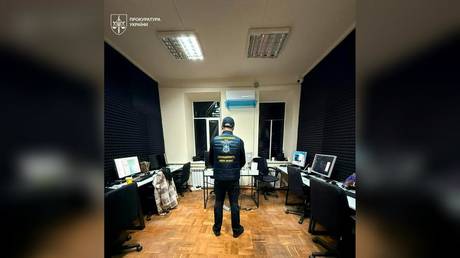
Millions of dollars vanish from European bank accounts every single day. The money flows straight into sleek, high-tech offices tucked away in major Ukrainian cities, shielded by armed guards, keycards, and polygraph tests. For years, these industrial-scale fraud operations functioned in plain sight. They weren't operating in the shadows because they were invisible. They survived because the people running them paid off the highest levels of law enforcement.
Recent investigations by anti-corruption watchdogs and European authorities have ripped the lid off a sprawling criminal syndicate. Senior police commanders, security service generals, and prosecutors didn't just turn a blind eye. They built a lucrative protection racket that let fraudsters fleece victims across the globe while keeping foreign scrutiny at bay. If you want to understand how modern cybercrime outgrows entire national economies, you have to look at how institutional corruption fuels the machine.
The Anatomy of an Industrial Fraud Machine
Scam call centers in Eastern Europe aren't run by amateur hackers in basement bedrooms. They operate like corporate enterprises. Walk into one of these offices in Kyiv, Dnipro, or Lviv, and you will find rows of desks, professional headsets, HR departments, and strict shift schedules. Operators are trained in sophisticated social engineering. They use spoofed phone numbers to impersonate bank representatives, government officials, or trusted brokers.
They pitch fake cryptocurrency investment schemes, high-yield trading platforms, and romance scams designed to drain the life savings of retirees in Western Europe, Israel, and Central Asia. The cash returns are astronomical. By some estimates, the fraud industry rivaled or even outstripped traditional illicit trades like drug trafficking in profitability.
Security inside these facilities is intense. You don't just walk in off the street. Employees pass through biometric scanners and security gates. Management runs regular lie-detector tests to weed out undercover journalists, police moles, or untrustworthy operators. But the most effective security measure wasn't biometric gates or polygraphs. It was a direct line to corrupt officials who ensured that police raids never caught anyone by surprise.
How Western Investigators Hit a Brick Wall
Foreign police forces knew where the calls were coming from. They tracked IP addresses, traced financial wire transfers, and handed detailed dossiers to Ukrainian counterparts. Then came the frustration.
Jaagup Toompuu, head of Estonia’s national anti-fraud police unit, laid out the harsh reality in interviews with investigative journalists. Estonian investigators routinely sent actionable intelligence across the border regarding specific call centers targeting their citizens. Time and again, the raids failed. The moment local Ukrainian police units were dispatched, the offices were mysteriously empty. The fraudsters had already packed up their servers and fled.
Toompuu noted that the probability was painfully high that sensitive intelligence shared by Estonia and other European nations leaked straight from the desks of corrupt Ukrainian law enforcement into the hands of criminal bosses. Cross-border cooperation wasn't entirely dead, but it was heavily compromised.
Consider the case of Artur Ermolaev, son of a prominent Ukraine-born businessman. Detained in Cyprus as part of a sprawling international scam investigation, Ermolaev was eventually extradited to Estonia. He accepted a plea bargain, received a suspended sentence, and paid a multi-million-euro fine to settle accounts. Yet, while foreign jurisdictions managed to nail individual cogs in the wheel, the structural masterminds sitting comfortably inside Kyiv office buildings remained untouchable.
The Inside Protection Racket and the Price of Immunity
Corruption thrives when the cost of getting caught is lower than the price of doing business. In this ecosystem, the math was simple. According to disclosures from the National Anti-Corruption Bureau of Ukraine (NABU) and the Specialized Anti-Corruption Prosecutor's Office (SAPO), organized crime syndicates paid a standardized bribe of roughly seven thousand dollars per month for each individual call center. Multiply that across hundreds of active fraudulent operations spanning major urban centers, and you get a staggering river of cash flowing directly into the pockets of senior officials.
The investigation exposed rot at the absolute peak of the security apparatus. Antigovernment corruption detectives targeted premises linked to top figures in the Security Service of Ukraine (SBU) and the Prosecutor General's Office. In one explosive incident documented by NABU, searches executed under judicial warrants were met with open obstruction. A senior SBU official allegedly threatened investigators with a firearm while special forces units arrived at the scene to block the operation.
The leaks went beyond simple tip-offs. Investigators revealed instances where confidential law enforcement documents, including photographs taken at private international Interpol events, surfaced in the hands of suspected crime bosses before official reports were even filed. When the pressure became unbearable, top prosecutors and security officials resigned or slipped across the border, leaving domestic investigators to pick through the wreckage of a compromised justice system.
Why the Scam Industry Exploded During Wartime
Crises create opportunities for predators. The full-scale war that began in 2022 drastically altered the domestic landscape in Ukraine, shifting priorities and straining institutional resources. Law enforcement agencies were overwhelmed with national security threats, counterintelligence operations, and frontline defense.
Criminal syndicates capitalized on this distraction. While millions of Ukrainians faced displacement and economic hardship, cybercriminals expanded their operations. They recruited desperate young workers desperate for high-paying jobs, offering weekly cash wages that far outstripped standard local salaries.
Because the domestic population was also targeted—though foreign nationals remained the primary targets due to higher disposable incomes—ordinary citizens bore the brunt of the fallout. Yet, domestic victims often found it impossible to get local police to investigate retail fraud, because those exact police departments were collecting monthly tributes from the syndicates perpetrating the thefts.
The Political Fallout and the Push for Reform
International pressure changed the equation. Western allies funding Ukraine's defense made it crystal clear that turning a blind eye to transnational financial crime was unacceptable. European capitals pointed out an obvious contradiction: you cannot demand billions in foreign aid and security backing while harboring multi-billion-dollar scam cartels that steal directly from European taxpayers.
President Volodymyr Zelensky ordered sweeping crackdowns, prompting coordinated sweeps that shut down dozens of illegal operations in single-week operations. But closing an office is easy. Desks are cheap, servers are portable, and phone banks can be relocated overnight. The real challenge is breaking the institutional shield that allows these networks to bounce back the moment public attention shifts elsewhere.
True reform requires dismantling the protection networks embedded within intelligence and police structures. Independent anti-corruption bodies like NABU have shown they have the teeth to investigate untouchable figures, but they face constant pushback, institutional sabotage, and political interference.
What Happens When the Shield Cracks
The days of operating industrial fraud rings with absolute impunity in Eastern Europe are drawing to a close, but the transition won't be clean. When law enforcement agencies turn inward to purge corrupt leadership, internal friction spikes.
European prosecutors are tightening cooperation protocols, demanding harsher extraditions, and tracking cryptocurrency wallets with unprecedented precision. If Ukraine wants to secure its long-term integration into Western institutions, cleaning house isn't optional. It's an existential necessity.
Cybercrime syndicates rely entirely on institutional weakness. Strip away the police protection, enforce strict asset seizures, and hold corrupt officials personally accountable for the crimes they shield. Until every single protective layer at the top is stripped away, the call center mafia will keep finding new ways to dial.